Some races are simply held in a place; others seem to arrive exactly where they were always meant to be.
The 9th A.N.A. National Mountain Bike Championship, scheduled for Saturday 5 and Sunday 6 September 2026 in Cesiomaggiore, probably belongs to the second category.
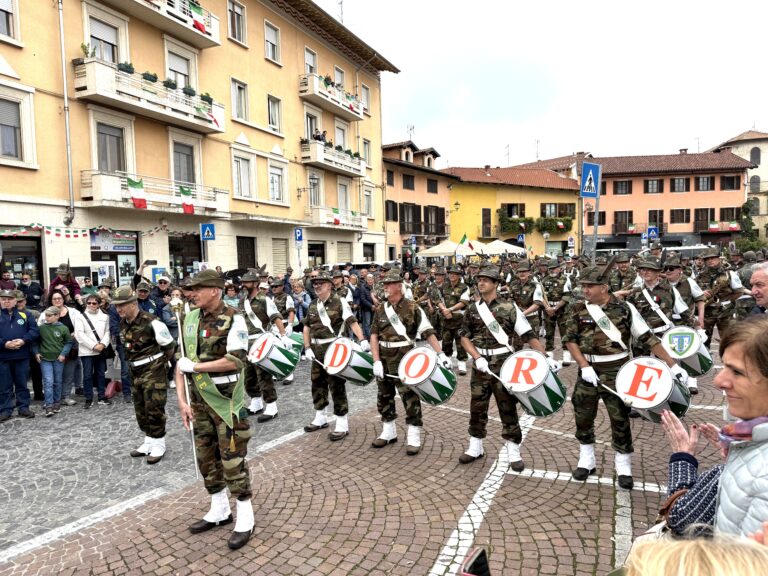
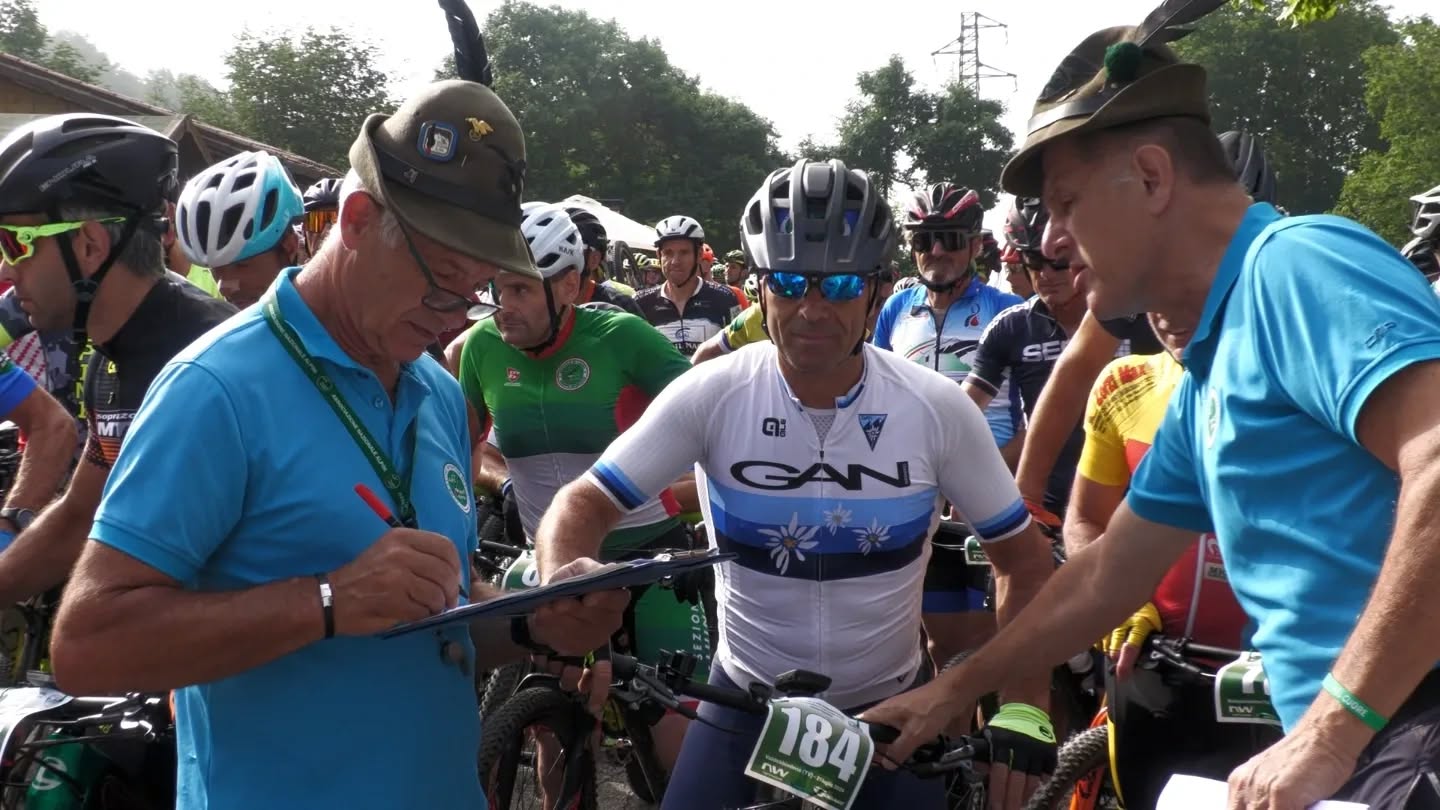
For two days the A.N.A. Feltre Section, the local Alpini Groups and the whole community will welcome hundreds of Alpini from across Italy, united by the same passion for mountain biking, for the mountains and for that spirit of friendship which has always turned Alpini sport into something that goes far beyond a results table.
And they will do so in Cesiomaggiore, a village where the bicycle is not merely a sport: it has become history, culture and collective memory.
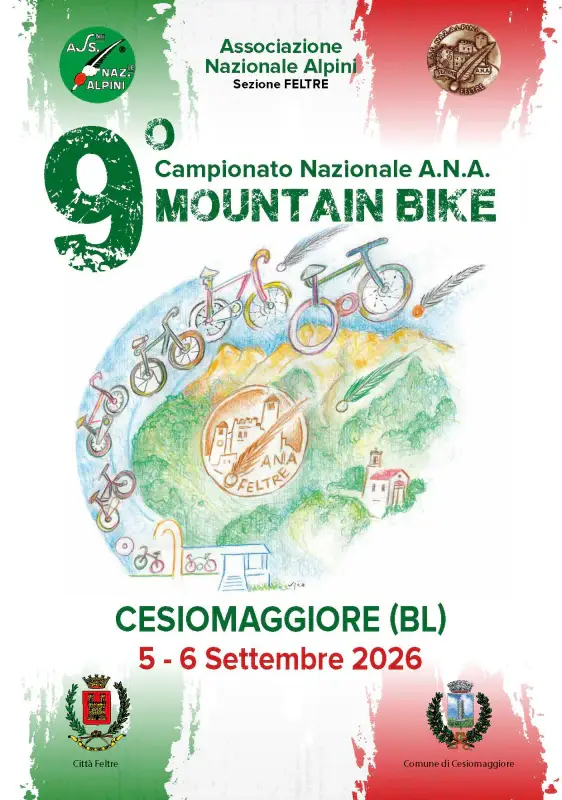
The official poster of the 9th A.N.A. National Mountain Bike Championship, held in Cesiomaggiore on 5 and 6 September 2026. Source: A.N.A. Feltre Section.
Cesiomaggiore, capital of Alpini mountain biking
The event is organised by the A.N.A. Feltre Section, together with the Alpini Groups of Cesiomaggiore and Pez, and will bring Alpini athletes and their companions from the Sections of the Associazione Nazionale Alpini across Italy to the foot of the Belluno Dolomites.
These will be two days in which competition and association life come together: trails, climbs, descents and hard effort, but also ceremonies, friendship, music, conviviality and that distinctly Alpini way of being together which values the opponent even before the result. In the Feltre area, this organisational effort sits alongside other important moments in the life of the Section, such as the A.N.A. 2026 Training Camps.
The heart of the event will be the Pradenich area, set in the greenery of the Cesiomaggiore and Feltre countryside.
The celebrations begin at the Bicycle Museum
One detail of the programme says more than many speeches about the bond between the event and Cesiomaggiore: the 4 p.m. muster is set to take place at the Historical Bicycle Museum.
At 16.30 the parade will set off through Via Roma, Piazza A. Ferrari and Piazza Mercato.
At 17.00 there will be the honours to the Fallen, speeches and the lighting of the tripod brazier, while at 18.00 Holy Mass will be celebrated.
At 19.00 the Alpini “rancio” (communal mess meal) at Pradenich and, from 21.00, a performance by the Fanfara Note Alpine band, conducted by maestro Sabrina Casagrande.
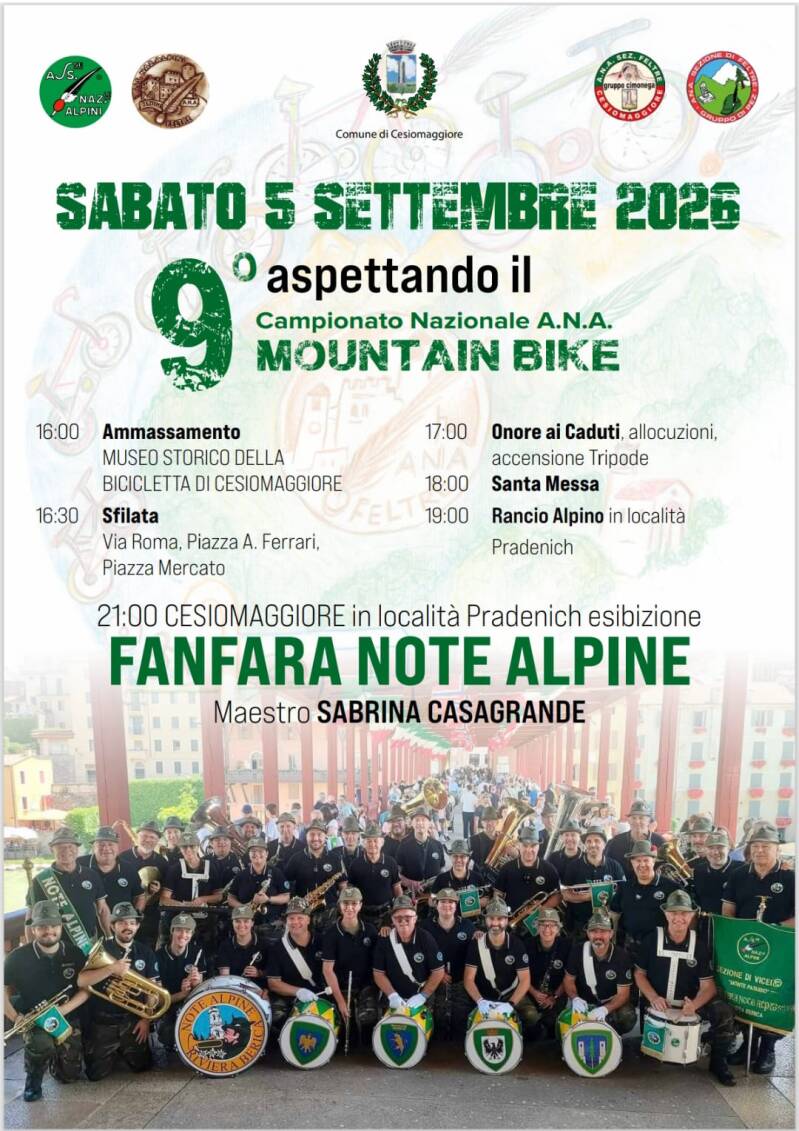
Official programme for Saturday 5 September 2026. Source: A.N.A. Feltre Section.
It is memory, landscape and a passion handed down.
Sergio Sanvido, the man who turned a passion into a heritage
To speak of cycling in Cesiomaggiore inevitably means remembering Sergio Sanvido (1928–2015).
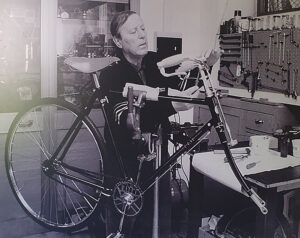
Craftsman, mechanic, restorer and collector, he devoted his entire life to the bicycle, gathering machines, components, photographs, jerseys, documents and memorabilia linked to the history of cycling.
In 1997 he opened the Historical Bicycle Museum, dedicated to the great Toni Bevilacqua. In 2007 he donated a large part of his collection to the Municipality of Cesiomaggiore, so that his personal passion might become the community’s heritage.
It is therefore no coincidence that the ceremonies of the A.N.A. National Championship begin right in front of the Museum: it is almost a passing of the baton between the memory of the bicycle and those who still live it today.
Silvio Rui and the hoteliers’ world championship that started in Cesio
The area’s cycling memory also holds a lesser-known story.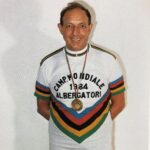
On 14 October 1984 Cesiomaggiore provided the setting for the amateur cycling world championship for hoteliers, starting and finishing in the village: the title went to Silvio Rui (24/08/1930 – 17/02/1999), a long-established hotelier from the Zumelle area and a keen amateur cyclist, who for years ran the “Al Moro” hotel and restaurant in Mel (BL).
It has not been possible to find independent official documentation of that specific episode, but Silvio’s sporting calibre is well known: in the 1980s and 1990s he was a multi-titled amateur cyclist, with wins at Triveneto, Italian and European level, as well as the Hoteliers’ Hour Record in 1988 and an amateur world record over 100 km in 1991.
Between the stoves of his hotel and his bicycle, he embodied for decades another way of living sport in Cesiomaggiore, authentic and passionate: today, more than forty years later, the village is once again hosting a national cycling championship.
From Tullio Campagnolo’s Croce d’Aune to Cesiomaggiore
Widen the view by just a few kilometres and you reach another place of fundamental importance in the history of the bicycle: the Croce d’Aune Pass.
It is on that very climb that tradition places the episode from which Tullio Campagnolo drew the insight that would lead to the development of the quick-release wheel and, later, to one of the most extraordinary industrial stories in Italian cycling.
It is a story we have told in depth on DolomitiBelluno.it, and one that helps show how deeply the roads of the Feltre area are intertwined with the history of cycling.
A race, but above all a gathering of Alpini
In the A.N.A. National Championships the competition matters. There is training, technique, hard effort and the will to win.
But anyone who knows the Associazione Nazionale Alpini knows that the meaning of these events does not end under the finishing banner.
Sport carries values that the Alpini recognise at once: commitment, discipline, respect, friendship, solidarity, the ability to endure hardship and a love of the mountains.
That is why, on 5 and 6 September, Cesiomaggiore will not simply be hosting a mountain bike race. It will be welcoming a piece of Alpini Italy, in the same village which, in a very different field, was the birthplace of another figure dear to Alpini and civic memory: Guido Rossa.
A sign that in Cesiomaggiore, after all, the spirit of those who stand up and take responsibility for a community has never been an isolated case.
Information on the 9th A.N.A. National Mountain Bike Championship: A.N.A. Feltre Section.
Historical background: “Toni Bevilacqua” Historical Bicycle Museum in Cesiomaggiore, Municipality of Cesiomaggiore and local historical sources.