In Godega Sant’Urbano, an exhibition on the Great War, with a concert and a parade, as part of the Antica Fiera, in the run-up to the Piave National Alpini Rally (Adunata).
Music with a choir and brass bands, a documentary exhibition devoted to the Great War and a significant Alpini gathering with a parade and the traditional field-kitchen meal. This is what will be happening at the weekend in Godega Sant’Urbano.
As part of the 90th National Alpini Rally, the Piave-Treviso 2017 Adunata, numerous events are planned under the patronage of the COA, the Adunata Organising Committee, and their staging is in the hands of the four ANA sections: Treviso, Conegliano, Valdobbiadene and Vittorio Veneto.
The first of the three events organised by the Conegliano ANA Section will take place in Godega itself, as part of the Antica Fiera, which every year attracts a great many visitors, and not only from the Veneto and Friuli.
Here is the detailed programme of events:
Friday 3 March, 8.30 pm
in the sports hall, concert by the ANA Giulio Bedeschi Choir and the Alpini brass band of the Conegliano ANA Section
Saturday 4 March, Alpini Gathering
9.30 am assembly in the car park of the Hotel Ristorante Primavera
10.00 am start of the parade
10.15 am flag-raising and honours to the Fallen in the Parco della Rimembranza
10.45 am opening of the exhibition in the Palaingresso of the Fair, with ribbon-cutting and official speeches
12.30 pm Alpini field-kitchen meal
On Saturday 4 March, on the occasion of the event, admission to the Antica Fiera is free.
The exhibition open to school groups
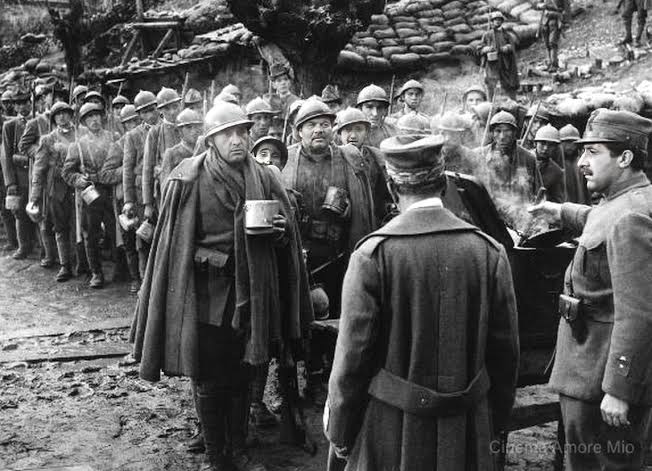
The exhibition is the result of a joint effort involving the Municipality of Godega, the COA, the Conegliano ANA Section, the Bibano-Godega Alpini Group, the Alpini Museum of Conegliano and the Centro studi Cerletti. The exhibition closes on 6 March, but will remain open to school groups for a further week and may go on tour; it contains around 700 photographs and a wealth of period material.
The aim is to illustrate the enormous damage caused to our towns and villages by the war, above all after the rout of Caporetto in the autumn of 1917, the hardships suffered by the refugees, and what the memory of the Year of Hunger meant for the people of the Sinistra Piave, subjected to a very harsh occupation.

A significant section is devoted to the Godega area. Although the municipality was not on the front line, it was an important logistical and strategic hub: there were no fewer than four Austro-German airfields here, with their headquarters at Villa Pera in Pianzano; the best enemy pilots, such as Brumowski, Fiala and Linke, were stationed here.
And it was from the Godega base that the Austrian Phönix crewed by Barwig and Kauer took off which, according to records kept in the Kriegsarchiv in Vienna, shot down Baracca’s Spad over the Montello on 19 June 1918, during the Battle of the Solstice.
It was again at Pianzano station, in those moments that were decisive for the outcome of the conflict, that Emperor Charles I arrived on 20 June and, in the armoured carriage of the royal train, held a dramatic council of war with Gen. Wenzel Wurm, commander of the Army of the Piave (Austrian war archives).
Having established that the Austrian offensive, the last and a desperate one, had broken against the stubborn defence of our soldiers, Charles I ordered the withdrawal of the bridgeheads pinned down across the Piave, effectively decreeing the end of the Battle of the Solstice, the prologue to Vittorio Veneto, to the break-up of the Empire of the Two Crowns and to the completion of national unity. “In short,” the Alpini explain, “the exhibition aims to be a starting point for deeper study, an incentive to reflect, a warning not to forget, before the roots of memory are dried up by the relentless passing of time.”
Press office:
Laura Simeoni
339/2213115
ufficiostampa@treviso2017.it
www.treviso2017.it
To find out more, a related article: The bridges over the Piave.