The 7th Alpini Regiment from the western front to 8 September 1943
There is a photograph that many elderly people in the Belluno area still remember: long lines of young men with feathers in their hats leaving the Salsa barracks, marching through the centre of Belluno between rows of silent onlookers, and boarding trains bound for a distant, unknown, hostile front. They were the boys of the 7th Alpini Regiment – the city’s regiment, with the «Belluno», «Feltre» and «Pieve di Cadore» battalions – called to fight a war that Italy had declared on 10 June 1940 with the same improvisation with which you change a coat. A war that would take them from France to Greece, from Montenegro to Provence, and that for many would end not on a battlefield but in a German prison camp, after the betrayal of 8 September 1943.
Retracing that story means honouring not only the fallen, but also those who survived carrying inside them the weight of years that no post-war period ever truly healed.
The structure of the regiment on the eve of war
The 7th Alpini Regiment had been formed in Conegliano Veneto on 1 August 1887 and had grown with the territory that fed it. In 1910, when its definitive structure took shape, the three founding battalions were already those destined to become legendary: the «Feltre», the «Pieve di Cadore» and the «Belluno», the latter formed with the 77th and 78th companies in the provincial capital. They were mountain men – woodcutters, miners, seasonal masons, shepherds – hardened by an environment that taught endurance even before the Royal Army demanded it.
On the eve of the Second World War the regiment belonged to the «Pusteria» Alpine Division, together with the 5th Mountain Artillery Regiment with the «Belluno» and «Lanzo» groups. A well-tested structure, with a memory of blood dating back to the Great War that still spoke in families, in taverns and in mountain cemeteries, where wooden crosses slowly rotted beside marble ones.
The western front: the short war that was not glorious
On 10 June 1940, when Mussolini appeared on the balcony of Palazzo Venezia, the 7th Alpini was among the units mobilised for the attack on France, already collapsing under the blows of the Wehrmacht. The «Belluno» battalion went into action on 23 June 1940 from the Goretta Pass, reaching within the day the Cabane Donadieu and Lake Lauzanier in the northern sector. The armistice with France came a few days later, before the fighting could take on significant proportions. There was no glory to tell. There was only the awareness, which many officers already had, of a badly equipped and even more badly led army, thrown into an adventure that history was already settling elsewhere.
In the following months the battalions remained stationed between the Col de Larche (Colle della Maddalena), Cuneo and the Puster Valley. They were waiting. And waiting, for an Alpino, is never really rest.
|
🔍 Find out more The «filthy war»: five days in the Alps against France For younger readers, even Zidane’s famous headbutt on Materazzi in 2006 is by now a distant «clash between Italy and France». Imagine the war in the Alps, fought in the summer of 1940.
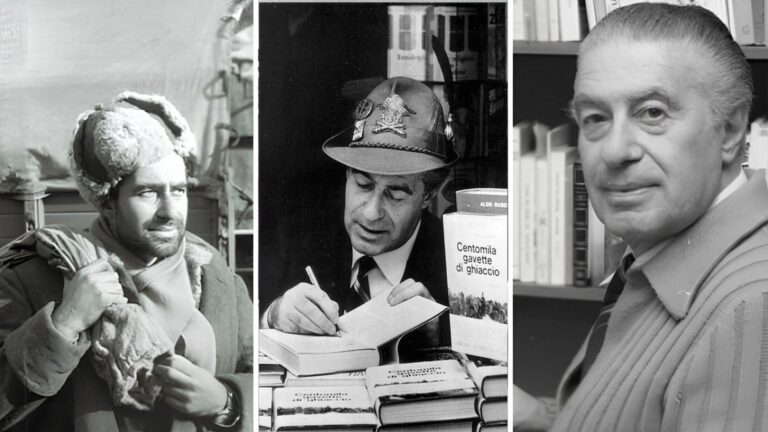
1940 – Mussolini and Umberto of Savoy review the Alpini And yet it is worth remembering what happened during those five inglorious days in June in the mountains between Mont Blanc and the Ligurian Sea. Books like Il sergente nella neve (The Sergeant in the Snow) by Mario Rigoni Stern have made generations of Italians aware of the catastrophe of the Russian campaign. The same goes for the war in Albania and Greece. But the campaign against France – which began on 21 June and ended on 25 June 1940 – has remained in the shadows. And yet it was no joke. Mussolini had declared it on 10 June from Piazza Venezia, deploying 315,000 men along the Alpine frontier. On reading the official note, the French ambassador spoke of a «stab in the back». By then the French army had already been overwhelmed by the Wehrmacht, and yet Italian attacks were stopped almost everywhere – from the Col de la Seigne to Montgenèvre, from the passes above Cuneo to the Ubaye. It took two days to take Menton, four kilometres from the border. The parade the Duce dreamed of in Nice never happened. The price of that «glory» was 631 dead, 616 missing and 2,631 frostbitten or wounded. Seven years later, De Gaulle presented the bill: the Roya valley, the Valle Stretta and a few kilometres of border at the Little St Bernard, Mont Cenis and Montgenèvre. Every summer thousands of hikers visit the forts and trenches of the Pasubio and the Dolomites. Few, however, look for the trenches of the Col de la Seigne or climb to the Chaberton – the «invincible» Italian fort destroyed in a few hours by French artillery. That is a mistake. Those stones speak too. «The war against France was a filthy war», wrote Mario Rigoni Stern, who had fought it with the Alpini. You discover it at the Col de la Seigne too, where the small barracks and bunkers stand against the wonder of Mont Blanc. ⚙ Editorial feature — sources: Mario Rigoni Stern, Il sergente nella neve; Italian military history, 1940. |

Albania and Greece: defeat and sacrifice

At the end of November 1940 the 7th Alpini Regiment was shipped to Albania as part of the «Pusteria», which was going to reinforce a Greek-Albanian front already in deep crisis. The division, still incomplete and without its pack trains, was thrown into the line almost immediately, on Mount Chiarista and Mount Timori. The situation was desperate: on 9 December 1940, with only 2,500 men, the «Pusteria» was holding 25 kilometres of front.
The Belluno battalions found themselves on different lines of advance: the «Feltre» and the «Pieve di Cadore» followed the regimental command in the Osum valley, while the «Belluno» operated under the 1st «Valle» Group in the Zagoria valley, where it remained until March 1941, taking part in numerous holding operations.
It was in those December days, amid frozen mud and wind-swept Albanian mountains, that the 7th Regiment lost its commander. Colonel Rodolfo Psaro, born in La Spezia in 1892 and appointed commander of the regiment only on 21 September, fell in action on 8 December 1940 at Qafa e Gallinës (Ciafa Gallina), while personally coordinating his battalions under enemy fire. The citation for his posthumous Gold Medal reads: «With his Feltre and Cadore battalions he valiantly and victoriously withstood the onslaught of overwhelming enemy forces». Streets in Belluno, Feltre and Brescia have been named after him. His death, like that of so many others, was the price of a war that was badly begun and even worse conducted.
At the end of the Greek campaign – concluded with the armistice on 23 April 1941 – each of the four battalions of the 7th received a Silver Medal for Military Valour for their conduct in those mountains, inherited from the Greeks and made even more hostile by frost and lack of supplies.
Montenegro: the guerrilla war that wore them down
In June 1941 the regiment was transferred to Montenegro, where the Yugoslav partisan guerrilla war made every day an unknown. It was not the head-on war of regular fronts: it was ambushes on mule tracks, burned villages, columns attacked at unavoidable passes. A ruthless war, unlike anything the Alpini had been trained for.
The «Belluno» battalion paid the highest price in an episode that has remained in the unit’s memory. A company travelling from Prijepolje to Pljevlja was attacked by more than four hundred partisans positioned on heights overlooking the Rikavac pass. The fighting lasted six hours and ended with the almost total annihilation of the company: forty-eight dead, including twelve wounded men killed after capture, and fifty-two prisoners, almost all brutally killed in the following days. Only the doctor and seven other Alpini, who managed to escape, survived. It was the poisoned fruit of a colonial strategy that had bred hatred, and of using Alpine troops – born for their home mountains – in distant and hostile theatres that consumed them to no purpose.
They were repatriated in August 1942. Two months later the regiment left again for France, stationed in Provence on garrison duties. It almost seemed like a truce.
8 September 1943: betrayal and the end
On 3 September 1943, with the signing of the Cassibile armistice – made public only on 8 September – the Royal Army suddenly found itself without orders, without a course of action, without a chain of command able to withstand the shock of those events. The 7th Alpini Regiment, then in Provence, had already begun an orderly withdrawal home when the Germans went into action.
At Cuneo the regiment was surrounded. Most of the men – thousands of Alpini from Belluno, Feltre and Cadore – were captured and deported to Germany, sent to internment camps as Italian Military Internees (IMI). Without prisoner-of-war status, without international protection, they were forced to choose between collaborating with the Nazis or enduring hunger and forced labour. Many chose not to collaborate. Many did not come back.
The regiment was disbanded on 12 September 1943. Some of its men joined the Resistance, others the Italian Social Republic; many were simply swept away by history, consumed by a war that had lost all meaning and direction. It was not until 1 July 1953 that the 7th Alpini Regiment was re-formed in Belluno, its own city, within the newly created «Cadore» Alpine Brigade.
A memory that does not close
The story of the Belluno battalions in the Second World War is not a story of heroes in the rhetorical sense of the word. It is the story of ordinary men – farmers with a feather in their hats – dragged into wars they had not chosen, on fronts they did not know, fighting for reasons they often did not understand. And yet they did it, with the tenacity and sense of duty that the mountains teach. And when everything collapsed, in the disgrace of 8 September, many also found the strength to choose: to choose freedom, to choose resistance, to choose the dignified silence of the prison camps rather than compromise.
Colonel Rodolfo Psaro fell at Qafa e Gallinës with his regiment firmly in hand. The forty-eight of the «Belluno» battalion died at Rikavac without surrendering. The deportees from Cuneo survived – or did not survive – in the German camps without betraying. These are names that deserve to be spoken aloud, because that voice is the only thing history cannot take away from us.
In our valleys, in our families, in some dusty drawer, there is still a postcard written in pencil from Greece, or a photograph in uniform taken before leaving. They are fragile testimonies. Collecting them, telling them and keeping them alive is the task of those who come after.
Michele Sacchet
Main sources: Italian Army — History of the 7th Alpini Regiment; vecio.it — Belluno Alpini Battalion; Istituto del Nastro Azzurro — 7th Alpini Regiment; Wikipedia — Rodolfo Psaro; A.N.A. Florence Section — The Greek Campaign.
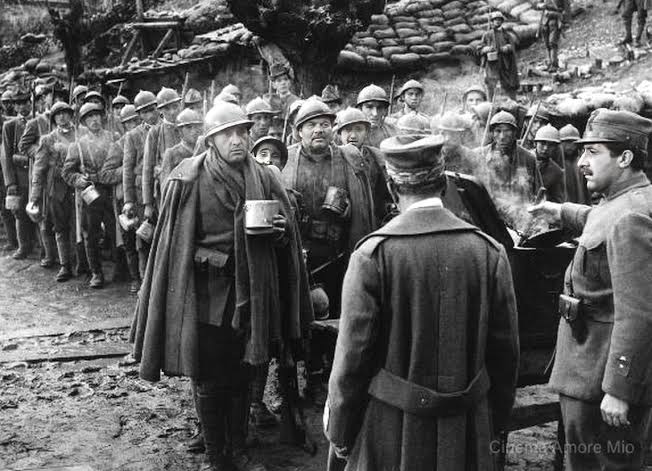
Cover photo: Alpine troops in France in 1940.
Further reading, a related article (in Italian): August 1917: the battle of the Bainsizza and the 7th Alpini Regiment on the Isonzo.