The cableways of the Great War: technology and courage on Italy’s mountains
The silent weapon: the cableway at war
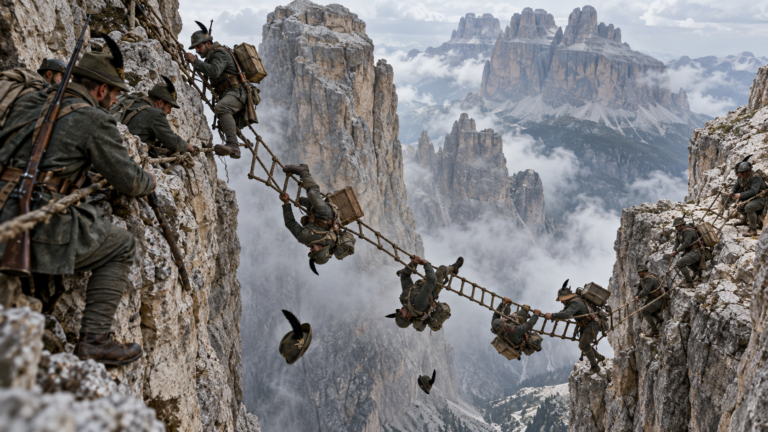
 In the Alps of the Great War, where winding mule tracks were often impassable because of avalanches and enemy fire, the Italian Corps of Engineers perfected an extraordinary tool: the military cableway. Silent cars flying across ravines, skimming slopes and passing over expanses of snow – carrying supplies, ammunition, food and the wounded along aerial lines strung with immense effort between the rocks.
The Engineers’ cableway crews were born of the glorious Miners’ Regiment. Where access to the ridge lines was hardest, their squads went up: calmly, firmly and with rigorous care, they faced the dangers of the mountain and those of the enemy.
The voice of a war correspondent
Let us hand over directly to the correspondent who in 1917 followed the work of the cableway crews at close quarters. His words — published in L’Illustrazione Italiana — convey with extraordinary vividness the rhythm of that work, the toil, the danger and the pride of those men.
| “ |
Along the winding mule tracks the pack-train columns wind their way: from the bottom of the valley, from the floor of the basin they climb to the ridge lines where the soldiers live in the trenches; and meanwhile, flying across the ravines, skimming the slopes, gliding over the wide expanses of snow, passes the car of the Cableway, in its steady, silent run: only a faint creak betrays its passage. |
| “ |
Sometimes an avalanche strikes and sweeps away the road, and over the mass of snow that has crashed to the bottom the car still passes, sure and steady. But those two ropes (one can barely make them out), along which the cars run, were strung with toil and hardship; feverish work was done to prepare the stations and hoist the trestles; and now an anxious attentiveness fills the soldier-motormen, who watch from above as one car climbs and the other returns to the valley. |
Construction: precision work under fire
The correspondent described in remarkable detail every stage in building a cableway line in a war zone. From the route marked out by the officer, to the night-time work parties carrying the ropes up the mountain, all the way to the final launch and the first run of the car.
| Reconnaissance | The officer fixed the start and end points in a quick reconnaissance, keeping an eye on enemy observers and camouflaging the engine huts. |
| Excavation | The miners prepared the platforms, access roads and shelters. The drills worked ceaselessly in the rock. |
| Assembly | Cage stations of iron lattice, trestles of interlocking tubes, engines, mechanisms and rollers for the carrying and hauling ropes. |
| Carrying the ropes | At night, long columns of soldiers climbed the mule tracks: each man carried a coil of rope on his shoulder, linked to that of the comrade in front and the one behind. |
| Launch and testing | The ropes were tensioned in a catenary, the cars hooked on, the telephone line laid. Then the test: the first car climbs, crosses the ravine, arrives. |
The correspondent also described the night-time rope detail in words that still convey the toil and comradeship of those soldiers:
| “ |
In the night, along the mule track or by footpaths, a long column of soldiers climbs slowly, at a steady pace, and every soldier carries a coil on his shoulder, and each is joined to the comrade in front and the comrade behind by a short length of rope running between one coil and the next. […] The detail is over: the rope is left in gathered coils, and the soldiers set off again at a run, bounding down the slope and joking. |
The figures of a colossal undertaking: 2,000 cableways, 2,300 kilometres of rope

Picture it: a dark dot moving silently across the snowy flank of a mountain, amid the dull echo of the artillery. Then another dot coming down fast, carrying at the bottom of the car a wounded soldier, lying flat, clinging to life. This is how the military cableways worked, thousands of times, between 1915 and 1918 — up and down, without pause, among the clouds and rocks of the Italian Alps.
They were not a new tool. Industrial cableways had already established themselves in Italy in mining: just think of the Savona–San Giuseppe di Cairo line, over 12 kilometres long, opened just three years before Italy entered the Great War. But what the Corps of Engineers had to invent for the war was something different: a system that was simpler, faster and demountable. A plant that about a hundred Alpini could assemble in 72 hours and dismantle in a few hours more, following the front as it advanced or retreated.
installations
The technique was standardised. Every installation was based on a double-rope system: a carrying rope, along which the car ran, and a hauling rope, closed in a loop between the two stations, which drove the to-and-fro movement of the two cars in opposite directions. The combustion engine was at the upper station; counterweights at the lower station kept the ropes under tension. The support trestles were tubular, modular and could be carried on a man’s shoulder.
| Carrying rope | The aerial rail along which the car ran, tensioned in a catenary between the support trestles. |
| Hauling rope | Closed in a loop and driven by the upper engine: it pulled one car up while the other came down, in continuous motion. |
| Engine | A combustion engine placed at the upper station. Counterweights at the lower station kept the ropes taut. |
| Assembly | About 100 Alpini, 72 hours of work. The riskiest phase was unrolling the ropes by hand, which exposed the soldiers to enemy fire. |
Yet this war was building, without knowing it, an extraordinary legacy. From the frantic development of military cableways — a technology born to survive, to carry bread and bullets up the rock faces — Italy would develop, from the 1930s onwards, its entire ropeway industry.
Those same tubular trestles, those same carrying and hauling ropes, would become the cable cars and chairlifts that turned the Italian mountains into tourist destinations. Without knowing it, the Engineers were also building the future of our Dolomites.
The car’s first journey
The climax — the test of the newly built line — is described by the correspondent with the same emotion those soldiers must have felt after days of exhausting work:
«A quick inspection of the trestles, a check of the telephone line, which has been laid in the meantime, and off! The car climbs: it passes the first trestle, takes on the steep span, and over the middle of the ravine it keeps climbing: it has arrived! And the other car has come down there, far below.»
And with the first regular service, supplies at last began to go up: sacks of food, building material, crates of shells for the artillery. Up above, in the trenches, the soldiers who had anxiously followed the difficulties of the work greeted its completion with enthusiasm.
The pride of the Corps of Engineers
The correspondent closed his article with words that still ring today as a tribute to all those anonymous soldiers who built, piece by piece, the logistics system of the mountain war:
| “ |
In the cableway soldiers, who are always entrusted with the care of the installation, there is the keenest satisfaction at this new achievement of the Corps of Engineers, which stands beside the other Arms, watchful and attentive, in the brotherhood that binds Italian soldiers with an unbreakable bond. |
Sources: