The Ippopotamo Cannon: the legendary ascent of the 149G on the Adamello
Six tonnes of steel, snow, ice and hundreds of men. In 1916 a huge 149-millimetre gun was hauled by the Alpini to more than three thousand metres on the Adamello. They called it
“Ippopotamo” (the Hippo). Its story is one of the most incredible feats of the White War.
The Ippopotamo Cannon in numbers
calibre of the gun
total weight
approximate weight of the barrel
start of the feat
arrival at the Venerocolo Pass
the war fought on the glaciers
What was the Ippopotamo Cannon?
Its real name was the 149 gun, a heavy artillery piece that had already seen war in Libya. Its official designation was 149 G: 149 is the calibre in millimetres, while the G stands for ghisa, the cast iron it was made of. When it reached the upper Val Camonica, however, a completely different task awaited it.
It had to be taken up the Adamello, in the heart of the White War, into terrain where normally only men, skiers and small mountain units would move, certainly not a steel giant weighing several tonnes.
The Alpini gave it a nickname destined to go down in history: Ippopotamo (the Hippo).
From the sands of Libya to the ice of the Adamello
It is this contrast that makes the Ippopotamo’s story so extraordinary: a heavy weapon designed for other theatres of war found itself dismantled, loaded onto sledges and dragged towards one of the highest fronts in Europe, through deep snow, ice, avalanches and extreme temperatures.
How six tonnes of cannon were taken up the Adamello
The transfer began on 9 February 1916. As far as possible the gun was towed by vehicles and animals, but when the mountain no longer allowed roads, the cannon had to be
dismantled and loaded onto large reinforced sledges.
From then on it was above all men who defeated gravity. Ropes, crampons, snow, ice and an effort hard to imagine today: piece by piece, the 149 climbed towards the glacier.
The account handed down in the pages of the Col Maòr newsletter recalls about two hundred men involved in the operation.
One of the key stages was the Rifugio Garibaldi, at over 2,500 metres. On 27 April 1916, after weeks of work, the cannon reached the Venerocolo Pass, at over 3,200 metres above sea level.

A war fought where even getting a cannon into position became a feat at the limit of the possible.
8 March 1916: the Malga Caldea tragedy
The great feat of the Ippopotamo also came at a terrible price. During the transport, on 8 March 1916, an avalanche swept away men working in the area of Malga Caldea.
The mountain, which already imposed extreme conditions, turned into a trap in a matter of moments.
Lest we forget
According to the historical account handed down in the Salce Alpini Group‘s article, fifty people were swept away and thirty-nine lost their lives. Among them were very young workers from Val Camonica and Valtellina employed in the support work.
The story of the Ippopotamo Cannon is therefore not only the account of an extraordinary military feat: it is also the memory of the men, civilians, families and communities who paid the price of war.
The cannon goes into action
Once at the Venerocolo Pass, the gun was reassembled and used to support Italian operations on the Adamello front.
Bringing a weapon of that size up there meant gaining a firepower that, until then, had seemed incompatible with such altitudes.
The White War was also this: artillery, barracks, cableways, trenches and men forced to adapt war to an environment in which the most dangerous enemy was often the mountain itself.
Where is the Ippopotamo Cannon today?
The following year the cannon was moved towards Cresta Croce, following the changing operational needs of the front.
And it is up there that its presence still recalls today that extraordinary page of the Great War on the Adamello.
A monument without a pedestal
The Ippopotamo Cannon is not just a military relic. Left on the mountain where it fought, it has become one of the most striking symbols of the White War and of the sacrifice of the men who lived and died on the Adamello front.
The White War and the Alpini
On the Adamello the First World War reached some of the highest altitudes of the entire European front. Alpini, gunners, engineers and support units had to fight against the enemy but also against avalanches, crevasses, frost and isolation.
The story of the Ippopotamo is one of many through which we can understand that war and the world of the men who lived it.
On our website we collect documents, accounts, battles and testimonies dedicated to the
Alpini in the First World War
.
Questions about the Ippopotamo Cannon
Why was the cannon called Ippopotamo?
“Ippopotamo” (Hippo) was the nickname given to the heavy 149 gun, probably because of its size and the imposing mass of the piece.
How much did the Ippopotamo Cannon weigh?
The complete gun weighed about six tonnes. To carry it up the Adamello it had to be dismantled, and its components were dragged separately on sledges.
When was it taken up the Adamello?
The undertaking began on 9 February 1916 and the gun reached the Venerocolo Pass on 27 April of the same year.
Where is the Ippopotamo Cannon today?
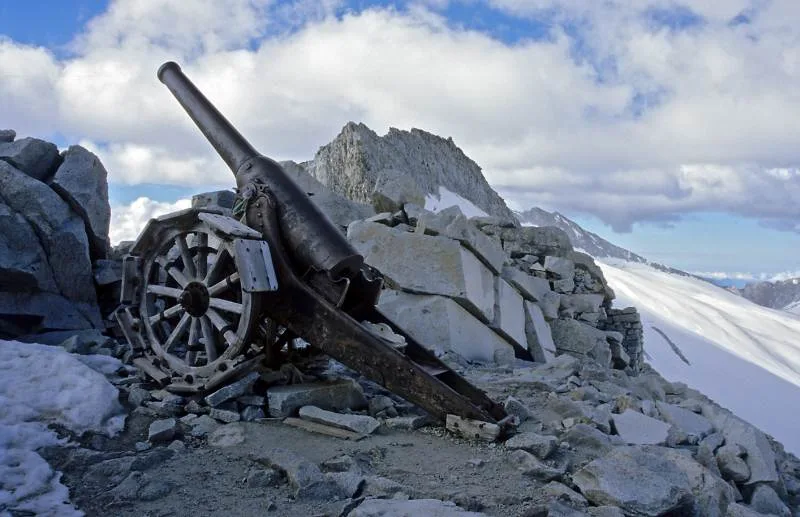
The cannon has remained in the Cresta Croce area, in the Adamello group, where it is still one of the best-known material testimonies of the White War.
What was the White War?
This term refers to the war fought at high altitude in the Alps during the First World War, among glaciers, snow and extreme weather conditions.
Lest we forget
Today the Ippopotamo is still up there. It is not just a cannon left on the mountain: it is a witness.
It recalls men who dragged tonnes of steel through the snow, men swept away by avalanches, soldiers and civilians called upon to pay the price of a war fought even on the glaciers.
HONOUR TO THE FALLEN.
Read on
- The cableways of the Great War: when the Italian Engineers conquered the mountains (in Italian)
- The Alpine mule: the story of the Black Feathers’ companion
- August 1917: the battle of the Bainsizza and the 7th Alpini Regiment (in Italian)
- 1917, the year of hunger – An de la Fan (in Italian)
- All articles on the Alpini in the First World War
Historical sources and photo credits
Historical sources
- Gruppo Alpini “Gen. Pietro Zaglio” di Salce, Col Maòr, the Group’s newsletter published since 1964. It is the original account from which this article was born, here updated and expanded.
- Il Cannone dell’Adamello. Storia, dati tecnici e munizionamento, ilcannonedelladamello.it (accessed 8 September 2026).
- Associazione Nazionale Combattenti e Reduci (National Association of Veterans), L’Ippopotamo di Cresta Croce, combattentiereduci.it (accessed 8 September 2026).
- “il Dolomiti”, Così un cannone da sei tonnellate è stato trasportato a oltre 3mila metri di quota, 11 February 2026, on the 110th anniversary commemoration organised by the A.N.A. Brescia Section (accessed 8 September 2026).
Photo credits
- “The 149 gun on Cresta Croce, Adamello group” — author: Patagonienfreund — archive: Wikimedia Commons. Licence: CC BY-SA 3.0. Photograph taken on 21 March 2010. Changes: resized and converted to WebP for the web.
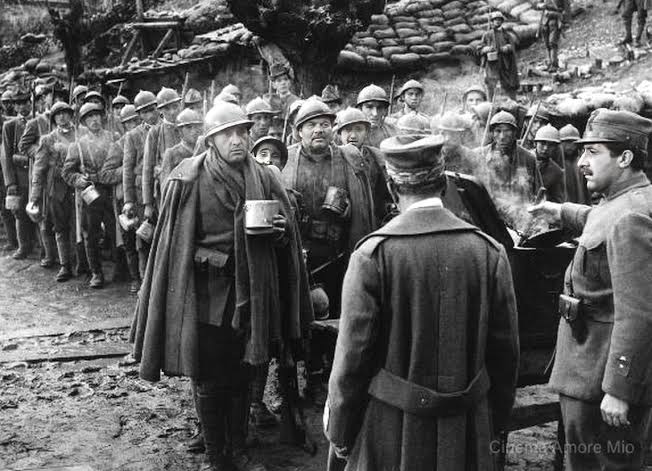
- “Italian troops marching in the Adamello area, 1917” — author unknown — archive: Wikimedia Commons. Licence: public domain. Changes: resized to 1200 px and converted to WebP.
Both photographs were downloaded from the original archives and uploaded to our server: no direct links to third-party images.