More than 85 years ago, Italy’s worst mining disaster
Contrary to a widespread belief, the Marcinelle explosion, which took place in Belgium, was not Italy’s worst mining disaster.
The greatest tragedy was that of Arsia (Arsa) on 28 February 1940, in what was then Italian national territory, with 185 dead – more than the 136 Italians who died at Marcinelle.
According to the reports of the Royal Carabinieri, the terrible accident was caused by reduced safety measures linked to the need to step up production: the outbreak of war had led to the naval blockade of the German colliers bound for Italy, not yet at war but by now determined to side with Hitler.
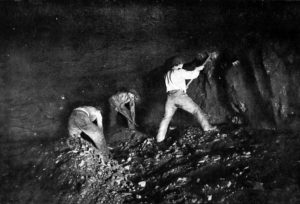 Border events led to the dead of the Arsa being forgotten: Italy considered them Croats, the Croats considered them Italians and fascists into the bargain. In reality the workforce and the dead included Italians, Slovenes and Croats (clearly a great mixture), as well as immigrants from all over northern Italy, Tuscany and Sardinia. The Arsa basin was the largest mining complex in Italy, and later in Croatia.
Significant in this respect was the speech of the Italian prime minister Alcide De Gasperi, when he declared that Italy was ready to accept the painful territorial losses demanded by Yugoslavia, but not to give up the Arsa mines. “We are prepared to concede Yugoslav rights and interests as far as possible, but it would not be fair for the Arsa mines, which could provide Italy with 80% of its national coal production, to be taken from it.”
Precisely because of the loss of these resources, in the immediate post-war period Italy had to sell thousands of workers to Belgium as “mine fodder” in exchange for coal. This is why one can say that Marcinelle is in some way a child of Arsia. As for its considerable industrial size: at its peak some 10,700 people gravitated around it, with a new town built to designs by Gustavo Pulitzer Finali and embellished with works by Ugo Carà and Marcello Mascherini, and a dedicated port on the Arsa Channel. The complex was a stronghold of the left: just think of the “Red Republic of Albona”, contemporary with the “Bolshevik Republic of Pola” and the occupation of the factories and of the Pola Arsenal in the early 1920s. In ’43 some spoke of revenge, and part of the management was thrown into the foibe at Vines.
Another serious disaster occurred in the immediate post-war period, and many German prisoners were among its victims. Perhaps these events too, but above all the police oppression and the enforced silence imposed by the regimes responsible for the killings, helped to consign the events of Arsia to oblivion, turning it into a non-place, the scene of an unwritten story, an important part of the history of these lands of ours.
News of the 1940 disaster had little echo in the local and national press: Il Piccolo of Trieste gave it 30 lines on page 2 under a two-column headline, reducing the victims to 60 and a hundred or so lightly injured, while stressing the promptness of the rescue led by the mine managers, who intervened at once «with comradely self-sacrifice and admirable zeal», the immediate presence on the spot of the prefect, the party secretary and the provincial hierarchy, and the behaviour of the mining population, who kept an exemplary calm, «showing a manly sense of awareness».
Il Piccolo of 1 March went on to report the presence on the spot of Undersecretary Cianetti and the resumption of work: “the workers reported regularly for their shifts, once again showing the austere awareness that drives these strong, tenacious Istrian miners, grieved by the disaster but not at all shaken. Like good fighters they carry on the hard battle in the service of the Fatherland, and no one has deserted his post”.
That year, 1940, I remember I was in the fourth year of primary school. I was walking with my aunt Ernesta along the road to the hospital when the hoarse wail of the siren broke the heavy fog hanging over Pola that February evening, announcing the slow arrival of an ambulance weighed down by its burden of pain, and straight after a second howl, a second ambulance. “Those are the men from the Arsa” sighed my aunt with a sob, “Poor, poor, poor people”.
We knew the Arsa mines through the stories of uncle Guido, a young teacher who for a while taught evening classes at Pozzo Littorio before being dismissed from teaching and sent away for having arranged and conducted the miners’ choir, whose repertoire included Chakavian laments from the mining region.
“Poor, poor people”. At those words I felt a painful sensation that I feel every time I hear mines spoken of. Broken lives, families, young people without a father – a sensation I felt again with great intensity reading the poems of Isabella Flego, “Il primo giorno” and “Zolle di carbone”, in which the writer, daughter and sister of miners, sings of the precariousness of the human condition and of the fear of the unknown, always present and dignifiedly hidden by the miner and his family, and of the awareness of the holocaust of which mine workers are victims, an almost religious sacrifice in which they are offered up on the altar of work for the progress of society. Ghosts hovering in the miner’s poor home, revived by the flame that comes to life from the lump of coal, a trace of life hidden in time and brought back to the light by the miner to sublimate his suffering.
Dignified acceptance, not resignation. The miner urging his son to study so that “you’ll be better off” (“ti stassi più ben”). In that well-being already enjoyed lies the awareness of being and feeling alive, the full consciousness and joy renewed every day by the long-awaited sound of the mine siren announcing to loved ones the end of that day’s shift, the easing of anxiety, the return of life.
Livio Dorigo, President of the Istro-Venetian Cultural Circle “ISTRIA”
(From the book “ARSIA – 28 Febbraio 1940”)
(Article taken from Col Maòr no. 1, 2015)
LEST WE FORGET…
Two miners from Belluno also died in the Arsia mining disaster:
CASOT DOMENICO VITTORIO, son of Pietro and Domenica Tronco – S. Giustina (BL), 16.10.1907 (married, 1 child)
MORI GIUSEPPE, son of Desiderio and Eugenia Biscaro – Farra d’Alpago (BL), 20.4.1913 (unmarried)
Related article: The 1976 Friuli earthquake, fifty years on.