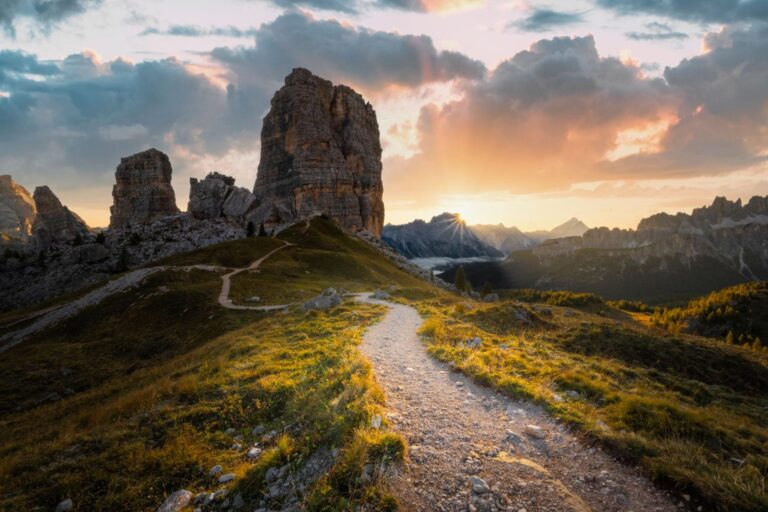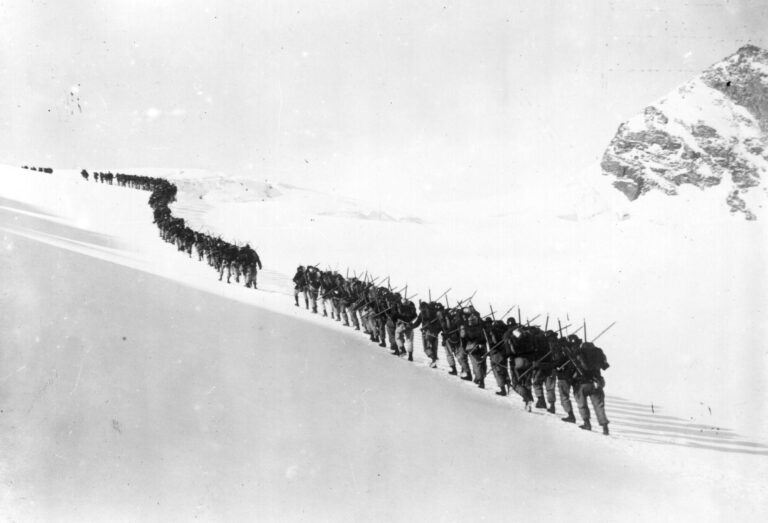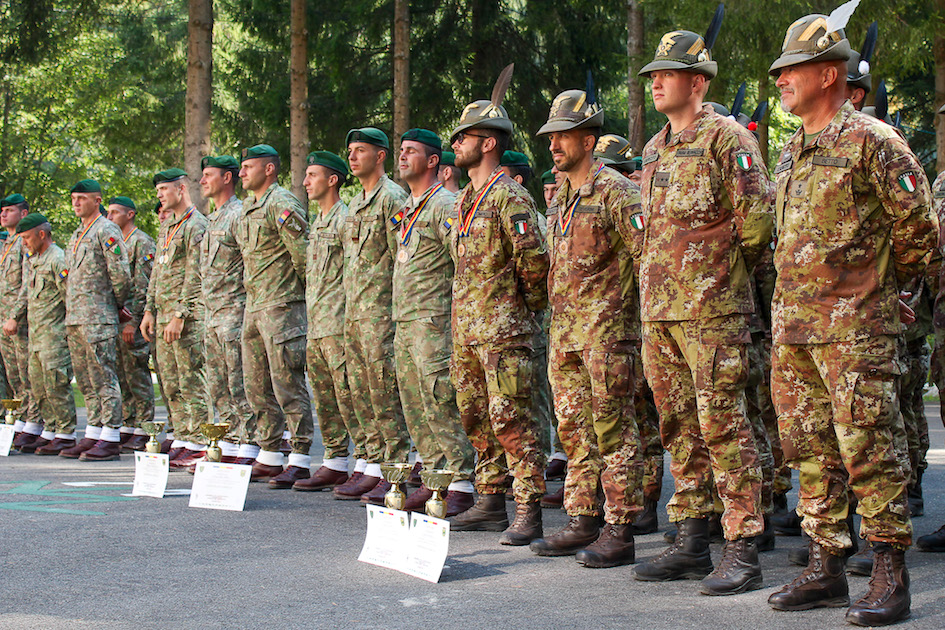
In Romania, the “Julia” Alpine Brigade trained alongside foreign units in patrol, climbing, navigation and rescue exercises. Training that highlights the relevance of mountain troops today, beyond the final ranking.
The participation of the Italian Army’s Alpine Troops in Carpathians Patrol 2026 came to an end in Romania on 11 September 2026. The international training and cooperation activity for mountain infantry units had begun on 7 September. The Italian contingent came from the “Julia” Alpine Brigade, led by the 8th Alpini Regiment and reinforced by personnel from the 7th Alpini Regiment.
An international challenge in the mountains of Romania
The initiative was organised by the Romanian Armed Forces as part of the celebrations marking the 110th anniversary of the Romanian mountain troops, the vânători de munte, established in 1916. It was neither an operation nor a mission, but a training and cooperation activity: allied units facing the same terrain and the same tasks in order to assess how effectively they can work together.
According to the Romanian Land Forces, six teams from three countries took part: two from the 2nd Vânători de Munte Brigade “Sarmizegetusa”, two from the 61st Vânători de Munte Brigade “General Virgil Bădulescu”, one Italian team and one Spanish team. A compact format, but one that brought three different mountain warfare traditions into direct contact, each with its own history, doctrine and equipment.
CARPATHIANS PATROL 2026 AT A GLANCE
- Where: Romania
- When: 7–11 September 2026
- Italy: “Julia” Alpine Brigade
- Units: 8th and 7th Alpini Regiments
- Tests: patrol, navigation, climbing, rope techniques, rescue and first aid
- Results: third place in Rapid Climbing and in the long-range patrol
- Objective: joint training and interoperability
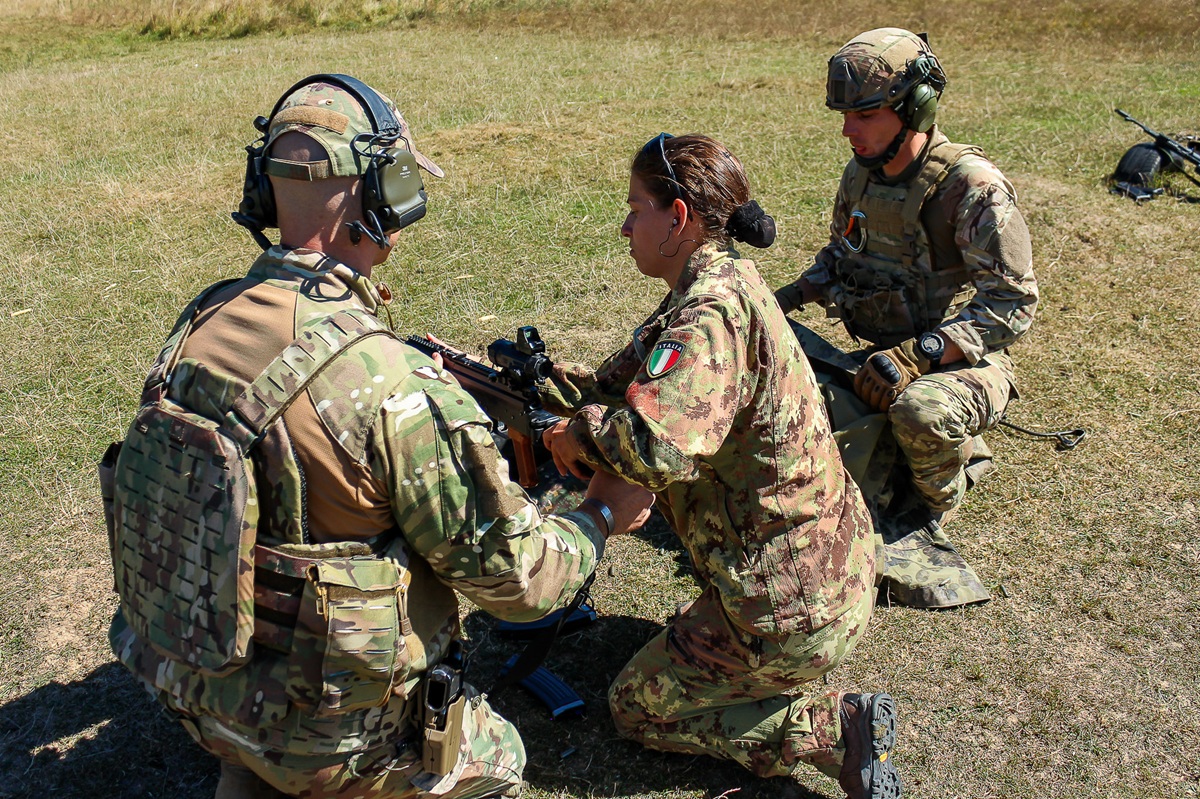
From patrol work to rescue: the skills put to the test
Over the course of five days, participants faced a range of operational situations in mountain terrain: movement and navigation, climbing, rope work, mountain rescue and first aid, as well as the ability to operate effectively as a team. Listed this way, they may look like simple programme items. On the ground, however, they are distinct professional skills, each requiring its own learning process, yet all of them must coexist in the same soldiers and often on the same day.
The final test gives a clear idea of the level of effort required. According to the Romanian Land Forces, the patrols covered around 25 kilometres with more than 1,500 metres of cumulative elevation gain, completing a series of tactical tasks along the way: grenade throwing, crossing a contaminated area, recovering an injured person from a rock face followed by first aid, observing and identifying targets on the ground, topographical exercises, and overcoming obstacles by rappelling and zip-line.
It is a list worth reading twice. This is not simply about combining a march with a climbing competition: it is about carrying out precise technical manoeuvres after hours of walking, while carrying a full load, in an environment that leaves little room for mistakes. A badly executed rappel at kilometre five has the same consequences as one at kilometre twenty, but not the same likelihood of happening. This is exactly where Alpine specialisation is tested.
Two third places, but interoperability is the most important result
The Alpini of the “Julia” achieved third place in the Rapid Climbing event, an artificial climbing test carried out in tactical gear, and third place in the Carpathians Patrol, the long-range patrol event. Solid results, achieved against units competing on home ground and in terrain they know well.
But the ranking is the least interesting part of this story, and it is worth saying so explicitly. Activities like this are not designed simply to establish who finishes first. Their purpose is to allow units from different countries to test, under controlled but demanding conditions, whether they can understand one another and operate effectively together. Success is not measured by the podium, but by how much friction disappears when three national teams have to share a wall-rescue procedure.
WHAT INTEROPERABILITY MEANS
Units from different armed forces speak different languages, use different equipment and follow different manuals. Interoperability means that, despite these differences, they can still operate together safely: they recognise the same procedures, use common signals and know what to expect from one another without having to ask. There is only one way to achieve this: training side by side before it is truly needed. On a rock face, where a misunderstood command can be as serious as a technical error, interoperability is not a bureaucratic formality: it is a safety requirement.

Why the Alpini still matter in a modern army
The question comes up regularly and is often framed in the wrong way: does a modern army still need infantry specialised in mountain warfare? The answer lies not in tradition, but in geography and physics. Mountains remain an operational environment that cannot be simplified: slopes dictate timing, altitude reduces performance, weather can change a plan within half an hour, and the load carried is limited by what people are physically able to carry. No technological system removes these variables; at best, technology helps manage them.
What has changed greatly is the wider context. A modern Alpine unit works with sensors, digital communications, air support, observation capabilities and data transmission systems that did not exist forty years ago. But those tools still have to be carried to where they are needed, and in the mountains that requires people who know how to move safely and effectively. Technical mountain expertise is not a relic of the past sitting alongside modern technology: it is what makes that technology usable.
There is also another element that the Carpathians Patrol highlights better than any description: decision-making under pressure. Finding a route, choosing an itinerary, deciding whether to rig a descent or look for an alternative, determining who carries the injured person and for how long — these are decisions made by a small number of soldiers, independently, when they are tired. It is a capability that can only be built through training, and one that is valuable far beyond the Alpine environment.
This is not an abstract issue. A large part of the Alliance’s eastern flank — including the Carpathians — is mountainous terrain, and the units training there today are the same ones that may have to operate together tomorrow. The fact that Italian and Spanish units climb into the Romanian mountains to test themselves alongside the host forces is not military folklore: it is routine maintenance of a shared operational capability.
Tradition and innovation on the same terrain
The 110th anniversary of the vânători de munte and the presence of the Italian Alpini, founded in 1872, tell two parallel stories of armies that understood early on that mountain warfare requires dedicated troops. One hundred and ten years later, the setting is commemorative; the substance is a technical test involving stopwatches, maps and ropes.
This is perhaps the most accurate way to read the story. Alpine tradition is not preserved simply by repeating it: it is preserved by continuing to perform, with today’s tools, the role for which these units were created. A third-place finish in Romania says relatively little. Five days in which Italians, Romanians and Spaniards learned to move and operate according to shared procedures say much more.
Along the same lines, and on Italian soil, there is the work of the “Julia” combat engineers involved in the clearance of more than 200 unexploded wartime devices at high altitude: long-standing skills applied to a contemporary problem. For the historical background, see the history of the Alpini and the pages dedicated to our Alpini Group.
Source and photographs: Italian Army – Northern Territorial Command. Data on team composition and the final test: Forțele Terestre Române (forter.ro). Journalistic adaptation by the editorial staff of Col Maòr – Alpini Group “Gen. Pietro Zaglio” – Salce – ANA Belluno Section.