Military service, mutiny and the Resistance: the story of a gunner of the 5th Mountain Artillery
Angelo was born in Campo di Mel in 1924, the eighth of ten brothers and sisters. His family were farmers, and apart from a few interludes he remained one to this day.
He was called up on 2 May 1943 at the D’Angelo barracks in Belluno (5th Mountain Artillery) and assigned to the 1st Training Battery; he had just turned 19.
Three days later all 120 men of the battery were handed a notebook and a pencil and given a dictation to check their level of education. In the following days they were taught Morse code.
Angelo could read and write well and already knew Morse code. For this reason he was promoted to corporal in the Command Squad after only two weeks of service. On 21 June the Battery went up to the Visentin, where it took the oath.
A few days later the gunners left by train for Calalzo and then marched on foot to Auronzo, where they set up the base camp to take part in the “Grand Manoeuvres”.
They operated on almost all the surrounding mountains and, on a roundabout route, still on foot, reached Belluno on the morning of 1 September. And then came the fateful 8 September 1943. The armistice between the Italian government and the Anglo-Americans, whose text was read by Badoglio and broadcast by radio at 19.42, caught everyone by surprise.
As is well known, the Italian armed forces were left without orders, practically in disarray; the soldiers had to fend for themselves, relying on their instinct for survival and on luck to avoid being captured by the Germans, who after Italy’s about-turn had gone from allies to enemies.

While the message was being broadcast, Angelo and his comrades of the 1st Battery, unaware of what was happening, were calmly marching back from the Nevegal towards their base, the D’Angelo barracks. They got the news of the armistice at Castion from Alpini who were hurrying home in small groups.
Back in the barracks, the officers gave the order to hand over their weapons, wait passively for the Germans and give themselves up as prisoners.
The gunners’ reaction was immediate and unanimous: «We face the Germans fighting, or we all go home». When the Colonel flatly refused, a revolt broke out, a real mutiny. From the parade ground where they were gathered, guns were aimed at the barracks and the gates, with the threat of knocking them down if they were not opened. There were also warning shots from rifles and machine guns, and finally the gates were opened, the rebels laid down their arms and everyone scattered.
Angelo set off on foot towards Salce with some comrades, managed to avoid a checkpoint, forded the Piave near Le Polse and reached his home in Campo di Mel the next morning.
So, after four months, his adventure as a soldier came to an end. Out of uniform, he went back to farming for a few months, then worked for the German “Todt Organisation” (civilians employed on military works) as head miner at S. Vito d’Arsiè.
During the Resistance he was a member of the Mazzini Brigade, with the battle name “Lupo”. He took part in several actions, such as the one of 28 February 1945 on the S. Boldo pass, where enemy units were bloodily repulsed by the crossfire of the “Tollot” and “Mazzini” partisan brigades.
After the war Angelo emigrated to Belgium to work at the blast furnaces. He came home in 1951. From 1962 to 1970 he worked at the Bampo kilns in San Fermo.
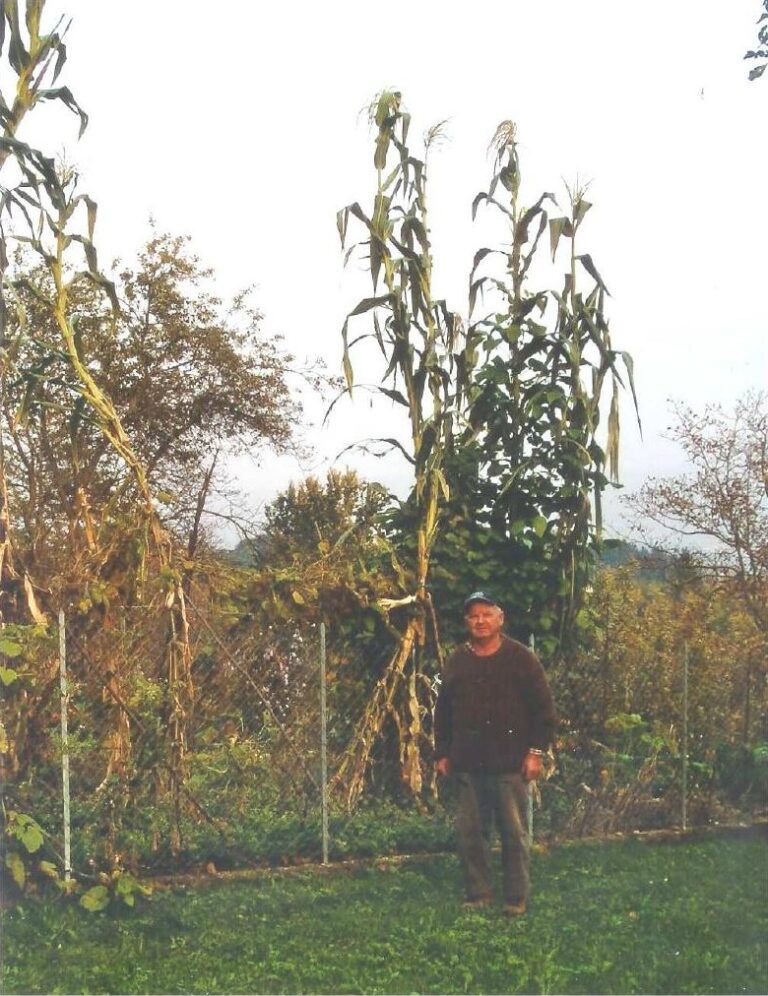
In 1961 he bought the Murer brothers’ farm at Chiaramada di Salce, where he still lives with his wife Maria.
He has three children and seven grandchildren.
(Article published in Col Maòr no. 2, 2009)