At the 49th Alpini National Rally, a chance meeting with a remarkable character, Dante Chichiarelli, an Alpino from Rosciolo dei Marsi
With my Alpini hat on my head, my «Bronica» hanging round my neck and my wife on my arm, I wander for hours and hours through the streets of Padua, packed with Black Feathers. The weather is fine, but the air is thin, at times even icy. We are both well wrapped up, but our faces are livid. As for my nose, it is a sight to behold. Being rather prominent, it cuts through the air a treat and is a lovely shade of purple-red that would really deserve a colour photograph.
Padua, a splendid city, has become even more attractive with this sort of peaceful, cheerful invasion that I and 399,999 other Alpini like me are subjecting it to. Out and about, in the streets, the squares, under the arcades, all you see are grey-green hats and feathers of every kind, long, short, black and white, pointing straight up at the sky or almost horizontal, eagle feathers or even just chicken feathers. A real invasion of Alpini, all on the move, all busy looking left and right, or with their noses in the air, admiring the palaces, churches and monuments of the oldest part of this city which, I insist on repeating, is truly fascinating. There is cheerfulness everywhere, even though the times we are living through are far from happy. Our lira has just taken a hefty slap – a real «wallop», in fact. Petrol, too, has gone sky-high. But here in Padua, in these three days of the 49th National Rally, few seem to have time to dwell on such sad things. We Alpini are seeing to it that the morale of the people of Padua, and of everyone who has come from elsewhere to watch our finest celebration, stays high.
We stroll along without any particular destination. Our wandering through the streets of Padua brings us in front of one of the many first-aid posts scattered at the most strategic points. Here, instead of nurses in white coats, stretchers, syringes, plasters and tourniquets, we find other kinds of first aid, ranging from sausages, sandwiches and little salamis to spaghetti or risotto with chicken livers. Good wine is never lacking and takes the place of the oxygen cylinders. You can taste the local wines, like Tocai, Pinot, Merlot or Cabernet, but there is also our Barbera, which for us Piedmontese is the favourite. The organisation, then, is flawless.
We stop at the first-aid post to eat something. The smell of fried sausages in the air is truly irresistible. The place is crowded. I take the opportunity to snap a few photographs. There is no shortage of interesting subjects, and I try to catch some of them unawares. Many, however, thinking they are doing me a favour, strike a pose, chest out, or even stand to attention. Others don’t even notice they are being framed by a lens. They carry on eating and drinking, unaware that someone is watching them to catch their best expression.
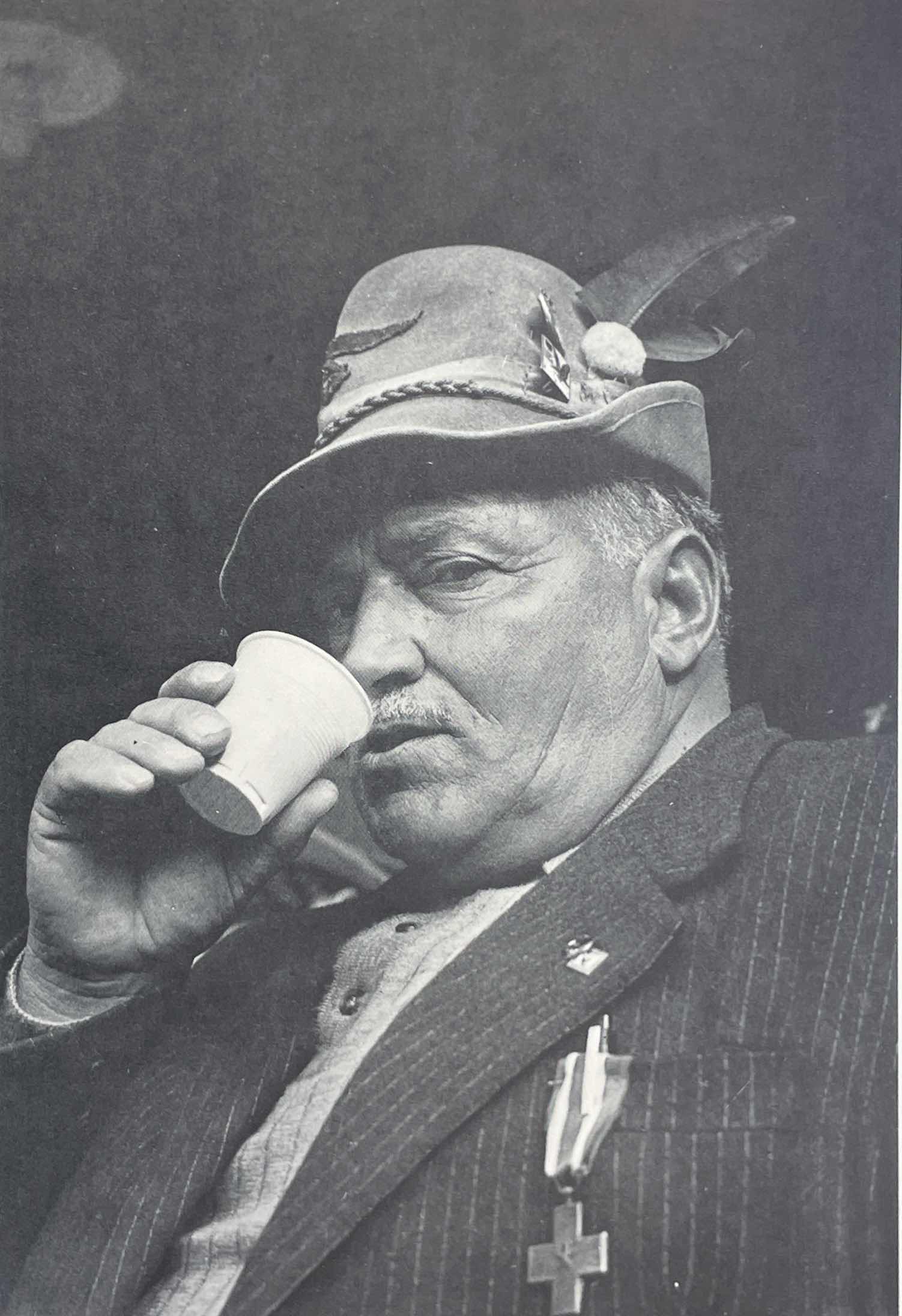
Dante Chichiarelli, too, the character I am about to tell you about, doesn’t notice me when I start following him through the lens of my camera. He is standing in the middle of a small group of friends, a sandwich in one hand and a little white plastic cup in the other. I watch him slowly sipping the contents of his cup, looking rather satisfied, but I wait before taking the photo so as to catch him while he drinks with his eyes half closed. On his chest, pinned to his jacket, the Alpino I am about to photograph wears a bronze cross, a “War Cross”. So I shift half a step so that it will be in the frame too, but just as my finger presses the shutter button, my subject turns his eyes towards me.
– I’m very pleased you’re photographing me … – he says with a smile and in a very kind tone – But … could I have a copy of the photo too? I’ll pay, of course …
We introduce ourselves at once and exchange addresses. The man I have just captured on my film is called Dante Chichiarelli and he comes from Abruzzo, from Rosciolo dei Marsi, in the province of L’Aquila. When I ask him which campaign the “War Cross” hanging on his jacket refers to, he explains that it is for the FGreek-Albanian front, where he fought with the “L’Aquila” Battalion, first on the Sarantaporos and Vjosë rivers, then on Mount Smolikas, then at Konitsa and at the Perati bridge.
Under his curious gaze I quickly jot down a few notes in my notebook, then I realise that talking about these things standing up, right where everyone is crowding to get something to eat, won’t do. So I explain the reason for the photograph and the notebook, and I suggest to Signor Dante a half-hour chat nearby, but somewhere a little quieter. We think we’ll find this quieter place in a bar, but they are all packed and full of noise. We go back to the square where we met and find a little corner that suits us. There, sitting on a step, almost on the ground, Dante Chichiarelli tells me his story, beginning by telling me about his village in Abruzzo.
Rosciolo is a farming village at nine hundred metres, at the foot of Monte Velino. Ten years ago a small bronze Madonna was placed on this mountain in memory of the Black Feathers fallen in all wars. Every year, on the first Sunday in July, Alpini come from all over Italy, join the Alpini of Rosciolo – all sixty-three of them – and together they climb to the top of the Velino on pilgrimage to say a prayer.
Rosciolo’s claim to fame is a very old church, Santa Maria in Valle, dating back to the year 1080. On the details of this church, such as the pulpit of 1150, built by the masters Robertus and Nicodemus of Guardiagrele, or the wooden screen depicting the Last Supper, a truly unique piece, Signor Dante shows me he knows everything. In fact, he is the very custodian of the church and its treasures – indeed, to use his own words, he tells me he is a «jealous custodian», given the times we live in, when anything can be expected.
When we come to the subject of the book, Chichiarelli tells me about the war in Greece and Albania. He was first at Burrel, in Albania, then at Korçë. On 28 October 1940 the «L’Aquila» Battalion, in torrential rain, crossed the swollen Sarantaporos river by means of ropes stretched from one bank to the other. Then the first clash with the Greeks, then the rescue on Mount Smolikas of what remained of the 8th Alpini, which had been decimated near Metsovo. After Mount Smolikas a hard retreat had begun, all the way to Konitsa, where a line of defence had been re-formed. But on 11 November the Greeks had broken through the Italian lines again and the «L’Aquila» Battalion had been forced to fall back once more, to the Albanian border, at the Perati bridge. There, near the bridge, there had been another violent clash with the Greeks, then a new retreat, as far as Mount Chiarista, one of the toughest bulwarks for the 9th Alpini, where «L’Aquila» and «Vicenza», together with the batteries of the 3rd Mountain Artillery, held out for more than a month and a half, at the cost of many dead and wounded…
— The medal I wear, — says Chichiarelli — is a simple Cross of Merit… But one of our generals had said that all of us who had fought down there should have received the one for valour, because we had all earned it…
— If you want a rather special episode, yes, I have one… It happened to me at the Perati bridge, the very one in the famous Alpini song, on 21 November, still in ’40…

— That day the Greeks had attacked the bridge area. By then the bridge was gone, because our engineers had blown it up to slow down the Greek advance, but a wooden footbridge had been built about a hundred metres from the destroyed bridge. At the moment of the attack I was in a farmhouse on the other side of the footbridge, on Greek territory, since the Sarantaporos river marked the border between Greece and Albania… I had just come back from distributing rations to the various companies deployed around the bridge when the Greeks started hitting us with their mortars set up on the heights overlooking that stretch of the river, then they began advancing towards us from all sides. It was an attack in force. The Greeks were trying to seize the footbridge while it was still standing, but our command, seeing that it was practically impossible to hold that position, had decided to destroy it. Our men had immediately doused it with petrol and set it on fire.
— We, that is, I and the others with me in the farmhouse, realised the footbridge was burning and began to withdraw, still under the Greeks’ crossfire. Besides my rifle, I had taken a few hand grenades with me. With short dashes and crawling on the ground behind cover, I had managed to get close to the footbridge. The flames were already quite high, but that wasn’t the danger… The footbridge was almost a hundred metres long, a hundred metres you had to run all the way, completely in the open, under fire from the Greek machine guns, which from up on the hills could hit us as they pleased. Many of us wanted to get across there so as not to end up prisoners, but very few managed it. Meanwhile the wood of the footbridge kept burning, and the longer you waited, the greater the risk that the whole thing would collapse…
— I started running with the strength of desperation… There were several of us, but by now each thought only of himself. A hundred metres, in those conditions, is a long way, you know? I saw others fall, wounded or dead, but if I stopped, I was lost too! I could hear the bullets whistling all around me, but I kept running, running… When I saw the man in front of me fall, I remember calling for help. I invoked my saints, Saint Joseph and Saint Anthony, to whom I had always been devoted; I shouted for them to help me and get me to the other side alive… And that’s what happened! I had got across, I don’t know how, but I made it… As soon as I was off the footbridge I threw myself into a ditch. I couldn’t go on! I ended up in a hole and fell on top of a suitcase – yes, a suitcase, open and all broken… Someone must have lost it or abandoned it, but you could see it had been ransacked…

Inside there was only a small fever thermometer, broken as well, and two pictures, two holy pictures… I took both of them in my hand and turned them over to see what was written on the back… They were pictures of Saint Joseph and Saint Anthony of Padua! It was them, the very saints I had called on a moment before, on the footbridge. A miracle? I still don’t understand what it was, but for me I believe it really was a miracle! How else can you explain it… The bridge burning with all its dead, and me instead there, without a scratch, holding those two pictures…
— Since then I have always carried them with me, in my wallet, but then I saw they were getting damaged. They were already old when I found them. One, Saint Anthony’s, was from 1906 and the other from 1912. They had been printed in Milan… So I preferred to keep them at home, in the chest of drawers. Both are very faded, one is even torn, but if you need them, I’ll send them to you… By registered post, of course! And I’ll also send you a photo of me from those days, the only one I have from the war in Albania. But I ask you one thing, Signor Capello. Don’t lose them…
Would you also like to know the true story – and the legend – behind the song the Alpini sing at every Adunata? Read “The Perati bridge: true story, legend and the Alpini song” →
From the book “I racconti degli alpini – storie di naja e di guerra” by Ezio Capello
Cover photo: Dante Chichiarelli, Alpino from Rosciolo dei Marsi