
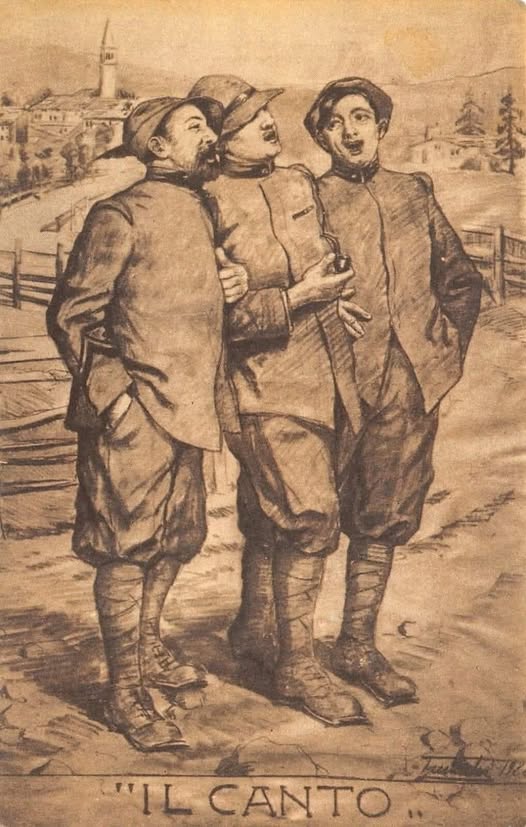
The Alpini have always sung, and not for show. For generations, singing was the way a mountain community told itself about hardship, distance, war and homecoming. Anyone listening to an Alpini choir today hears a repertoire that seems all of a piece, born in the trenches. It is not: it comes from three different sources, and telling them apart changes the way you listen to it.
The three sources of the repertoire
The first is the oral tradition of the valleys, older than the Alpini themselves. Work songs, emigration songs, tavern songs and courting songs that circulated in the Alpine valleys long before 1872, and that soldiers brought with them to the barracks because they were the only songs they knew.
The second are the trench songs, born or reworked between 1915 and 1918. Almost never original compositions: more often new lyrics grafted onto already familiar melodies, adapted to a front, a unit, a mountain. This is the mechanism that explains why the same tune appears with different words in different areas.
The third is the most recent and the least recognised: the 20th-century composed songs, written by named musicians between the 1920s and the 1960s. Many have become so much part of the repertoire that they are mistaken for old folk songs. They are not.
Songs of the Great War
The Alpine front of 1915-1918 produced the best-known core of the repertoire: songs about life in the trenches, artillery fire, the troop trains that carried men to the front, and the dead left up on the mountains. They are direct texts, often free of rhetoric, in which war is never heroic: it is cold, waiting and fear.
Many of these songs have a longer prehistory than is usually told. “Il testamento del capitano” (The Captain’s Testament) is the most debated case: tradition links it to an officer killed in battle long before the 20th century, and the form sung today became fixed in the years of the Great War, on a text that had already been circulating for some time.
The historical context of those years is told in the articles on the Alpini in the First World War.
Greece, Russia and the bitterest song
The most famous Alpini song of the Second World War was born on the Greek-Albanian front in the winter of 1940-1941, when the Julia Division crossed the Sarandaporos river. It is a textbook case of how tradition works: the melody is not new, it comes from a Great War song tied to another bridge and another river, and the lyrics adapt it to a different defeat.
The true story of that crossing, and the legend that has settled on top of it, are reconstructed in Ponte di Perati: the true story, the legend and the Alpini song.
The Russian campaign, on the other hand, left fewer songs than one might expect: the retreat of January 1943 was told above all in memoirs, not in the choral repertoire. The events are covered in the articles on the Alpini in the Second World War.
Composed songs that sound old
In the 20th century several musicians wrote new songs in the Alpine style, and some were so successful that they were absorbed into the heritage as if they had always existed. In Friuli, Arturo Zardini composed pieces in the Friulian language in the 1920s linked to those who fell in the Great War. Bepi De Marzi, with the choir he founded in Arzignano in 1958, wrote pieces that are sung all over Italy today, often attributed to tradition.
The point is not pedantic. Calling a 20th-century composition a “folk song” means erasing an author and a precise story, and it also means being unable to ask the right question: why did that piece work so well that it sounds old?
The choirs
Alpine singing became a form of association with the mountain choirs. The first and most influential was born in Trento in 1926 in mountaineering circles and set a way of singing — male voices, sober harmonisation, no accompaniment — that would become the model for almost all the others. From then on, A.N.A. sections and groups built their own choirs, which are at once a repertoire, a school and a guardian of memory.
This is an important difference from other traditions: the Alpini choir is not born for the stage. It is born to sing together, and the concert comes afterwards.
Three things people say that are not true
- “They are all trench songs.” False for most of them: many are pre-existing folk songs, adapted.
- “They are all anonymous.” False for a substantial part of the most performed repertoire, which has documented 20th-century authors.
- “They are war songs.” Almost never. They are songs about war, which is the opposite: they tell of waiting, cold, a distant home and the dead, not victory.
In Salce
Choral evenings and charity concerts are among the oldest activities of the Salce Alpini Group, together with the Befana Alpina and the group trips. The accounts of those evenings, with the names of the guest choirs and the programmes performed, are in the volumes of the newsletter Col Maòr, from 1964 onwards.
This section will collect entries on individual songs: where they really come from, who wrote them when this is known, and which legends have attached themselves to them. Where the source is uncertain, we will say so. It is the difference between handing down and making up.
Sources
- “Col Maòr” newsletter, volumes from 1964
- Archive of the A.N.A. Belluno Section
- Repertoires and concert programmes of Alpini choirs


