
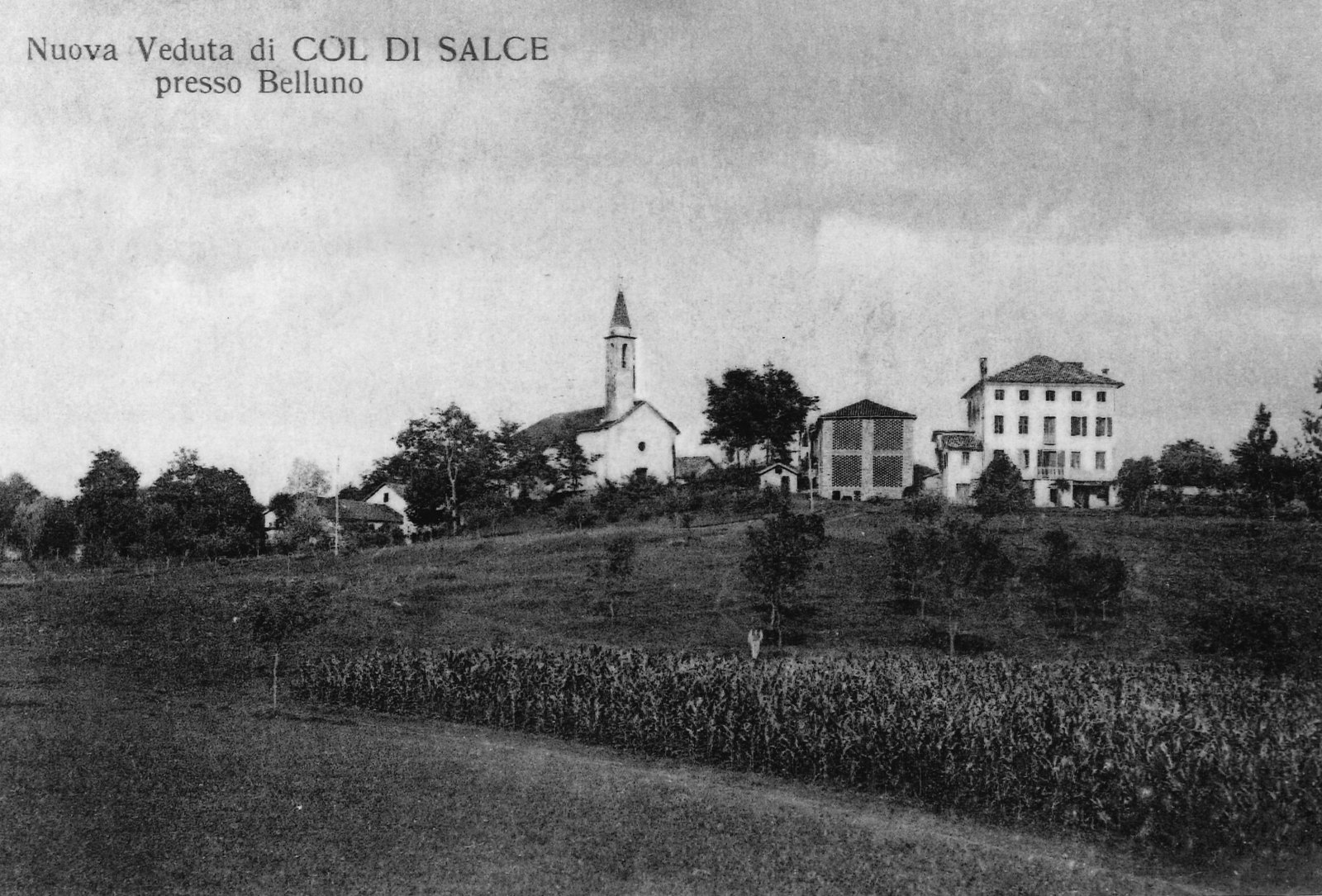
The church on the hill, the General’s villa, the bar where the Group hung its sign, and the little house that became the Alpini’s first home of their own
“Nuova Veduta di Col di Salce presso Belluno” – a new view of Col di Salce, near Belluno – reads the line printed across the top of the postcard that opens this page, preserved in the 60th Anniversary Book. Whoever took the photograph for this postcard, around 1920, had stopped by the main road. In front of him lay a field of maize, then a meadow rising gently and, at the top, everything that for decades would make the village recognisable at a glance: the pointed bell tower, the church, and beside it the large square house of the villa with its farm buildings.
It is a simple picture, yet it already holds almost the whole story that the Group’s papers allow us to tell. On that hill stood the parish church of the community of Salce. In that villa lived the general who would give his name to the village’s Alpini. And a few steps away, between the church and the houses, many of the moments recorded over sixty years by the Col Maòr newsletter would take place: celebrations, pre-dawn departures for the national rallies, Befana parties, annual meetings, farewells.
The church of San Bartolomeo
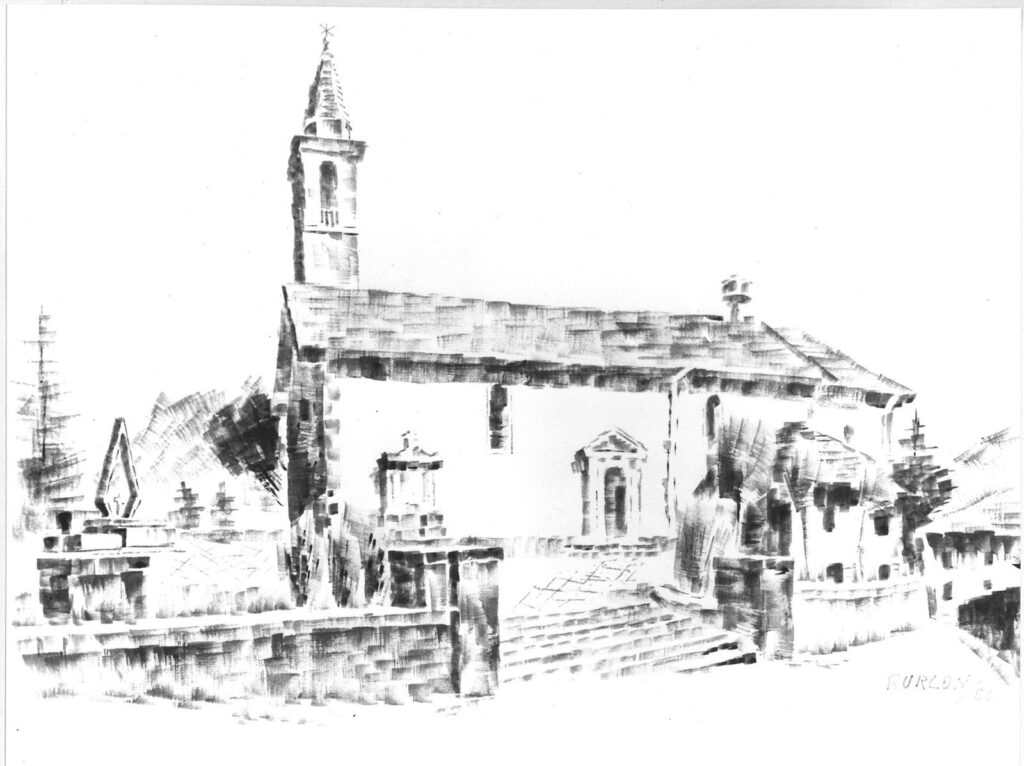
In the 60th Anniversary Book the church of Col di Salce appears in a pencil drawing by Augusto Burlon, with a caption that leaves no room for doubt: “Col di Salce – Parish Church of San Bartolomeo”. The same book recalls that the church of San Pietro in Salce was built in the sixteenth century, “200 years after that of San Bartolomeo”, and attributes the altarpiece to Luigi Speranza, a painter born in Salce.
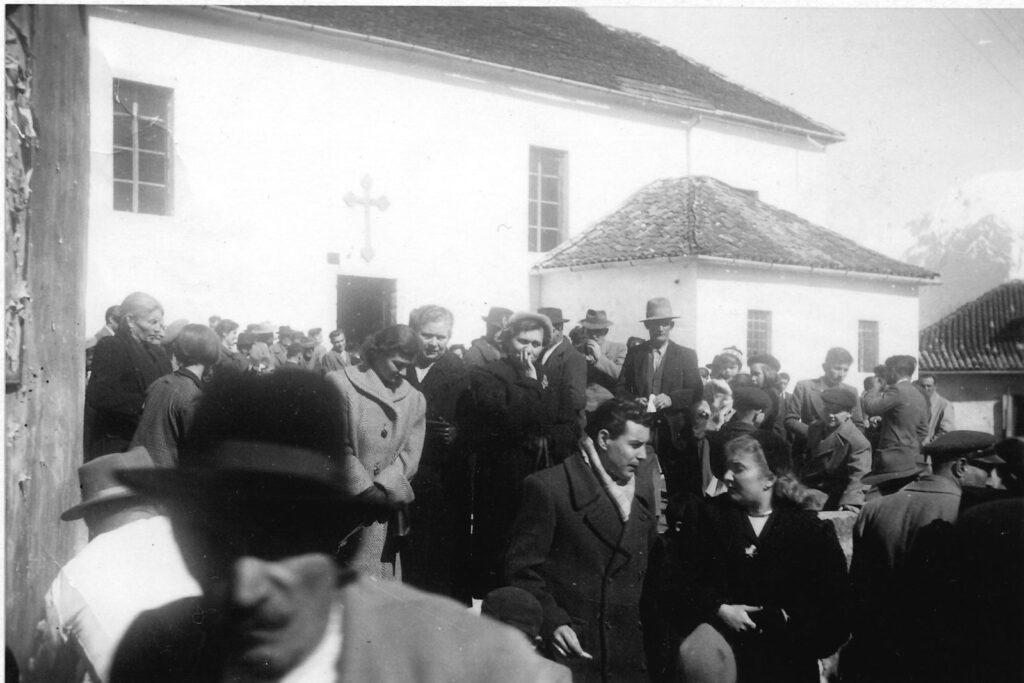
Whenever the Col Maòr announces a Mass, it almost always writes the same words: “in the parish church of Col di Salce”. There, every year, the Group remembered its departed members and the Fallen; there, in 2004, the exhibition for the Group’s fortieth anniversary closed with a Mass in memory of Mario Dell’Eva. And the churchyard, even more than the church, was the village square. The book devotes a whole page to it, “Sul Sagrato di Col” – on the churchyard of Col: the choir singing “Signore delle cime” during the tribute to the Fallen, parishioners celebrating in 2004 the fiftieth anniversary of Father Lorenzo Sperti’s ordination, and a photograph from 1938 taken as people came out of the “Mesa Granda”, the great Mass, all hats and heavy coats.
The war memorial stands in the churchyard too; the Col Maòr says so in 2020: “It stands on the churchyard of our parish church.” It is the memorial that the Group and the community wanted in the 1960s, bearing the names of all the fallen. There was not always a crowd around that stone. On 4 November 1970 an evening Mass was celebrated at Col di Salce, and a wreath donated by the Municipality was laid; the newsletter counted those present – the Group’s pennant, “16 (sixteen!) men, two women and two nuns” – and did not hide its bitterness: “Those who were there were truly disappointed.”
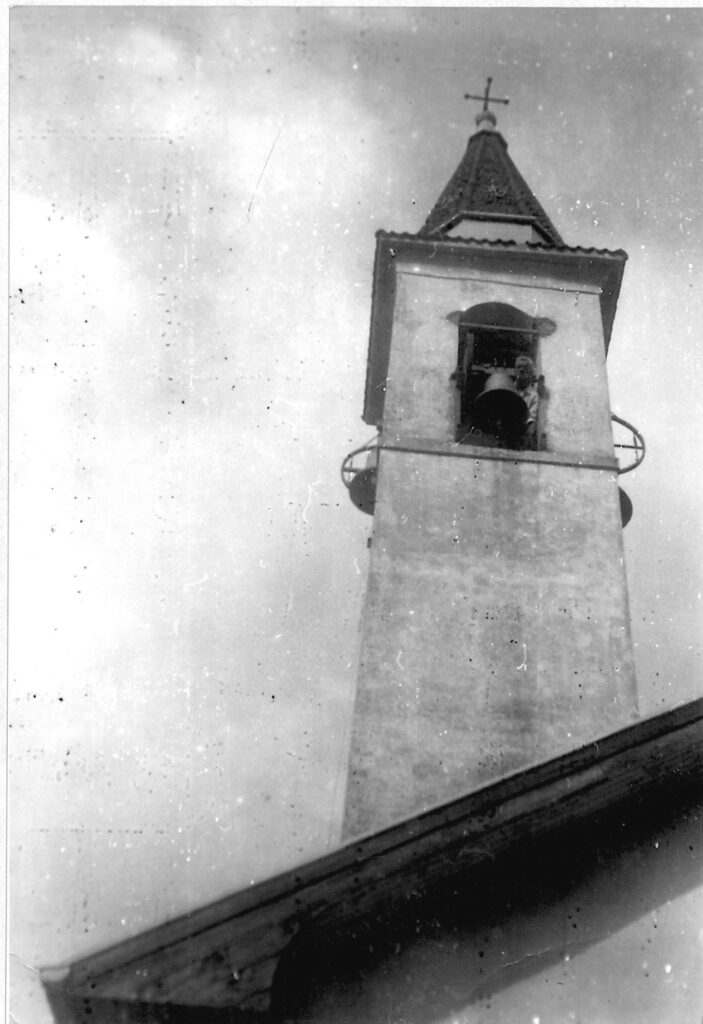
The bell tower has its own story. On 24 August 1974 the automated bells were inaugurated. The photograph, taken from below, catches Carlo Dal Pont, known as “Gambina”, leaning out to hug the bells he would never again ring by pulling the ropes. The book’s caption says it in a few words: “It is a farewell.”
The General’s villa
When in 1964 the Salce Alpini Group chose whose name to take, the reason began with four words: “Citizen of Col di Salce”. General Pietro Zaglio, former commander of the 7th Alpini Regiment, born in Verona in 1885, lived for many years at Col di Salce and died there in 1961. A newspaper of his day, reprinted by the Col Maòr, greeted his promotion to general by recalling that he had long honoured Belluno “with his residence in the small hamlet of Col di Salce”. And the first portrait the newsletter devoted to him, in 1964, fixes a precise image: “The sad days of 8 September 1943 found him in his villa at Col di Salce, ill and weary, but proud as ever.”
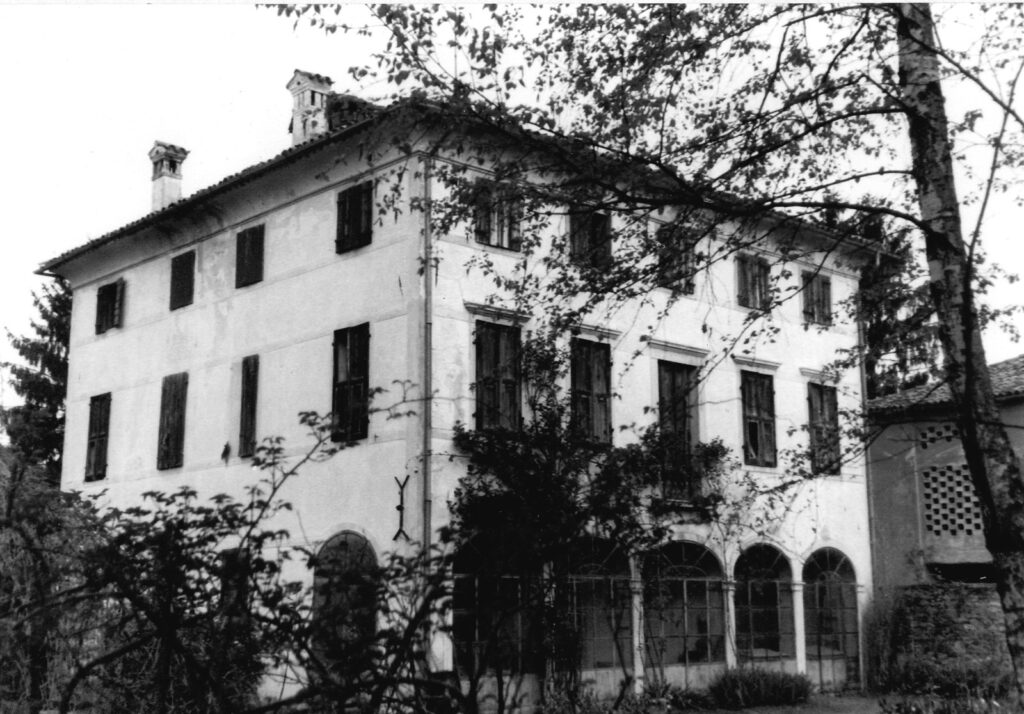
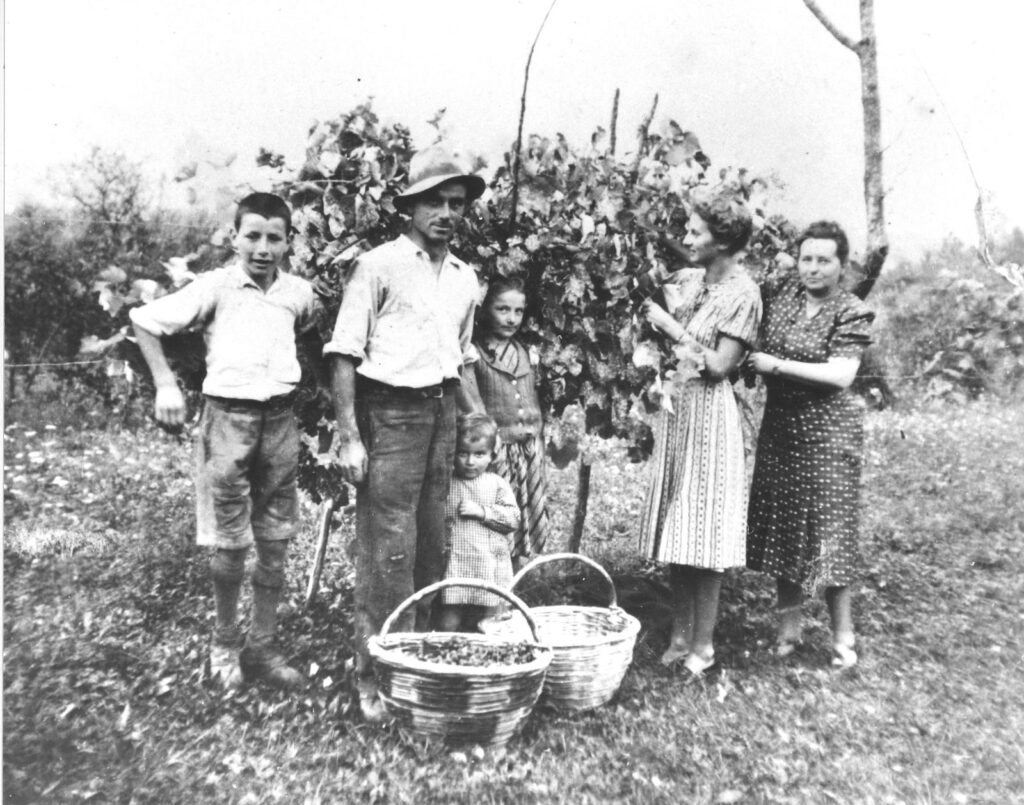
Around the villa turned the life of a country estate. In a photograph of the 1939 grape harvest, among the vines, we see the Bortots – Paolo, Zaccaria, Ottorina and Giovanni – beside Eugenia Zaglio, the General’s daughter, and Nella Prosdocimi Zaglio, his wife. Ten years later, in November 1949, the “Cortile dei Zaglio”, the Zaglio courtyard, was the setting for the wedding of Attilio De Salvador and Antonietta Bortot, with the parish priest Father Ettore Zanetti.
Writing in the Col Maòr in 2016, Paolo Tormen told the story of that “colonìa della famiglia Zaglio”, the Zaglio family farm, through Alba, the roan mare who worked there for almost twenty years with Rico, the sharecropper. Her stable, he writes, stood “right in the middle of the village, between the church, the bar ‘da Ciso’, al dugo dei sboc and the road that goes down to Nére”, so that she too, in her own way, took part in everyone’s life. A single sentence holds the whole geography of the village. In June 2012, in the farmyard of Villa Zaglio, a company of parents staged a comedy in dialect, “Quàtro Ciàcole in Cortivo”.
At Narciso’s, where the Group hung its sign
For many years the Salce Alpini Group had no home of its own. In 1964 the Col Maòr announced: “On the outside of the Bar ‘Da Narciso’, seat of our Group, the Group’s new sign has been put up.” A small cupboard was also promised to keep the pennant and the archive, and a year later a notice board to be set up in the bar for the members. Tarcisio Colbertaldo, “Ciso”, brother of Decimo, the future group leader, was one of the first auditors of the accounts; bookings for the outings were made with him, and in a dialogue printed in 1966 two old men of Salce end their chat with the usual conclusion: “’ndone a bere n’ombra su da Ciso?” – shall we go up to Ciso’s for a glass?
On 25 October 1964, after the year of mourning for the Vajont disaster, the Group could finally celebrate. The programme printed in the newsletter puts Col di Salce at the centre of everything: at 9.30 “assembly on the churchyard of the church of Col di Salce”, then the blessing of the pennant, Mass in the parish church, the wreath for the Fallen and the speech of thanks. The group leader was Giovanni Dal Pont. At 11.30, drinks “da Narciso”, in the first-floor room: “in pié come i cavai”, standing like horses, the programme warned, but in good cheer.
For more than twenty years, when the Col Maòr said “the seat”, it meant that place: in 1974 names for the outing were collected at “the Group’s seat – Bar of Col di Salce”, and that is where membership stamps were renewed, badges collected and coach seats booked. The newsletter itself started from there: Mario Dell’Eva closed the issues of the 1960s with his signature and a line, “Col di Salce, April 1966”, and the editorial address was the village’s own. But it was a makeshift arrangement, and at the end of 1985 the group leader called it plainly a “precarious seat”.
A first seat, at last
The turning point came in July 1987, and the newsletter greeted it in Latin: “Salce: habemus sedem!” Group leader Decimo Colbertaldo had signed a nine-year lease for “a little house at Col di Salce” – a home, the Col Maòr would recall many years later, “in the centre of Col di Salce”. The house needed complete renovation. The members did it themselves, on Saturdays and Sundays: among them Cesare Colbertaldo, Toni Tamburlin, Ernesto Barattin, Mario De Luca, Mario Dell’Eva, Ezio Caldart and Decimo himself.
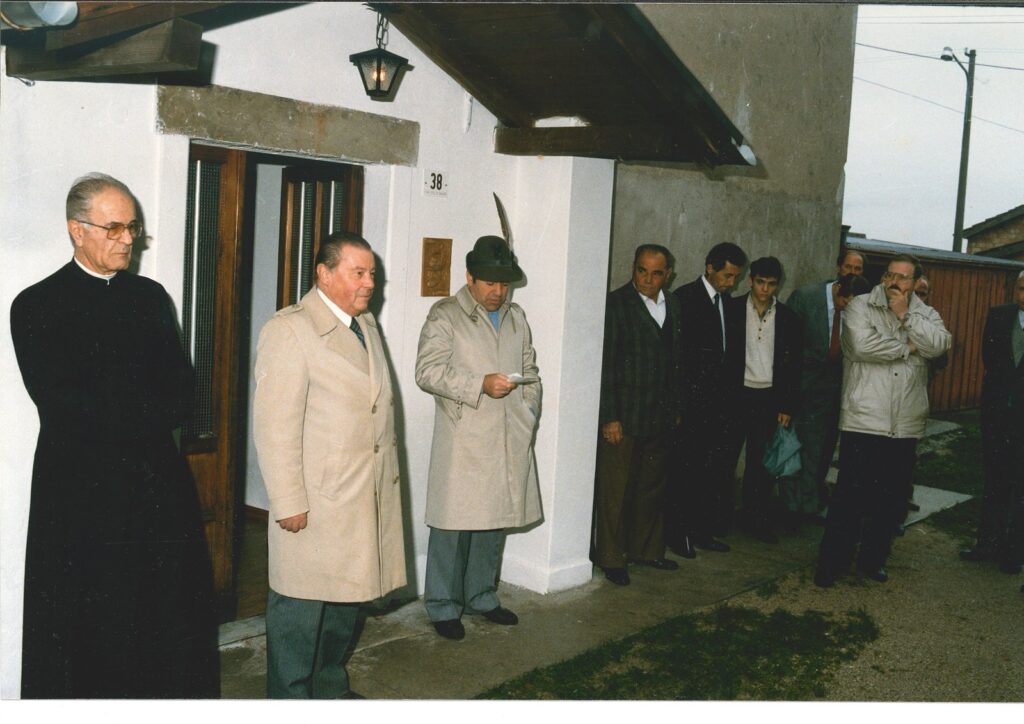
For Sunday 22 November 1987, after the Mass for departed members and the Fallen, the newsletter set the official opening; the December issue reported that the seat had been “inaugurated, blessed and opened to members”, together with those of the U.S. Salce Renault sports club, on Saturdays from 5 to 7 pm and Sundays from 10 to noon. The new group leader, Ezio Caldart, thanked those who had worked “to create our seat at Col di Salce” and urged everyone to use it. The following year the façade was smartened up by Cici Carlin, Carlo Colbertaldo, Celeste Sommacal, Toni Fratta, Giovanin Bortot, Mario De Luca, Italo Bertin, Bruno Boito and Decimo Colbertaldo. In 1995, in those rooms, the Salce Alpini returned the hospitality of their friends from San Damiano d’Asti, “in an evening of great cheer”.
That lease, says the 60th Anniversary Book, was not renewed when it expired. Meanwhile the idea of another seat had taken shape, built together with the U.S. Salce sports club, the Piave bowls club and the Salce blood donors: the associations that, with the Alpini, make up the “4 Stelle”. Today the Group is at home in Via del Boscon. But its first seat of its own, the one the Col Maòr still remembered in 2025, was a little house at Col di Salce.
A village that gathers
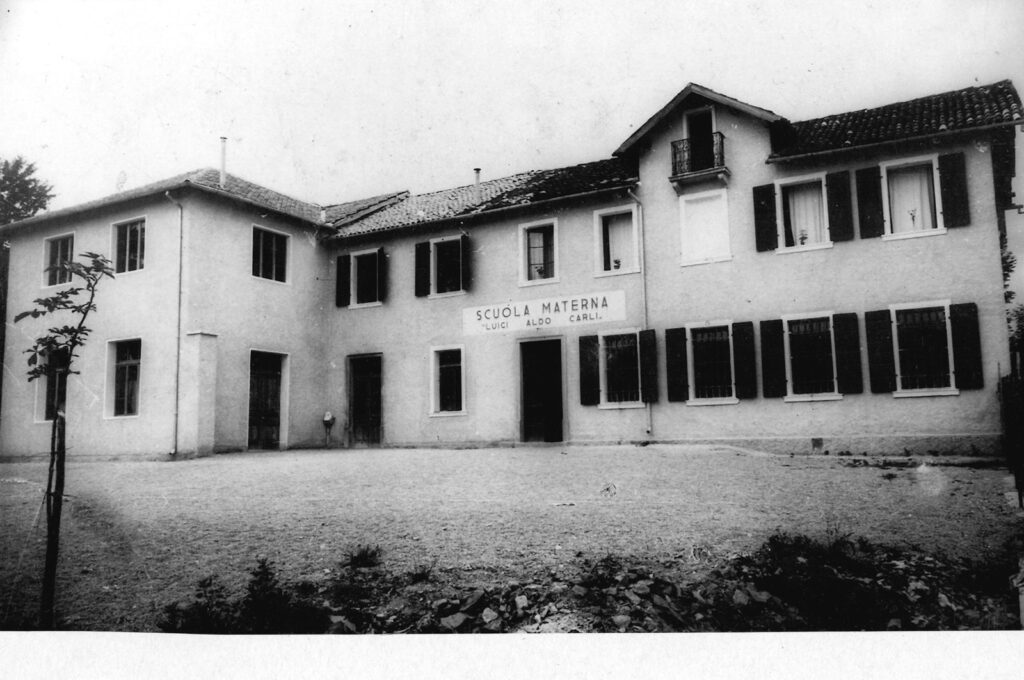
At Col di Salce, by the will of Marianna De Biasio, widow Carli, the “Luigi Aldo Carli” nursery school was built, named after her husband and her son Aldo, killed in April 1945. In November 1959 the Mayor of Belluno, Annibale De Mas, came to Col di Salce to open the new ring road and the school’s heating system. In the presbytery of Col di Salce, in 1965, the sports club that would become Salce Renault held its very first meeting.
For decades the coaches for the outings and the national rallies left from Col di Salce, often before dawn: “departure from Col di Salce at 4.30”. The Alpine Befana came to Col di Salce – in 1987 even by bicycle – and in January 2017 she still appeared on the churchyard, “affectionately escorted” by the Alpini, with stockings for the children. The San Bartolomeo cycle race, and later the San Bartolomeo cycling tour, passed through here: in 1988 it was Toni Tamburlin who received the trophy from Father Gioacchino Belli, with Mario Dell’Eva in the background. And in 1999 the restored fountains of Salce and Col di Salce were inaugurated, paid for by a collection among the people of both villages, after the Group had cleaned up the surroundings.
What remains
Between the 1920 postcard and the photographs of the sixtieth anniversary the village has changed: the bell-ringer has let go of his ropes, the lease on the little house was not renewed, the Alpini found a home in Via del Boscon. Yet leafing through the Group’s papers, Col di Salce remains the place where everything starts again. It is the churchyard where they gathered in 1964 for their first celebration, the name Mario Dell’Eva wrote at the bottom of the newsletter, the door in front of which Decimo Colbertaldo read out his thanks. Anyone who wants to find it again can start from that postcard: the field, the rising meadow, the bell tower at the top.
Key dates
| 1920 | Postcard “Nuova Veduta di Col di Salce presso Belluno” |
| 1938 | Crowd on the churchyard after the “Mesa Granda” |
| 8 September 1943 | General Pietro Zaglio is in his villa at Col di Salce |
| November 1949 | Wedding in the “Cortile dei Zaglio” |
| 1950 | The “Luigi Aldo Carli” nursery school has just opened |
| 1961 | General Zaglio dies at Col di Salce |
| 1964 | The Bar “Da Narciso” is the Group’s seat |
| 25 October 1964 | Official inauguration of the Group: assembly on the churchyard of Col di Salce |
| 4 November 1970 | Evening Mass and wreath at the war memorial |
| 24 August 1974 | Inauguration of the automated bells |
| July 1987 | Nine-year lease for the little house at Col di Salce, the first seat of its own |
| 22 November 1987 | Official opening of the seat |
| 1988 | Members smarten up the façade of the seat |
| 1999 | Restored fountains of Salce and Col di Salce inaugurated |
| 2012 | Dialect comedy in the farmyard of Villa Zaglio |
In the MEMORIA network
- General Pietro Zaglio, “citizen of Col di Salce”
- Decimo Colbertaldo, the group leader of the first seat
- Mario Dell’Eva, who signed the Col Maòr from Col di Salce
- Mario De Luca, Toni Tamburlin, Ernesto Barattin and Toni Fratta, at work in the little house
- A year of mourning, then the pennant: the 1964 celebration
- The Alpine Befana
- The Osteria Supani, another inn where Salce met
Sources
- Col Maòr no. 2/1964 (General Zaglio); nos. 3 and 4/1964 (Bar “Da Narciso”, programme of 25 October); no. 6/1965; no. 2/1966 and no. 6/1969 (signature and editorial address); no. 6/1970 (4 November); no. 5/1974 and no. 1/1976 (the seat at the Bar of Col di Salce)
- Col Maòr no. 1/1986 (the “precarious seat”); nos. 4, 5 and 6/1987 (“Salce: habemus sedem!”, opening and inauguration); no. 4/1988; no. 5/1995; no. 1/1999 (the fountains)
- Col Maòr nos. 1, 3 and 4/2005; no. 2/2009; no. 2/2011; no. 2/2012; no. 2/2016 (Paolo Tormen, “Alba”); no. 1/2017; no. 3/2020; no. 2/2025
- 60th Anniversary Book of the Salce Alpini Group (2024), pp. 28, 37, 42, 74, 92, 97, 102, 104, 108, 112, 117, 120, 128-129, 168


