
Agordo — the barracks a valley wanted for its Alpini
Agordo wanted the Alpini almost at once. As early as 1873, one year after the Corps was founded, the valley’s representatives wrote to the Ministry of War asking for a permanent unit. It took nearly ten years, but in the end the barracks came, and it was named after the day the Agordo valley rose against Austria: 22 March 1848.
A long wait
For the General Staff, Agordo was a border town: the frontier then ran little more than twenty kilometres away. Yet the road was long. The 24th Alpini Company, formed in 1874 and meant to spend its summers in Agordo, never arrived. In 1878 it was the turn of the 36th, later renumbered 34th, but it too was diverted to Belluno.
The 34th Company finally reached Agordo on 30 April 1882 and was housed in the old “Jesuits” barracks, today “Jacopo Tasso”. It belonged to the 10th Battalion in Conegliano, together with the 33rd in Feltre, the 35th in Pieve di Cadore and the 36th in Tolmezzo.
From the “Cadore” to the “Feltre”
The Royal Decree of 5 October 1882 created the first Alpini regiments, and battalions took the name of their recruiting area. Two companies stayed in Agordo, the 65th and the 66th, in the “Cadore” Alpini Battalion of the 6th Regiment. In 1886 the two Agordo companies moved to the new “Feltre” Alpini Battalion, white tassel, and from 1887 to the newly formed 7th Regiment.
The building on the east side was built precisely to house the second company, which would otherwise have gone to Feltre.
The barracks
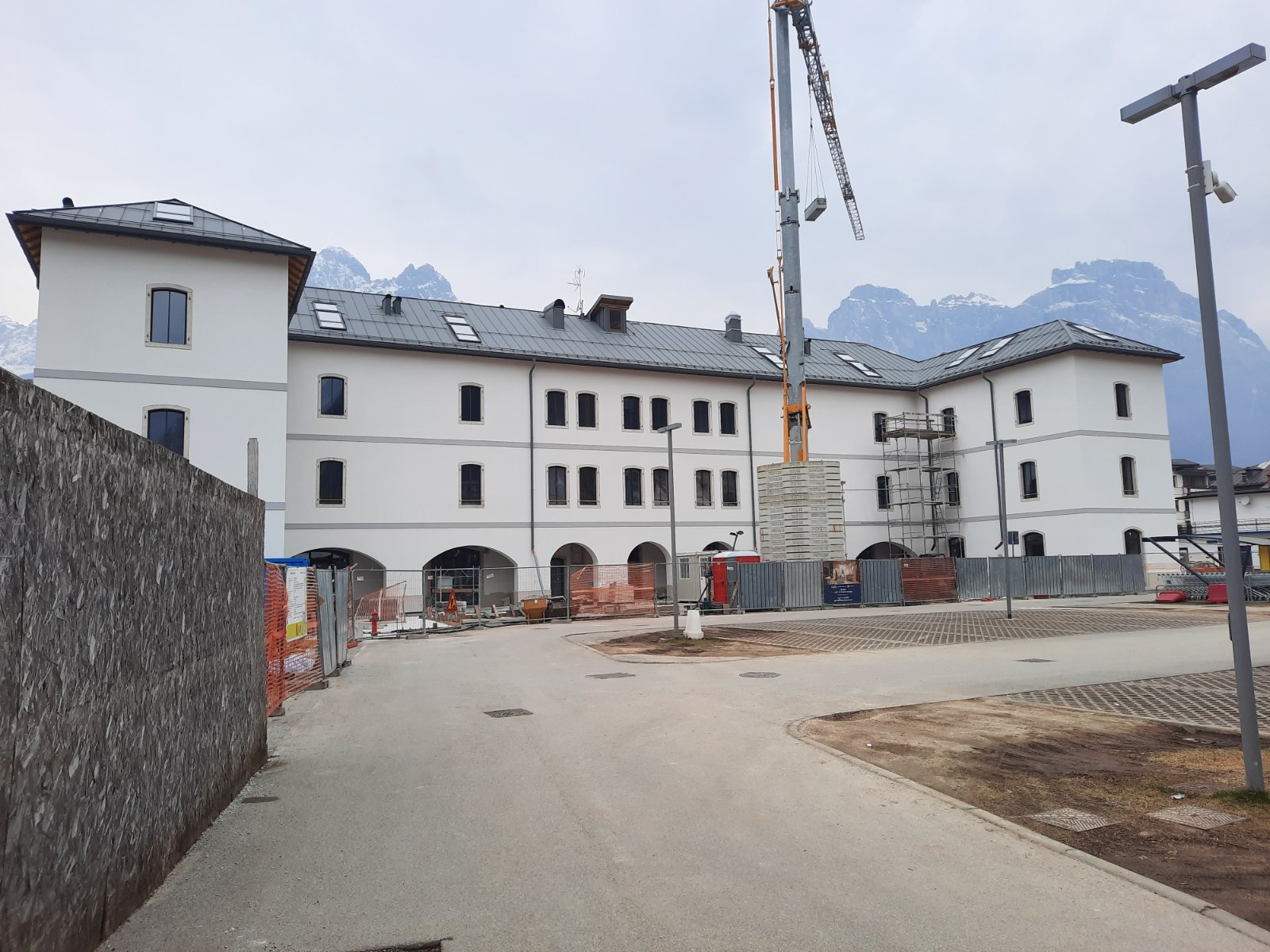
The complex was made of several buildings set along the boundary wall around a large parade ground. The main block, completed in September 1881, is a three-storey building with a C-shaped plan that held the orderly room, the guardroom and the dormitories. Towards the street it has tall, narrow windows aligned on every floor and, in the middle, the great arched gate. Towards the parade ground it opens onto a fine portico with three round arches in the centre and two lower arches on each side.
The other buildings came later: the officers’ club to the east in 1902, the storehouse, later stables, to the south after 1908, and the northern building later still. Since November 2003 the main building has been listed as a cultural heritage site.
The “Wolves of Agordo”
After the Second World War, around the turn of the 1950s and 1960s, the 65th Company of the “Feltre” returned for a short time to the place where it had been born more than seventy years earlier. From the early 1960s the barracks housed the 78th Company of the “Belluno” Alpini Battalion: the “Wolves of Agordo”, in the last years only as a detachment.
With the 1975 army reform the whole “Belluno” battalion was gathered at the “Tommaso Salsa” barracks in Belluno. From then on the Agordo barracks became a logistics and training base of the “Cadore” Alpine Brigade: a base for field camps and firing courses, home to the Meteomont staff, the brigade sports group and the Alpini training for the Alpine Troops ski championships. In 1995 it was finally abandoned.
Why “22 March 1848”
No document explains the choice of the name. The answer lies in the plaque in the entrance hall: 22 March 1848 is the day the Agordo valley rose against the Austrian authorities and army, in the year of the uprisings that swept across Italy and Europe. On 6 April Agordo and Cencenighe joined the Republic of San Marco, and on 11 April a tree of liberty was planted in Agordo. For those days, by Royal Decree of 4 August 1906, Agordo received the Medal of the Cities Deserving of the Risorgimento.
The barracks today
The area has changed. The main building has been restored and turned into homes. To the east, on the site of some outbuildings and of the former Parissenti works, a supermarket has been built, and the parade ground is now its car park. There are plans for a space in the main building dedicated to the “Wolves of Agordo”, with photographs and mementos of the 78th Company, the last unit stationed there.
“The Wolves of Agordo.”
Sources of this story
The history of the barracks was told by our board member Oscar Colle in the series “Le caserme degli Alpini” of the Col Maòr, in two instalments: no. 1/2025, pp. 10-11, and no. 2/2025, pp. 10-11. For the period up to the 1920s the author refers to the book by Gino Sorio and Antonio Zanetti, “Notizie storiche sulla caserma ‘22 marzo 1848’ di Agordo”, published by the Municipality of Agordo with the Comunità Montana Agordina in 1994. The photograph at the top, the barracks today, was published in no. 2/2025.
Did you do your national service in Agordo, among the “Wolves” of the 78th? Your photographs and memories can help complete this page.


