MEMORIA PROJECT · An Alpino from Seren on the Piccolo Cauriol
An Alpino of the 7th Regiment, born in Seren, killed on the Cauriol on 19 October 1916 while shielding his lieutenant. Silver Medal of Military Valour, awarded posthumously. A small saddle in the Lagorai once bore his name.
Some mountains seem made for waiting. The Cauriol is one of them. It stands on the border between the Val di Fiemme and the Vanoi, dark with porphyry, its points rising one after another as if someone up there had lined them up to stand guard. Whoever climbs from the hut in summer finds cows at pasture, cowbells, water running down the Val Sadole. Then the forest thins out, the path turns to stone, and at some point you realise you are walking through something that never quite ended.

Among those rocks there is a small saddle. The Alpini who knew it called it Forcella De Cet. It is not the name of a peak, nor of a saint. It is the name of a soldier.
A clipping from 1920
In September 1920 the war had been over for less than two years. Those who were coming home had come home, and the villages were counting the empty places. On 5 September L’Alpino, the newspaper of the Association founded only a year earlier, printed on page five a short account signed with a pen name, El Vecio, “the old one”. Its title was a date: “19 Ottobre 1917”.
El Vecio writes like someone who was there. To him the Piccolo Cauriol is an “enormous black ridge, all sheer spires”, a Milan Cathedral blown up beyond measure and painted with tar. Behind every spire there is a sniper. At 4.30 p.m. the order to attack comes, and the men of the scout platoon leap out from the Cauriol saddle: five hundred metres of rough ground, under fire that seems to make the stones boil.
Then comes the moment for which the story was written. An Austrian, a few paces away, aims his rifle at the lieutenant leading the Alpini. Private De Cet Giovanni, from the Feltre area, sees it. He throws himself in front of his officer and shouts, in the language of home: «Tenente, attento, i lo copa» — “Lieutenant, look out, they’ll kill him”. They kill him instead. The bullet strikes him in the forehead. The lieutenant lives.
The ending is two bare lines. The Silver Medal of Military Valour was decreed to his memory, and the saddle where he fell, El Vecio writes, “is today called Forcella De Cet”.

The article “19 Ottobre 1917” signed El Vecio, in L’Alpino of 5 September 1920, nos. 17–18, p. 5. Historical archive of L’Alpino (in Italian), Gruppo Alpini Salce.
One year out
Anyone who read that page believed the date, and it was natural to believe it. But memory, even the most honest, sometimes moves things by a step. The official records say something else.
In the list of Alpini decorated in 1916, compiled by the Associazione Nazionale Alpini from the military bulletins, his entry is there among hundreds of others. Giovanni De Cet, service number 12571/77, Alpino of the 7th Regiment, born in Seren del Grappa. Silver Medal of Military Valour, posthumous. Place: Monte Cauriol. Date: 19 October 1916. The decree awarding it is dated 2 August 1917.
The day and month were right; the year was not. Four years had passed between the event and the account, and four years of war and aftermath bend time. The substance did not bend. The official citation describes the same scene in the dry words of the bulletins: among the first to reach the enemy trench, De Cet had stood up on the parapet and with hand grenades had stopped the first and fiercest attack; then, seeing that the enemy had taken aim at his officer, he shielded him with his own body and fell.
Two different sources, four years apart, tell of the same act. In a war of millions of names, it is rare for a private soldier to be remembered so precisely. In some rolls of the fallen the surname appears written as one word, Decet, with a second name: Bernardo.
The Feltre battalion’s mountain
To understand where Giovanni died, we must go back a few weeks. On 27 August 1916, at 7.50 p.m., after three assaults had been thrown back, the Alpini of the Feltre and Monte Rosa battalions took the summit of the Cauriol, 2494 metres high. A few metres below the top, Second Lieutenant Attilio Carteri had fallen, and the saddle between the two summits still bears his name. The song named after the mountain, still sung by Alpini choirs, dates from those days.
But the summit was not enough. To the west, a spur just under 2400 metres high had stayed in Austrian hands: the Piccolo Cauriol. From there, from machine guns dug into the rock, the enemy kept every movement under fire. All autumn long the Alpini tried to take it. 19 October was one of those days.
In the same list, next to De Cet, are other Alpini of the 7th decorated for the Cauriol that October: Giovanni Dal Farra, Valentino Dalle Mule, Guerrino Pianezze, Pietro Scarton, Giuseppe Taverna, Vittore D’Ambros. They are our own surnames, names still heard around Feltre, at the foot of the Grappa, along the Piave. Of Scarton the citation says that, wounded, he kept throwing grenades and stones with the arm he could still use.

Seren, before the uniform
We do not know Giovanni’s face. We do not know what work he did before he left, whether someone was waiting for him at home, whether he wrote letters or could not write at all. We know he was born in Seren, the village at the foot of the Grappa a few kilometres from Feltre, and that the newspaper called him “feltrino”, as everyone from that basin was called.
And we know how he spoke. At the greatest moment of his life he did not shout a phrase fit for a monument. He shouted four words in dialect, the same he would have used to warn a friend of a stone tumbling down the scree. I lo copa. They’ll kill him. He did not think of himself: he thought that they were about to kill someone else.
He was an Alpino like so many, one of the young men the 7th Regiment called up from its valleys. That is exactly what makes his act so great. No one had ordered him to do it.

What remains up there
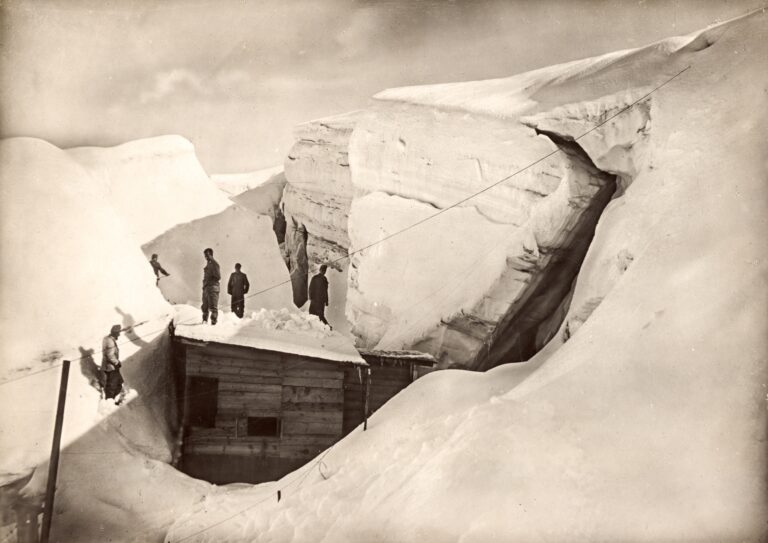
The Cauriol front was abandoned at the end of October 1917, after Caporetto. The Italians came down and the mountain returned to its silence. On its slopes, in little more than a year, thousands of men had died, many from cold and avalanches rather than enemy fire.
Whoever climbs today from the Rifugio Cauriol along the old military road finds, at the start of the path, a 305-millimetre Austrian mortar shell turned into a memorial stone, “on the 50th anniversary of the Battle”. At the Passo Sadole there are still trenches, dry-stone walls, rusty barbed wire. Higher up, a half-collapsed tunnel. On the summit, a cross and the plaques to the fallen.

The Forcella De Cet, on the other hand, is not on today’s hiking maps. The saddle crossed before the summit bears Carteri’s name, and Giovanni’s seems to have survived only in the memory of those who fought up there and in the pages of an old newspaper. Some enthusiasts who have walked those paths believe his saddle is there, among the rocks facing the Piccolo Cauriol. Finding it, with a military map of the time in hand, is a task the MEMORIA project would like to take on. If any of our readers keeps a map, a photograph, a letter from those years, showing it to us would be a gift, to us and to him.

A name that waits
Perhaps a mountain needs no signposts to remember. The spires of the Piccolo Cauriol are still there, black as El Vecio saw them. In the evening, when the sun leaves the Lagorai and the shadows climb back up from the Val Sadole, those who linger up there may feel that someone is still standing guard: a young man from Seren, upright on the parapet, his eyes on his lieutenant.
That day the lieutenant lived. We do not know his name, nor how many years that shout gave him. We know that on the mountain there is a name waiting to be called. Giovanni De Cet, Alpino of the 7th, one of ours. Present.
Sources
- El Vecio, «19 Ottobre 1917», L’Alpino, 5 September 1920, nos. 17–18, p. 5: issue page (in Italian) and PDF.
- Associazione Nazionale Alpini, Alpini e Artiglieri da montagna decorati nella Grande Guerra 1915-1918. 1916, entry “Giovanni De Cet” (D.Lgt. 2 August 1917, B.U. 1917, disp. 59, p. 4934): PDF on the ANA website.
- Trentino Grande Guerra, Monte Cauriol.
- Pietri Grande Guerra, Monte Cauriòl – Lagorai.
- DolomitiBelluno, Monte Cauriol: walking in the footsteps of the Feltre battalion.