ALPINI MEMORY · 1919–1933
From the first newspaper printed in Udine to the 85,000 copies reported in 1933: a story of veterans, memory and belonging, told through two portraits by M. Genua.
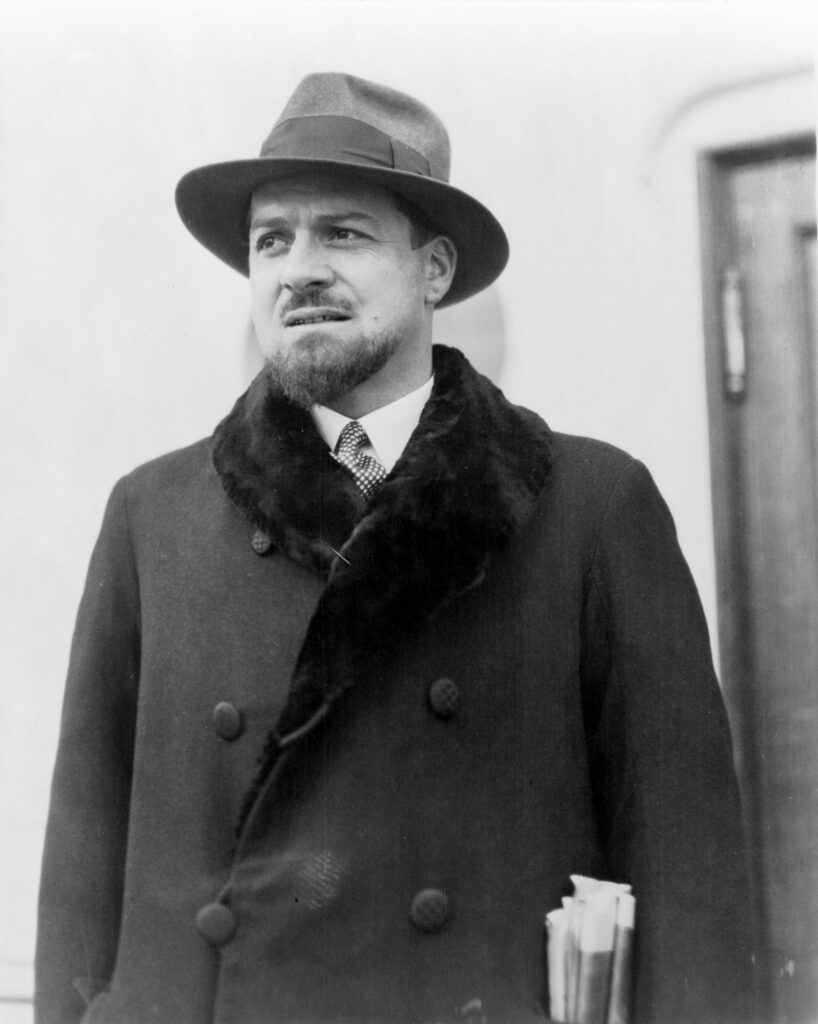
Some pages tell a story before we even read them. In its 1 January 1933issue, L’Alpino places two men wearing the distinctive feathered Alpini hat side by side: Italo Balbo and Angelo Manaresi. The drawings, signed by M. Genua, have two brief captions: “Il Fondatore de ‘L’Alpino’” – the founder of L’Alpino – and “Il Continuatore”– the man carrying the work forward. Those words suggest a thread: an idea conceived among soldiers still on active service had grown into a newspaper reaching a broad Alpini community.
To follow that thread, we must return to 1919. We must also remember that between Balbo and Manaresi came other men, other editorial teams and almost nine years of work.
Udine, 1919: a newspaper for the Alpini
The first issue of L’Alpino appeared in Udine on 24 August 1919, within the setting of the 8th Alpini Regiment’s depot. Lieutenant Italo Balbo, Lieutenant Enrico Villa and Second Lieutenant Aldo Lomasti, who oversaw the first editorial work, were involved in the initiative. Balbo actually took over as editor with the fourth issue, dated 14 September. [1]
The newspaper and the Associazione Nazionale Alpini, the National Alpini Association founded in Milan on 8 July that year, therefore began independently. Their affinity soon became apparent: the ANA welcomed the new publication, which would go on to become its voice. [1]
Villa’s recollections also give the founding a practical, modest flavour: an idea discussed among comrades, the search for advertising and the problem of paying the printer. His account portrays an editorial team whose enthusiasm had to become paper, ink and balanced accounts. [2]
The pages did not focus solely on wartime exploits. They also addressed veterans’ difficulties, assistance payments, disability and official recognition. Memories of the units stood alongside the needs of men returning to civilian life. [1] Here lay a fundamental purpose of the newspaper: to give the Alpini a place where they could still recognise themselves as a community, even far from the barracks.
Demobilisation and the early years in Milan
The first Udine period lasted eleven issues. Then a straightforward difficulty arose: the editors themselves were due to be demobilised. The newspaper born within the military risked dispersing with the men who had created it.
The transfer to the ANA made it possible to continue. The new series appeared in Milan on 5 January 1920, as Year II, Issue 1, with its office at 8 Via Silvio Pellico. The depot’s small newspaper was thus becoming an association publication with a national reach. [3]
That continuity was not the work of a single editor. The newspaper’s chronology records several editorial teams and people in charge between 1920 and 1928; Arturo Andreoletti was editor for the first five months of 1928. Manaresi took over in June of that year. [4] The word “continuatore” in the 1933 drawing therefore expresses an inherited idea, rather than an immediate handover.
Manaresi: preserving the idea, extending its voice
When Angelo Manaresi became editor in June 1928, L’Alpino already had a history as an association newspaper. The official chronology records his editorship as lasting until August 1943. [4] His was therefore a long tenure, during which the newspaper accompanied the Association’s activities.
This was not simply an editorial succession, however. Manaresi took charge of the ANA as commissioner in 1928, as the fascist regime brought veterans’ associations within its structures. The ANA’s historical account describes the organisation’s transformation and the military language imposed on association life. [6] The newspaper of 1933 also openly reflects that political setting.
Yet the original thread remains visible within this history: speaking to the Alpini, collecting their memories, circulating news and maintaining links between men scattered across the country. The term “continuatore” can be understood in that sense: Manaresi did not reinvent the newspaper, but kept alive its role as a means of connection and belonging.
Success recorded in the masthead
The issue of 1 January 1933 provides concrete evidence. At the top, beside the names of the founder and editor, appear the words “Tiratura copie 85.000”– a print run of 85,000 copies. The masthead describes a fortnightly newspaper of the Associazione Nazionale Alpini, free to members and available by subscription to other readers. [7]
This gives a measure of the scale achieved during Manaresi’s editorship. The figure needs to be read correctly: the stated print run refers to copies printed and does not, by itself, establish how many were sold or actually read. Nevertheless, it documents a national scale, far removed from the experiment begun in a military depot.
In the same issue, the article Bilancio numerico, signed by General Baldino, reports 70,000 Alpini members at the end of 1932. This is another contemporary figure, relating to the ANA and separate from the newspaper’s print run. The issue also opens with Manaresi’s Saluto al Bocia!and announces the Alpini gathering in Bologna in spring 1933. [7]
These items show the newspaper at work: a greeting to readers, an account of the Association and an event that could bring them together. Its success lay not only in the number printed in the masthead. It also lay in its ability to give Alpini community life a shared rhythm.
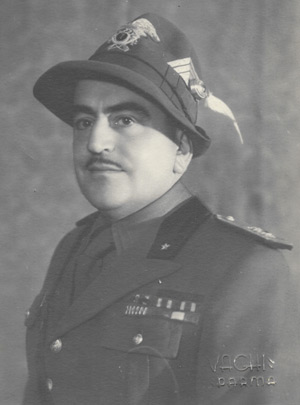
Angelo Manaresi, president of the A.N.A.
A childhood friend of Paolo Monelli, Manaresi served alongside him in the First World War. An inguinal hernia had initially made him unfit for military service, but he underwent an urgent operation so that he could volunteer for the front.
Serving in the Feltre Battalion of the 7th Alpini Regiment, he took part in the celebrated capture of Monte Cauriol on 27 August 1916. On that summit he wrote the famous “vecio can” decalogue, named for the seasoned Alpini veteran: a set of “laws” devised specifically for the men of the black feather.
After the war he resumed his work as a lawyer. He served in the Italian Chamber of Deputies from 1921.
On 28 June 1928 he was appointed Extraordinary Commissioner of the Associazione Nazionale Alpini, becoming its president on 15 May 1929.
From September of that year until July 1933 he served as Undersecretary at the Ministry of War.
After the fall of Fascism, he returned to practising law, although his deepest affection remained with the Alpini and his local section.
A voice that outlasts its founders
Seen today, Genua’s two drawings also offer a small lesson in how a newspaper tells its own story. In 1933 the publication chose to represent its history through two faces: the man who began and the man who continued. Between those faces, however, stand the other editors, contributors, sections and readers who made continuity possible.
The idea of 1919 proved enduring: after the war, a bond formed within military units could find a new home on printed pages. Manaresi helped preserve and enlarge that home. The 85,000 copies reported in 1933 are a tangible sign of it.
That is why preserving these pages still matters. Not simply to recognise a famous name or a face, but to understand what united the Alpini, what changed them and the times in which they lived. A newspaper becomes a source of memory when it allows us to hear both.
Browse the original document: L’Alpino · 1 January 1933 · Issue 1, in the Gruppo Alpini Salce historical newspaper archive.
Sources and image credits
- ANA, 24 August 1919: the first Alpini newspaper appears in Udine.
- ANA, Come nacque L’Alpino, a recollection by Enrico Villa. The date of the first issue follows the chronology of 24 August 1919; the retrospective account gives a different date.
- ANA Udine, The history; ANA, It was 17 July 1920.
- L’Alpino, The editors.
- Aldo Berselli, Balbo, Italo, Biographical Dictionary of Italians, Treccani.
- ANA, Leadership during the Fascist era.
- L’Alpino, 1 January 1933, Year XV, Issue 1: masthead, Saluto al Bocia! and Bilancio numerico, p. 1; drawings by M. Genua, p. 2. The numerical figures are those reported in the document.
- Italian Chamber of Deputies, Angelo Manaresi.
- ANA, The presidents.
Images. The two drawings are reproductions cropped from the original page, without generative reconstruction: M. Genua, L’Alpino, 1 January 1933, p. 2; copy held in the Gruppo Alpini Salce historical newspaper archive. The photograph of Balbo comes from the Library of Congress George Grantham Bain Collection, identified on Wikimedia Commons as having no known copyright restrictions. Manaresi’s portrait comes from the ANA website. The cover photograph is from Archivio Luce.