

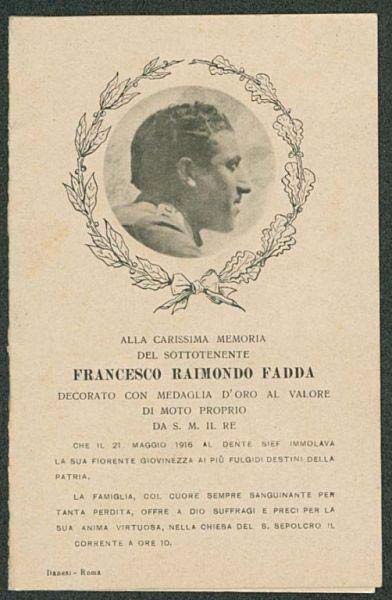
A student at the “Pietro Martini” Technical Institute in Cagliari, second lieutenant in the 46th Infantry Regiment of the “Reggio” Brigade, posthumously awarded the Gold Medal of Military Valour. He fell on the Dente del Sief on 21 May 1916, aged twenty-two.
From Tempio to Cagliari
Francesco Raimondo Fadda was born in Tempio Pausania on 28 October 1893, the son of Francesco Fadda Garzia and Violante Pedroni. He spent his childhood in Gallura; the family then moved to Cagliari, where his father worked for the Banca Commerciale. He studied at the “Pietro Martini” Technical and Nautical Institute and in 1914 obtained his diploma in the physics and mathematics section.
On 31 December 1914 he enlisted as a volunteer and attended the officer-cadet course of the 84th Infantry in Florence. On 15 July 1915 he was commissioned second lieutenant in the 46th Regiment of the Reggio Brigade, made up largely of Sardinians, and was assigned to the 2nd Battalion.
On the Tofane and at Col di Lana
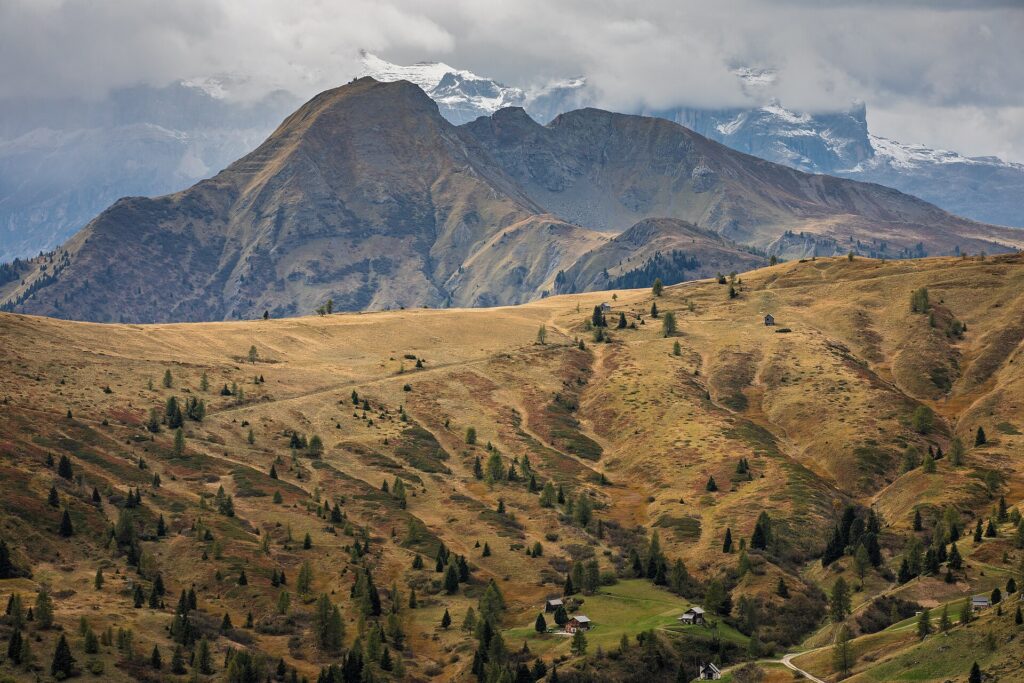
He joined his regiment on the Tofane, above Cortina d’Ampezzo. He fought for the pinnacles overlooking the Forcella di Fontana Negra and in the October 1915 offensive towards Col di Lana, when the regiment helped to take the Valparola basin. The fighting took place above two thousand metres, in frost and blizzards, against heavily fortified positions.
Dawn on 21 May 1916
A month after the mine on Col di Lana, the Reggio Brigade returned to the attack on the Sief–Settsass ridge. At dawn on 21 May Fadda was ordered to take the Austrian outpost on the Dente del Sief. He fell upon the enemy posts, captured their defenders and opened the way for the supporting platoons. Beside him a unit of volunteers from the 45th was led by Lieutenant Ignazio Salaris, who was also killed that day.
Pushing forward under the small redoubt to overcome the last resistance, Fadda was hit first by a hand grenade, which tore away half of one hand, and then by a shell that severed both his legs. According to the citation he refused to be carried back and went on urging his men until he saw the position taken. The diary of Adone Nostri, an officer of the 62nd sapper company published by Luciano Viazzi, describes his end in far crueller detail: the distance, often found, between the language of decorations and that of those who were there.
The citation
The Gold Medal was granted in July 1916 on the King’s own initiative. He was one of the first Sardinians to receive it.
“At the signal to attack, he rushed resolutely forward at the head of his men and was the first to reach the enemy position, which he managed to occupy after a bloody and fierce struggle. Struck by a grenade that tore away half of one hand with three fingers, and then by a shell that severed both his legs, with an admirable sense of duty, aware of the supreme need not to interrupt or weaken the violence of the assault at that moment, he refused to be carried away, continuing to spur on his men and pointing to the coveted goal. After he saw it reached with a last effort, serene for the work accomplished, fully conscious, he died on the spot, maintaining to the last a strong and heroic bearing.”
Dente del Sief, 21 May 1916
Where he is remembered
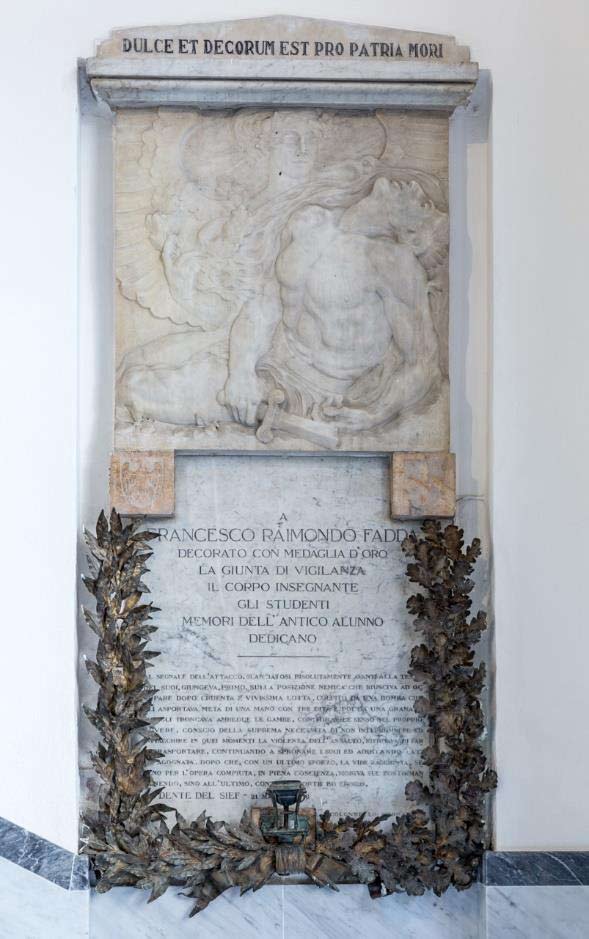
He rests in the military shrine of Pian di Salesei, in Livinallongo del Col di Lana, built in 1938. In the entrance hall of his school, the Martini Institute in Cagliari, a bronze and marble plaque by the sculptor Andrea Valli, showing a dying soldier crowned by Victory, commemorates him. In Tempio Pausania the “F. Fadda” barracks bore his name, and his name is carved on the town’s war memorial. The centenary of his death was commemorated on 21 May 2016.
The other heroes of the Sief
His story is intertwined with those of Ignazio Salaris and of Riccardo Bajardi, who fell on the summit of the Sief in September 1917. The pages The Heroes and Heroes of Belluno gather the other Gold Medals remembered by our Group.
Sources
- R. Salis, Il ricordo degli studenti sardi: il caso delle lapidi dell’Istituto Tecnico Pietro Martini, “Grande Guerra” project, ICCD 2016, CC BY-SA licence (in Italian).
- G. Carolei, G. Greganti, G. Modica (eds.), Le Medaglie d’oro al Valore Militare dal 1915 al 1916, Rome 1968, p. 170, as quoted by ANCFARGL (in Italian).
- L. Viazzi, Col di Lana monte di fuoco 1915-1917, Mursia, Milan 1998.
- Historical summary of the Reggio Brigade (in Italian).


