
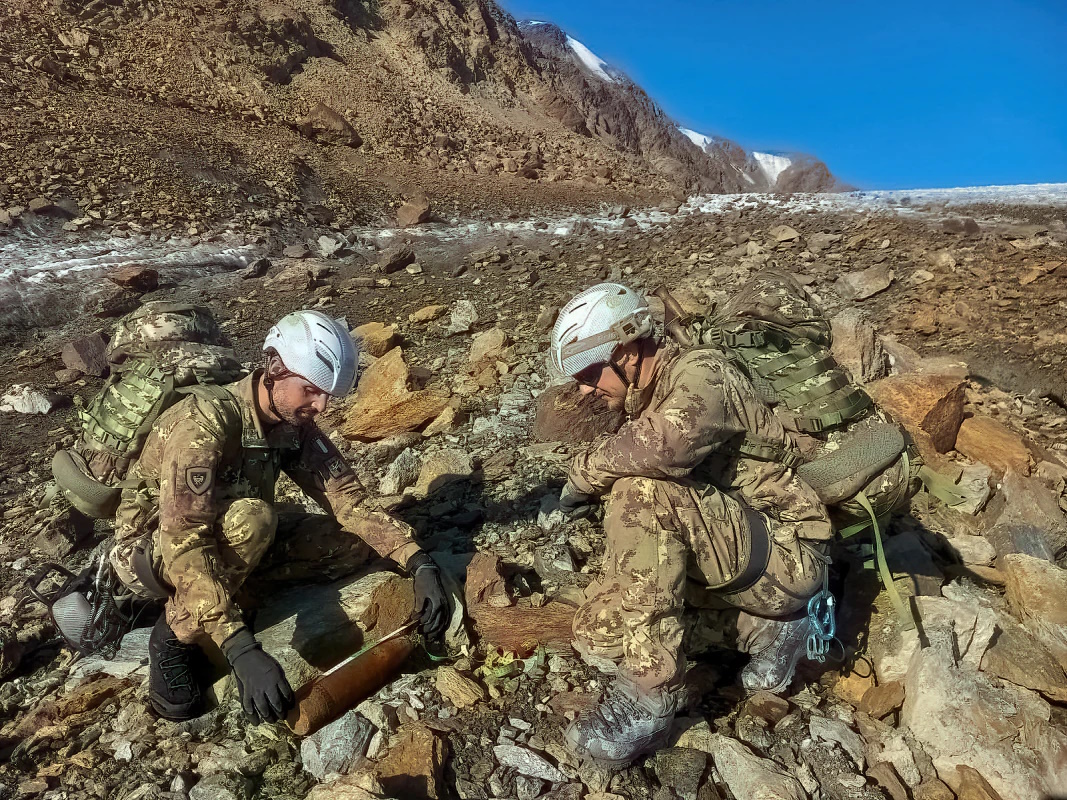
There are wars that end with a signature on a treaty, and wars that never entirely end. The First World War ended in November 1918, yet in the Alps it continues to leave physical traces: a metre less snow, a tongue of ice retreating, a scree slope shifting, and out of the mountain comes something that was fired more than a century ago and never exploded.
They are not relics. They are live munitions. And every summer someone has to go and retrieve them, one by one, wherever they lie: at three thousand metres, on the ice, on the moraines, in places no road reaches.
More than two hundred devices in a few weeks
The news was announced by theAssociazione Nazionale Alpini (National Alpini Association) through its periodical L’Alpino: over the past two weeks Army bomb-disposal experts have found and defused more than 200 explosive devices dating from the First World War. This is the latest progress in the campaign to clear wartime ordnance at high altitude that the Alpine Engineers carry out every year during the summer window, the only period in which it is possible to work in those environments with an acceptable margin of safety.
It is not an isolated figure: it is the ordinary pace of a task that has been repeated for decades and that, season after season, keeps producing the same numbers. The war fought at altitude meant an enormous quantity of materiel carried to places it should never have reached, and part of that materiel is still up there.
Where the sappers worked
The areas covered by the operations are all in Trentino-Alto Adige, on the massifs and glaciers of the western sector of the Italian Alpine arc. These are not the Dolomites, and the point is worth making: they are different mountains in their geology, their history and the shape of the front line.
- Carè Alto and the Vedretta di Lares, in the Adamello-Brenta area, in the province of Trento;
- Val Martello, in the province of Bolzano, on Cima Tre Cannoni;
- the Stelvio area, on the fringes of the Livrio glacier.
These are the places of the so-called White War: the highest front in Europe, where Italians and Austro-Hungarians faced each other for years above three thousand metres, hauling guns, ammunition and men up to altitude by means that seem scarcely credible today.
What is resurfacing
The material recovered is typical of that front: artillery shells of various calibres, hand grenades and other items, of both Italian and Austrian manufacture. Material more than a hundred years old, but not inert for all that.
As to why it is coming to light precisely now, it is best to be precise and not to oversimplify. The operations take place, as the source records, amid melting glaciers and scree slopes: the retreat of the ice and the movement of the slopes expose what was buried. But the finds also depend on where people search, how much they search and how many people frequent those altitudes today. Glacial melting is a documented factor; it is not the only explanation, and automatically attributing every find to it would mean claiming more than the data allow.

The 2nd Alpine Sapper Engineer Regiment
The work is carried out by the bomb-disposal specialists of the 2nd Sapper Engineer Regiment of the “Julia” Alpine Brigade. It is a unit that combines two skills that rarely go together: technical knowledge of explosives and the mountaineering ability to get all the way up there carrying equipment, procedures and responsibility.
A bomb-disposal expert in the lowlands works on a building site, in a ploughed field, in a cellar. A bomb-disposal expert of the Alpine Engineers must first reach the device: on a glacier, on rock, often by helicopter to a landing point and then on foot. And he must do so knowing that the object he is about to deal with is, by definition, unstable.

Working at three thousand metres
The difficulties are not only technical. The useful window is short and coincides with the summer, when the winter snow has withdrawn and the slopes can be crossed. Weather at altitude changes within a few hours. The ground is unstable: the moraine shifts, the ice opens, the scree slides. Every operational phase must be planned in advance, because improvising at those altitudes is not an option.
The devices located are made safe and, where possible, brought down to the valley to be destroyed at suitable sites. When moving them is too risky, they are dealt with on the spot. It is slow, repetitive and invisible work, which makes no news except when the totals for a season are added up.

A chain of cooperation
None of these operations is the work of a single unit. Working alongside the sappers are:
- the helicopter unit of the Army’s 4th AVES (Army Aviation) Regiment “Altair” , based in Bolzano;
- the Helicopter Unit of the Permanent Fire Brigade Corps of the Autonomous Province of Trento;
- resources of the Civil Protection of the Autonomous Province of Trento;
- the Military Corps of the Italian Red Cross;
- the teams of the Guardia di Finanza Alpine Rescue.
Every phase is planned by the Army’s Northern Territorial Command , stationed in Padua, and coordinated with the Government Commissariats for the provinces of Trento and Bolzano. It is, in miniature, the model that is always invoked whenever mountains are discussed: no one can do it alone, and safety is a chain in which every link is worth as much as the others.

The mountain as a physical archive
There is a way of looking at these finds that goes beyond the news. The Alpine range is, in effect, the largest physical archive of the Great War. It preserves not only documents: it preserves objects, positions, communication trenches, the remains of huts, cables, pitons, pylons. And it also preserves what that war left behind that is dangerous.
It is an archive that cannot be consulted in a reading room and that, unlike a document, can wound. That is why the sappers’ work does not contradict memory: it is part of it. Whoever makes a mountainside safe makes it possible for people to keep climbing, telling stories and remembering on that mountainside.
We have written about that ability to carry the impossible up to altitude in our account of the cableways of the Great War and the Italian ingenuity that conquered the mountains: the same lines that carried the guns up are the reason why shells are still found up there today.
And Belluno?
The operations we are describing did not take place in the Belluno area: they took place in Trentino-Alto Adige, and that should be stated clearly. But there is a connection, and it is of two kinds.
The first is historical. The Belluno area was itself both front line and rear area, and its mountains tell of the same war fought at altitude: this is the subject of our section devoted to the First World War. The Great War trails that cross the Belluno Dolomites are walked by thousands of hikers every summer, and the safety rules described above apply there in exactly the same way.
The second is one of tradition. Belluno is an Alpini city and home to the 7th Alpini Regiment, part of the same “Julia” Alpine Brigade to which the Engineer unit engaged in this clearance work belongs. There is no evidence, and we do not claim, that the 7th Alpini took part in these specific operations: the link is one of territory and belonging, not an operational one. But it is the same world, the same school and the same way of being in the mountains — the one we describe, for example, in the story of the Rifugio 7° Alpini, its mules and the Schiara.
Safeguarding memory means protecting those who walk
As the Salce Alpini Group, memory is our vocation: names, dates, photographs, the stories of men who have “gone on ahead”. But memory is not a museum under lock and key.
Two hundred devices removed from a glacier are two hundred reasons why a hiker will return home tonight without knowing they ran a risk. There will be no ceremony for this, and no name engraved. It is exactly the kind of work the Alpini have always done: doing it well, doing it in silence, and letting the result speak for itself.
Safeguarding the memory of the mountains also means protecting those who live in and travel through those mountains today. Everything else is just words.
Main source
L’Alpino — «I guastatori della Julia hanno bonificato 200 ordigni in alta quota» (The Julia sappers have cleared 200 devices at high altitude), ANA editorial staff, 11 September 2026.
The guidance in the box «What to do if you find a possible explosive device» follows the recommendations issued by the civil protection authorities and the police regarding the discovery of wartime ordnance. This article is original content by the Gruppo Alpini «Gen. Pietro Zaglio» di Salce and does not reproduce the text of the source.


