A young Hungarian officer’s notebooks and photographs follow the Great War as far as the Valbelluna. A testimony to be read alongside Italian memories, without concealing its contradictions.
Peron is a threshold. The road comes from the Valbelluna and continues towards the Agordino, following the Cordevole. In November 1918, for the men retreating north, those place names pointed towards home.
Among them was László Kókay, a young Hungarian officer. He had spent years at war, keeping notes and photographs. Today his pages allow us to follow a route from the Piave to familiar places: Oregne, Gron, Mas, Peron, Cencenighe.
They are more than names on a map. In the diary they become bridges, halts, searches for quarters and encounters with people who had lived through occupation.
Before the uniform
Kókay was born in Szeged in 1897. He was attending the Piarist secondary school when he volunteered in the spring of 1915. In December that year he reached the Doberdò front with the 46th Austro-Hungarian Infantry Regiment.
His war would continue on the Karst and the Piave. In 1918 he served among the men of Assault Battalion 17. Source: introduction to Kókay’s diaries, A Nagy Háború.
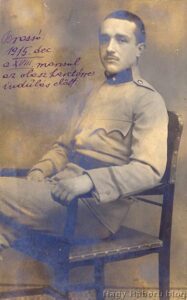
His 46th must be distinguished from the Italian regiment of the Reggio Brigade. The identical number can be misleading: these were regiments of opposing armies.
A photograph before the Piave offensive
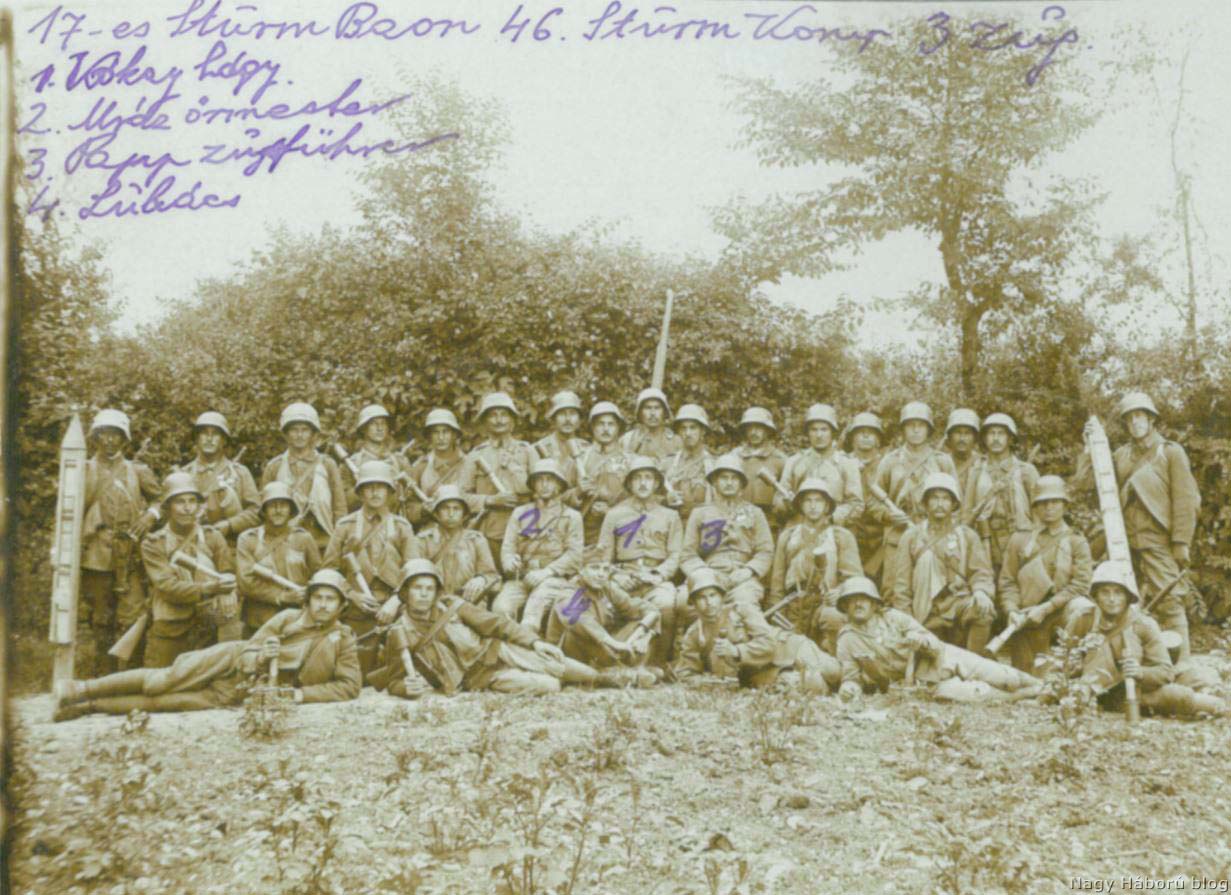
On 2 June 1918, Kókay had his platoon photographed. In the diary he explains that he wanted to preserve an image of the men before the offensive.
They stand among trees, arranged in several rows. The handwritten inscription on the photograph connects their faces with the unit. It is a group portrait prepared as a keepsake: it does not show combat or document the later passage through the Valbelluna.
Kókay’s assault platoon, photographed on 2 June 1918 before the Piave offensive. László Kókay archive, published by A Nagy Háború. Source and account of the photograph.
Alongside the photographs, the notebooks preserve a different sequence: events as the author observed them and chose to tell them. Reading them requires attention both to lived experience and to its later writing.
A night in front of Peron
In the entries for 1 November 1918, Kókay describes the retreat through Oregne and Gron, passing through Mas and rejoining Assault Battalion 17. The march halts before Peron, where the men spend the night in the open.
Numerous fires burn among the encamped troops. It is All Saints’ Day; looking at them, Kókay thinks of the lights on graves in his own city and of his father, buried in Szeged. Source: diary, part 46.
Memory of his family thus enters the geography of the retreat. The Cordevole is a military route, but in the officer’s pages it also becomes the distance separating him from home.
That evening’s march had been a race against time. At 5.15 p.m. the company reached the bridge over the Mis at Gron, already prepared to be blown up at 9 p.m. and guarded by the 1st Company of the 46th. Among the sentries was old Bobojcsov, the barber: Kókay notes that at dawn the next day he was captured by the Italians at that very spot. Only later did the officer learn that the Italians had entered Belluno at noon and that civilians had immediately helped them repair the demolished bridges on the Piave and the Cordevole.
The camp before Peron also has another side. To get firewood, Kókay writes, his assault troops tore down within minutes the wooden balcony of a nearby house, together with the beams that supported it and the outside staircase. The owner, left on the upper floor, could only come down by a ladder brought by her neighbours; she went looking for the command to complain, and the author supposes she was simply laughed at.
Oregne: the passage that must not be left out
In the same account, Kókay states that he fired at some young men in Oregne, interpreting the launching of flares as signals to the Italians. He says that two soldiers joined the shooting and that one of the young men fell to the ground.
He gives no name and does not establish what happened to him. Our research on the Italian side has not yet identified the person hit or found independent confirmation of the episode.
This passage calls for a separate investigation: Oregne, 1 November 1918: tracing the young man who was shot.
Reading a diary also means confronting what makes its author uncomfortable to encounter. The closeness created by photographs, youth and family memories cannot erase the account of violence.
Following the Cordevole upstream
On 2 November, the battalion leaves Peron. Kókay describes a valley crowded with retreating units, difficult passages and halts along the road.
He also reports theft and looting. In some passages he acknowledges why the inhabitants are angry; elsewhere he describes his own men’s appropriations less severely. This is a contradiction the reader must be allowed to see.
The day ends at Cencenighe, after a march the author puts at about 45 kilometres. Source: diary, part 47.
The entry for 2 November is full of detail. Shortly after setting off, a corporal of the unit seizes a woman’s pram, putting the child and the bedding on the ground, so as to load the packs onto it; Kókay admits that he thought the woman was right and, at the same time, burst out laughing. The road is so crowded that units march as many as eight abreast, and the officers fear an attack by Italian aircraft, which never comes. Around 10.30 a.m. the column slows down at the Italian barrier fort of Sasso di San Martino, blown up a year earlier together with its bridge: the men cross on a makeshift bridge, pushing the carts up the ramp by hand. Beside the road still runs the narrow-gauge field railway built by the Italian army.
At Ponte Alto, during the lunch halt, the battalion forms a “gang”, as Kókay himself calls it: three men from each company, led by an ensign, tasked with finding food. At Agordo an artillery captain warns that civilians are shooting at the soldiers from the woods east of the town; a gendarme speaks of a corporal and a private killed and two wounded. The major orders the men to carry their rifles on their shoulders and to return fire at the first shot, but the column crosses the town without a shot being fired.
Further on Kókay describes, without reticence, the looting by stragglers of every nationality, among whom the Bosnians and, he writes, regrettably also the Hungarians stood out; the inhabitants had fled into the mountains with their belongings. A Honvéd corporal from Szeged tells him that he struck a woman on the head with a spade when she tried to defend her provisions, and Kókay records his own horror. Neither the woman’s name nor her fate is known, as with the young man of Oregne. He also sees some forty Italian prisoners driven forward by gendarmes, laden with loads and given no food; another officer tells him he saw them eating grass. Near Listolade the Hungarian officers discuss the news, partly inaccurate, arriving from home about Hungarian independence and the Károlyi government, and decide they no longer want to fight for Austria. To their weary soldiers they repeat: “Hold on, boys, every step brings us closer to Hungary.”
That evening Cencenighe is crowded with troops, and to occupy the house assigned to it the company drives out some twenty Austrian Schützen. The inhabitants have gathered in a few houses, leaving the others with their furniture. Later the “gang” returns with two pigs, cheeses, sheets and towels; Kókay receives a cheese and a sheet. Source: diary, part 47.
The route can be followed on a map, but the distances and judgements remain those of the witness. Every detail useful to the military reconstruction needs comparison with other sources.
The notebooks after the war
Kókay copied out his notes in 1919–1920, assembling them in bound notebooks. The editorial introduction states that his family preserved four of what were probably eight original notebooks. He died in Szeged in 1972. Source: introduction to the diaries.
The history of the writing matters. What we read derives from wartime notes subsequently put in order: a personal source, valuable for reconstructing experiences and perceptions, to be compared with orders, reports and civilian testimony.
The same roads, other testimonies
The context of the front and the occupation is reconstructed in Austro-Hungarian troops in the Belluno Dolomites: tracing an empire.
Kókay’s story accompanies the research into the Reggio Brigade at Mas and Barp. The two perspectives cross the same territory, but do not demonstrate a direct encounter between the units.
Nor does Kókay’s passage through Mas and Peron place him at the Le Coste positions.
His notebooks add a voice to the history of the Valbelluna. To listen fully, we need to leave the other voices alongside it: those of Italian soldiers, inhabitants and families who preserved a memory. And that of the young man at Oregne, whose name we are still seeking.
The Great War in the Belluno area: further reading
These articles connect military units, personal testimony and the history of places.
Credits: László Kókay archive, published by Nagy Háború.
Cover photograph: Kókay’s assault platoon, photographed on 2 June 1918 before the Piave offensive. László Kókay archive, published by A Nagy Háború.