
Rediscovered stories · Cannigione, Sardinia
The memorial stone by the sea and the story of Filippo Dessole
by Michele Sacchet
A walk during the holidays, a name carved in stone and a question that would not leave me: who was Filippo Dessole?
 During my holidays in Cannigione I had got into the habit of walking along the sea in the morning. One morning, passing by the harbour, my eye fell on a memorial stone, right there, overlooking the water. The next morning I passed by again. I read the name: Filippo Dessole. I took a photograph, but the photo alone was not enough to answer the question that stone had sparked.
Who was he? Why was his memory in that spot, where today dozens of holidaymakers, boats and families out for a stroll go by?
Once the holidays were over and I was back home, I searched online and… nothing. No news. Nobody knew anything about him, except for a Facebook post by a lady who, as curious as I was, asked whether anyone knew his story.
Nobody.
So I wrote to the local Guardia di Finanza (the Italian Financial Police). My request was forwarded to the Technical, Logistical and Administrative Unit for Sardinia. On 19 August 2026 the reply arrived, signed on behalf of the acting commander of the Command Unit, Captain Vincenzo Garau. With the letter came the service record, an extract of the death certificate and the reports written in the summer of 1940. The memorial stone finally had a voice.
A man, before a name on a stone
Filippo Dessole was born in Sassari on 10 June 1900, son of Gavino and Giovanna Maria Contini. Before putting on the uniform of the Royal Guardia di Finanza he was a carter.
The first time Filippo Dessole served was in the Army, during the First World War. He was not yet a finanziere. He was a carter from Sassari, born on 10 June 1900: when he was called up, on 20 March 1918, he was seventeen.
His service record places him at the depot of the 46th Infantry Regiment from 20 April 1918. On 5 November of the same year he is listed as a sapper. It is a detail that helps us imagine him as a young man, busy with the work assigned to soldiers, but the document does not say that he was at the front nor does it mention any battles he took part in. It would be wrong to attribute them to him.
On 27 February 1919 he was placed on temporary leave. He was recalled on 1 December 1919, but a few days later he was examined at the military hospital in Cagliari. On 15 December he was permanently assigned to sedentary duties and the following day he went back on leave. The record does not specify what condition led to that medical decision.
This, then, was his first military experience: conscription in the Army, begun when he was still a boy, with a brief recall at the end of 1919. The decision to join the Royal Guardia di Finanza as a volunteer, for a three-year term, came later, on 10 August 1920. They are two separate chapters of his life.
In the summer of 1940, recalled to service, he was serving as a guard of the Royal Guardia di Finanza with the Cannigione brigade. He had just turned forty. In Sassari his wife, Grazietta Marras, and their four children were waiting for him. The eldest was only six.
These details, scattered among forms and reports, change the way we look at that memorial stone. It tells not only the fate of a serviceman in the year Italy entered the war. It lets us glimpse a home, a large family, an everyday life cut short.
The evening of 8 August 1940
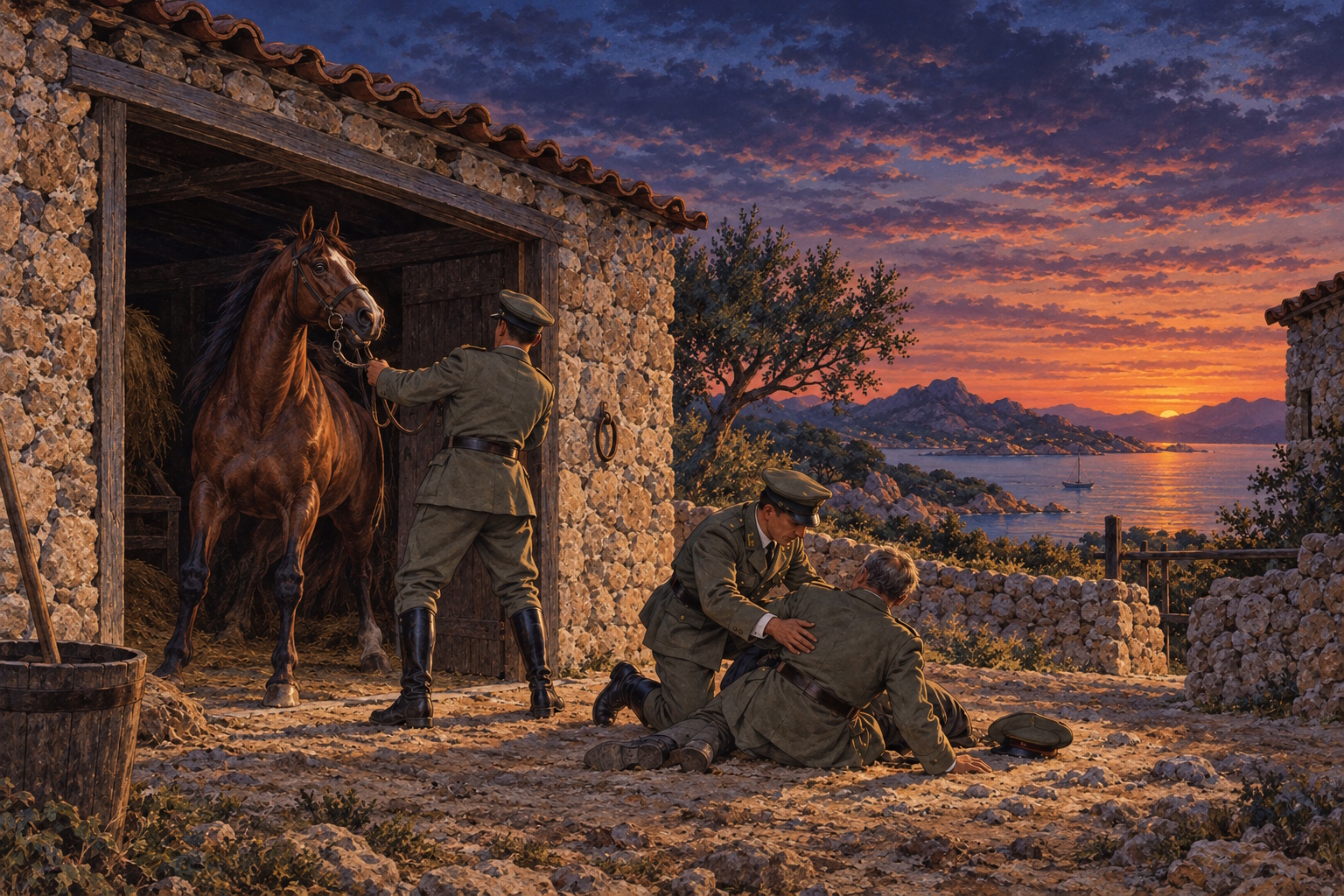
The papers tell us that, that evening, finanziere Giorgio Lentini was on «horse duty». At around 7.30 pm he took two of the unit’s horses, Iside and Buggianu, near the barracks to give them fodder and water. Other finanzieri were there too, among them Filippo. Once that work was done, at around 8.30 pm Lentini got ready to lead the animals back to the stable, about four hundred metres away.
Filippo had been unwell and had been granted four days’ rest by the unit’s doctor, ending precisely on 8 August. He had not been ordered to look after the horses. Seeing his colleague alone, he offered of his own accord to help him: he took Iside by the bridle and walked with him towards the stable. They were chatting as they walked.
Lentini went in first. Shortly afterwards he saw that Iside had entered the stable on his own. He turned round and found Filippo on the ground near the entrance, bleeding from the head and nose. He called for help; finanziere Paolo Daga and some local people helped carry the injured man back to the brigade station. The commander, Antonio Melis, informed while he was in Arzachena, called in the medical officer, Lieutenant Vincenzo D’Ambrosio, who reached Cannigione in a hired car.
Filippo was still able to speak. He told the doctor that, while he was holding Iside by the bridle, the horse had pushed him violently against the outer edge of the stable door. The doctor treated him and ordered him taken to the military hospital in Arzachena. He arrived there at about 11.15 pm, accompanied by Lentini. The head injuries were extremely serious. Despite treatment, Filippo died at 4.45 am on 9 August 1940.
No one, however, had seen the exact moment of the impact. The subsequent report considered it likely that the horse had shied, but could not rule out that a kick had thrown Filippo against the same edge. His account to the doctor remains a precious testimony; the papers do not allow it to be turned into a certainty about what physically happened.
The questions of his superiors
The commander of the 15th Legion, Colonel Giovanni Acampora, did not stop at the first reconstruction. In his report of 16 August he pointed out shortcomings in the organisation of the horses’ care, late and contradictory communications about the cause of the accident, the failure to formally record the words spoken by the injured man, and the time that passed before his admission to hospital. He also asked for explanations about the absence of the brigade commander and about the handing over to the widow of the money found among Filippo’s personal belongings.
After further enquiries in Arzachena and Cannigione, on 3 September he clarified that Filippo had not been assigned to horse duty and that no one had given him that order. The doctor had considered it sufficient to accompany the injured man personally on the journey to hospital; that is why commander Melis had not got into the car. The difference between the first messages — one spoke of a kick, the others of Iside shying — arose from conflicting initial information, not from a definitively established sequence of events. Acampora noted irregularities in the way Melis had documented one of his own duties and announced disciplinary action on that point; he concluded, however, that no one bore criminal responsibility for Filippo’s death.
On 10 August the funeral was held in Arzachena. The report mentions the attendance of civil and military authorities and of many local people. Grazietta, informed in Sassari, managed to arrive in time to see her husband and attend the ceremony.
In the following pages the story continues well beyond the funeral. Among Filippo’s belongings 448 lire and 20 cents had been found: the command had handed them over to Grazietta, who was in financial difficulty. The magistrate of La Maddalena then pointed out that the sum should have been deposited in favour of the underage children. Having considered the small amount and the family’s situation, he decided that there was no need to ask for it back. The command also proposed to apply for a grant from the Corps fund and, if the widow so requested, to start the procedure for a possible pension. The reports document these steps, without telling us the final outcome of the applications.
Acampora also wrote that he had arranged for a marble memorial on the grave of Filippo, so that the people of Arzachena and the finanzieri of Cannigione would keep the memory of this man. The documents confirm this arrangement; on their own they do not prove that the stone I came across by the sea is that very memorial.
Looking at the memorial stone again
When I think back to those walks along the seafront, the memorial stone is no longer just a mark in the landscape. Now I know the name of the man it remembers, I know the date of his death and I know that he left behind Grazietta and four children. I also know how careful we must be in telling what happened: the reports do not fully agree on how it happened, and an archive document must not become an invented scene.
One simple fact remains, however, spanning eighty-six years and reaching that stone by the sea: one evening Filippo stepped forward to help a comrade. It was an ordinary gesture. It was the last of his life.
I thank the Guardia di Finanza and Captain Vincenzo Garau for enabling me, with the documents they sent, to give a human face back to the name I had come across by chance during my holidays.
Remembering often begins like this: stopping, reading and wanting to know.
Michele Sacchet
Documentary sources: service records, extract of the death certificate from the Municipality of Sassari and reports of the 15th Territorial Legion of the Royal Guardia di Finanza of Cagliari dated 16 August and 3 September 1940; documents sent to the author by the Technical, Logistical and Administrative Unit for Sardinia with a letter dated 19 August 2026.
Historical context: Historical Museum of the Guardia di Finanza, «I Finanzieri nella II Guerra Mondiale» (The Finanzieri in the Second World War); «L’impiego della Guardia di finanza nella difesa costiera nel secondo conflitto mondiale» (The Guardia di Finanza in coastal defence in the Second World War) (in Italian).


