
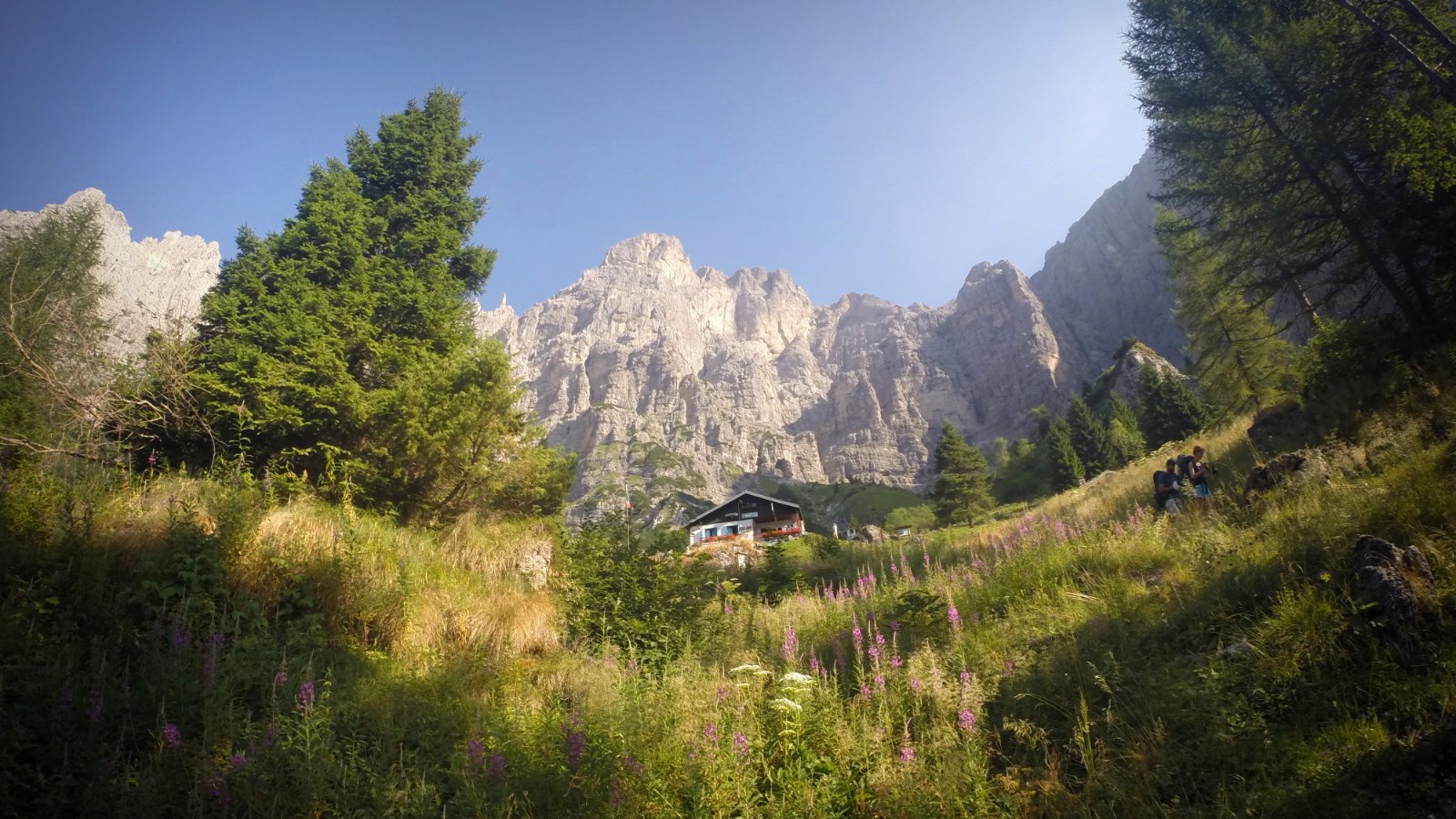
On 25 September 1951, Dino Buzzati described in the Corriere della Sera the opening of the Rifugio 7° Alpini, the mountain hut beneath the Schiara. Seventy-five years after that day, we look again at a story that also tells of the deep bond between the Belluno-born writer and his mountains.
Anyone arriving in Belluno who looks up towards the north sees it at once. The Schiara is not the highest of the Dolomites, but it is the one that stands right there, pressed against the town: a wall of pale rock that turns pink on summer evenings and in autumn wraps itself in fog until it disappears. For the people of Belluno it is not just any mountain. It is the mountain.
In September 1951, at the foot of that wall, something happens that Belluno had been waiting for for thirty years. At Pis Pilón, 1,502 metres above sea level, a new mountain hut is inaugurated, built by the strength of men and mules along the Val d’Ardo. Many people climb up that day: serving Alpini and Alpini veterans, members of the Club Alpino, officials, townspeople who set off before dawn to walk the three hours from Case Bortot.
Among them is a forty-five-year-old man who has been gazing at those rocks since boyhood and who, for more than twenty years, has lived and worked in Milan, in Via Solferino, at the Corriere della Sera. His name is Dino Buzzati, and he was born just a stone’s throw away, in San Pellegrino di Belluno.
Two days later, on 25 September 1951, Corriere readers find his account of the day under a headline that is hard to forget: “The old general of the Alpini did not speak in vain”.
23 September 1951: a day beneath the Schiara
The date that Belluno’s collective memory has fixed for the inauguration of the Rifugio 7° Alpini is Sunday, 23 September 1951: consistent with the season, with the holiday and with the report that would appear two days later. In fairness, though, because memory deserves rigour, it must be said that the sources available today agree on the year and the month — September 1951 — while the exact day is not unambiguously documented. Anyone who has kept an invitation, a dated photograph or a copy of the newspaper from that time would be giving us a precious gift.
About the building site, on the other hand, we know a great deal. The location had been chosen by Giuseppe “Chino” Viel near the Casera del Pis Pilón. The shell of the building was put up by the Bortoluzzi company for 3,800,000 lire and was finished at the end of August 1950; the finishing work was entrusted to the firm of Senator Attilio Tissi, who was also one of the greatest Italian mountaineers of his time. Everything else was done by men and animals: 735 mule trips, 1,440 working hours, 120 loads carried on shoulders, with the help of the gunners of the 23rd Battery of the Belluno Group and the Alpini of the 8th Regiment from Tolmezzo.
We have told elsewhere, in full detail, the story of the Rifugio 7° Alpini and of the men and mules who helped to build it (in Italian). Here we are interested in something else: what a reporter who wrote novels for a living saw on that day.
Two days later, Buzzati tells the whole story in the Corriere
It was by no means a given that the special correspondent of Italy’s most important daily newspaper would attend the opening of a provincial mountain hut. It makes sense once you consider that this correspondent had been born a couple of kilometres from the start of the trail, and that he had joined the Corriere della Sera on 10 July 1928, barely in his twenties, never to leave it: reporter, war correspondent, essayist, art critic.
The article opens the way fine September days open in the mountains: “The new Schiara hut is being inaugurated right beneath the great wall: it will be a magnificent day”. This is not the prose of someone sent to cover an event. It is the voice of a man who has always carried that wall inside him and who, for once, can describe it to his readers in Milan while pretending simply to be doing his job.
🖋️ Dino Buzzati, a Belluno man at the Corriere della Sera
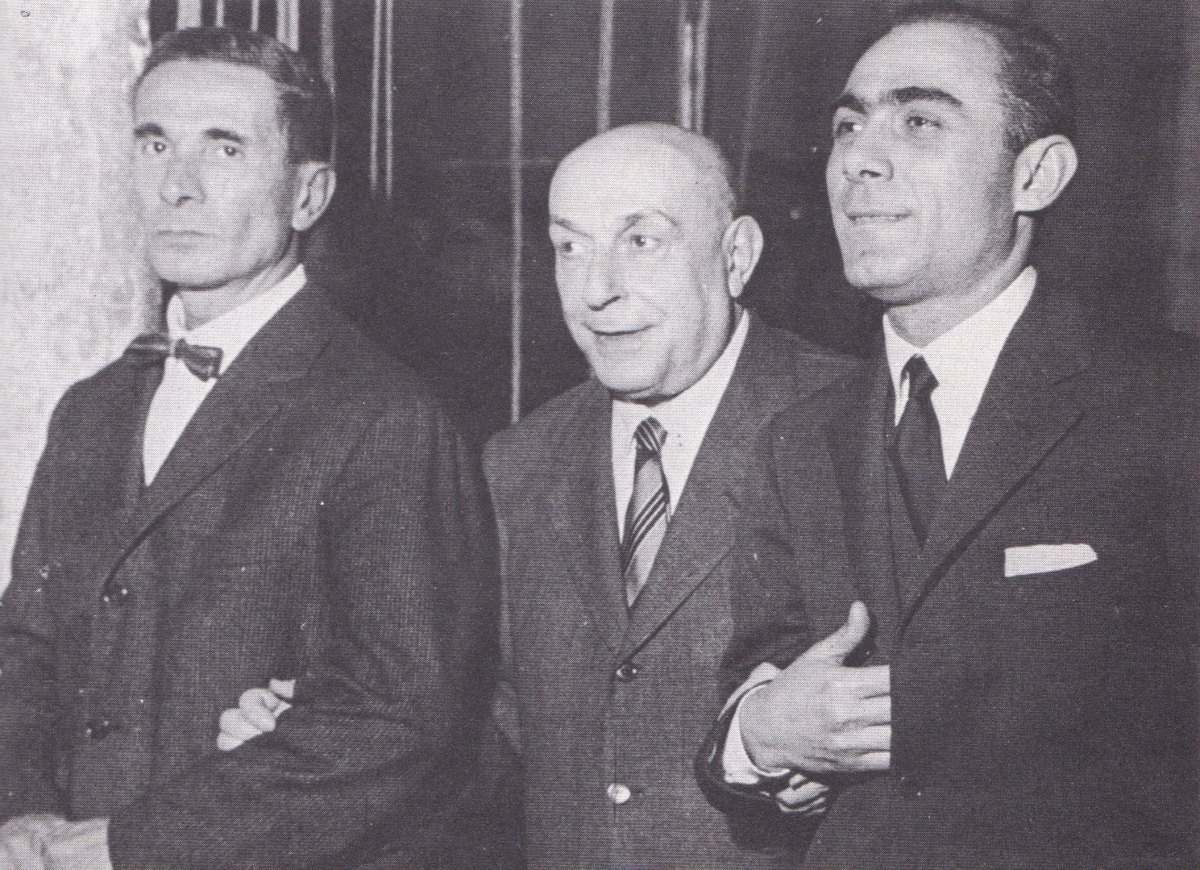
He was born on 16 October 1906 in San Pellegrino, on the outskirts of Belluno, in the family villa: the Buzzatis were a Belluno family, even though their everyday home was in Milan. He joined the Corriere della Sera on 10 July 1928 and stayed there for the rest of his life — reporter, naval war correspondent, essayist, art critic.
The mountains are in his books from the very first: Bàrnabo delle montagne (1933), then Il segreto del Bosco Vecchio (1935) and, in 1940, Il deserto dei Tartari (The Tartar Steppe), the novel that made him one of the most widely read Italian writers in the world. These were followed by La famosa invasione degli orsi in Sicilia (1945), Sessanta racconti (Strega Prize 1958), Un amore (1963) and Poema a fumetti (1969).
Alongside writing there was always painting, with his first solo exhibition in 1958: “For me, writing and painting are the same thing”, he used to say. He died in Milan on 28 January 1972.
He remained attached to Belluno and its mountains all his life: he returned every summer, drew them, wrote about them. And when it came to naming his mountain, he had no doubts.
“The old general of the Alpini did not speak in vain”
The headline of the article of 25 September 1951 is the key to the whole story. A hut beneath the Schiara, Buzzati writes, had been talked about “for at least thirty years”: plans, meetings, good intentions and no money. Then something shifts, and his report tells us what: the decision to give the hut “the name of the VII Alpini in memory of the regiment’s fallen”. After thirty years, he notes, the money had arrived.
That is the whole meaning of the headline. Not a generic tribute to military rhetoric — Buzzati knew rhetoric very well and could spot it from a distance — but the almost astonished observation that, for once, the words of an old Alpini officer had produced something solid: a stone building at 1,502 metres, with bunks and a stove inside.
Exactly who that old general was cannot be established from the sources available today: the report refers to him for what he represents, not by name. It would be good to be able to say for certain, and we would be glad if someone, in family archives or those of the Section, were to find the names of those who spoke that day.
The Schiara, “the mountain of my life”
To understand why that 1951 article is no ordinary report, you need to know what the Schiara meant to the man who wrote it. Buzzati had climbed it as a boy, at fifteen, with friends; he had drawn it, painted it, written about it. In 1964 he would dedicate to it a piece whose title says it all, L’amico Schiara (“Friend Schiara”), returning in memory to those first climbs.
The bond was an everyday, almost domestic one. He used to tell how, in summer, back at the family home just outside Belluno, he would go out in the morning, cross the meadow and turn round at the far end: there stood the Schiara. He called it “the mountain of my life”. Not a summit to collect — he spent his climbing summers mostly on the Pale di San Martino and the Croda da Lago — but the mountain of home, the one you see from the courtyard and that comes back in your dreams.
🏔️ The Schiara group

The Schiara group closes off the Belluno basin to the north and culminates in the 2,565 metres of Monte Schiara. It is the southernmost corner of the Belluno Dolomites, today the heart of the Dolomiti Bellunesi National Park and an area recognised as a UNESCO World Heritage Site.
Its symbol is the Gusela del Vescovà, the pierced monolith — some forty metres high — first climbed on 14 September 1913 by Andreoletti and Jori. From the town it looks like a thin needle leaning against the sky: an image every Belluno native carries within.
At the foot of the south face runs the Val d’Ardo, the wild gully that climbs from the Bus del Buson to Pis Pilón: it is the route the mules travelled hundreds of times to build the hut, and still today it is CAI trail 501, the normal ascent from Case Bortot.
Buzzati: Belluno, the Dolomites and a world of rock faces and mystery
Buzzati’s mountains are never just geography. They are a world of “mysterious mountains”, of “long winters”, of “fairy tales” and of “spirits of the caves”, where what matters more than altitude is the “untranslatable sense of distance, solitude and legend”. The imaginary walls surrounding Fort Bastiani in The Tartar Steppe have the shape and above all the silence of the rock faces seen from Belluno.
His longing for the mountains stayed with him even after he stopped climbing. In 1941 he confessed to the readers of the Corriere d’Informazione: “Every blessed night, for some twenty years now, I have dreamed of the mountains”. It is a sentence that explains, better than any commentary, why in September 1951 he was glad to climb towards Pis Pilón with a notebook in his pocket.
It also explains the tone of his piece: faced with the Alpini, the mules and a new hut, Buzzati does not play the man of letters on an outing. He is the reporter who can recognise, in a day of sunshine and speeches, the moment when a community finally comes to terms with something it had put off for thirty years.
Why the Rifugio 7° Alpini had to wait thirty years
Thirty years is a long time. The idea of a hut beneath the south face of the Schiara had been circulating in Belluno since the 1920s, and anyone who knew those rocks knew how much it was needed: the Val d’Ardo is long, the routes on the Schiara are demanding, and without a base at altitude everything becomes an expedition. But the conditions were lacking: first the economic crisis, then the war, then the ruins of the war.
Paradoxically, it was the post-war period that unlocked the situation. In the Belluno area, reconstruction coincided with the need to rediscover a shared identity, and the Alpini — those who had come home and those who had not — were at its heart. When the project stopped being “just another hut” and became a memorial, the money and the manpower were quickly found.
A hut dedicated to the Fallen of the 7° Alpini
The 7th Alpini Regiment had been formed on 1 August 1887 and has always belonged to the Val Belluna: the Feltre, Pieve di Cadore and Belluno battalions. It had left its men on the Isonzo and on the Bainsizza plateau, on the Grappa, in Albania, in Greece, in Russia; it was disbanded on 12 September 1943, re-formed in 1953, and today is once again based in Belluno. Anyone wanting a concrete example of that price can read our account of the Battle of the Bainsizza in August 1917 and the 7th Alpini Regiment on the Isonzo (in Italian).
Dedicating the hut to the fallen of the 7th meant turning a building into an act of remembrance: not a plaque in a cemetery, but a living roof that welcomes everyone who climbs up, every summer. That is why, seventy-five years later, the name does not sound like a formula. And, as Buzzati’s report makes clear, it was also the reason the hut could finally be built.
The Rifugio 7° Alpini and the Alta Via n.1 of the Dolomites
There is a reason why the name of this hut is known today far beyond the borders of the province. The Rifugio 7° Alpini is in fact the last hut on the Alta Via n.1 of the Dolomites, the classic traverse of about 125 kilometres that links Lake Braies to Belluno in a dozen stages.
Those who arrive here from the Bivacco del Marmol, after the Piero Rossi via ferrata, have days of walking across the Dolomites behind them; ahead lie only the descent through the Val d’Ardo, Case Bortot and the town. The hut is, in short, the last night at altitude on one of Europe’s best-loved Alpine traverses: a detail nobody could have foreseen in 1951, and one that today makes that stone roof a piece of Belluno known halfway around the world.
🇮🇹 1951–2026: 75 years of the Rifugio 7° Alpini
23 September 2026 — seventy-five years since the day the Rifugio 7° Alpini was inaugurated beneath the south face of the Schiara.
25 September 2026 — seventy-five years since the article in which Dino Buzzati described that day to the readers of the Corriere della Sera.
Seventy-five years later
Almost everything about that September of 1951 has changed. The mules no longer climb up: the helicopter has taken their place, carrying up in a single morning what once required seven hundred trips. The three hours from Case Bortot are walked in light boots with the weather forecast on a phone, and for some years the ascent has also hosted an uphill time-trial race. The Corriere della Sera that published the article is now read mostly on a screen.
What has not changed is the hut’s purpose: a roof and a hot meal at 1,502 metres for those who get there on their own two feet, beneath an unforgiving rock face. Nor has the reason for its name changed, which is also the reason the hut exists.
As for Buzzati, those pages have acquired over time a value they did not have then: they are one of the few first-hand accounts of how the hut came into being, written by someone who was not “covering an event” but coming home.
That mountain is still there
If today you step outside in Salce, or in any meadow of the Val Belluna, on one of those September mornings when the air is already cold and the sky is clear, you see exactly what he saw: the great wall, the slender Gusela leaning against the sky, the furrow of the Val d’Ardo climbing into the shadow.
The people have changed, and so have the means and the ways of getting up there. The Schiara, however, goes on doing what it has always done: standing above Belluno and watching over the town. It was “the mountain of his life”. It has remained, quite simply, ours.
🇮🇹 Want to know the full story of the Rifugio 7° Alpini?
From its construction to the mule transports, from the Alpini to the Schiara: we have reconstructed the history of the hut that has become a symbol of the Belluno mountains.
Sources and further reading
- Reconstruction of the building site, the transports and quotations from Buzzati’s article: Crono Rifugio Settimo Alpini — Storia.
- General information on the hut and on the Corriere della Sera article of 25 September 1951: “Rifugio 7º Alpini” entry on the Italian Wikipedia.
- Buzzati and the Belluno Dolomites, with the quotations about the Schiara: Dolomia Magazine.
- Biography and chronology of his works: dinobuzzati.it — La vita.
- Nature, via ferratas and trails of the Schiara group: Parco Nazionale Dolomiti Bellunesi.
- Stages and route: Alta Via n.1 of the Dolomites, from Lake Braies to Belluno.
- Our historical feature: Rifugio 7° Alpini: the extraordinary story of the Schiara hut built by men and mules (in Italian).
Opening image: the Rifugio 7° Alpini at the foot of the south face of the Schiara. Photo: BjoeMu, Wikimedia Commons, CC BY-SA 4.0.


