The Alpini Were Denouncing Overtourism 100 Years Ago
MEMORIA · From the «L’Alpino» newspaper archive
In 1929 Angelo Manaresi, president of the Italian National Alpini Association and a veteran officer of the «Feltre» battalion, wrote «La montagna profanata» – the profaned mountain. Two years later he included it in a book. Read today, with queues forming beneath the Dolomites, it might have been written yesterday.
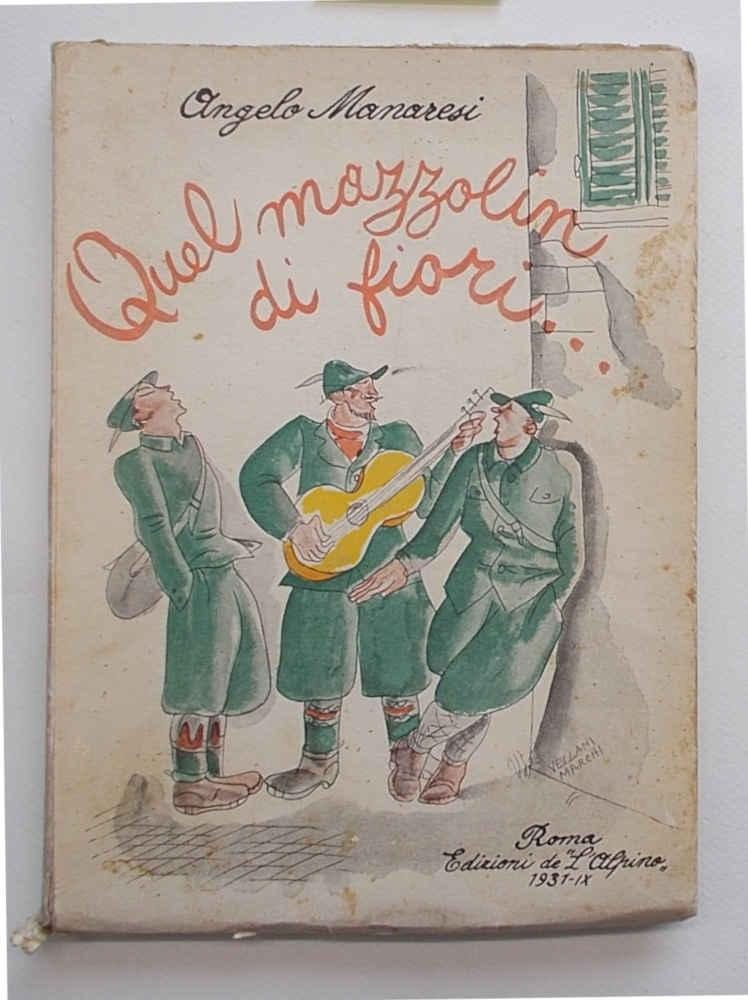
The book has a pale cover, a little worn at the corners. Three Alpini in green cloth, one holding a guitar, sing beneath a window. Above them, in a red script that looks handwritten, is the title of a song every Alpino knows: «Quel mazzolin di fiori…» – That little bunch of flowers. Higher still, the author’s name, Angelo Manaresi. At the bottom: Rome, Edizioni de L’Alpino, 1931-IX.
On page 100 a chapter begins that speaks neither of war nor of songs. It is called «La montagna profanata», and it describes a mountain overrun by people who do not love it, who use it as a drawing room and climb it only to be seen. You read it with a smile, and then the smile fades. Almost a hundred years later, in the Dolomites, the problem has changed its name but not its nature. Today we call it overtourism.
The rediscovered book
«Quel mazzolin di fiori…» is a collection of Manaresi’s writings, illustrated by the Modena painter Mario Vellani Marchi: 246 pages, many black-and-white drawings and a colour cover. The copy we are working from carries the author’s handwritten dedication.
The chapter that interests us, however, is older than the book. Manaresi had first published it as the front-page editorial of «L’Alpino» on 1 August 1929, the newspaper of the Association he chaired. That issue, like all the others from those years, can be browsed in our «L’Alpino» newspaper archive. There the text has its original sound: a summer front page, alongside the circulars for the gathering on the Adamello and the building works at the Contrin hut.
Who was the man who wrote it? A lawyer from Bologna, passionate about the mountains since boyhood. In 1915 he had an urgent operation so that he could enlist as a volunteer, and he asked specifically for the Alpini. He was sent to Belluno, to the 7th Regiment, and then to the «Feltre» battalion. He fought in the Valsugana, on the Cauriol and on Monte Grappa, where he was wounded in the foot. In 1929 he was president of the ANA and Under-Secretary for War in Mussolini’s government. An Alpino, a man of the regime, a man of the mountains: all three at once, and the text carries all three. We have told how he ran the Association’s newspaper in «L’Alpino»: from Balbo to Manaresi, the birth of a shared voice.
Box 1 · The document
«Quel mazzolin di fiori…», 1931
- Author: Angelo Manaresi (Bologna 1890 – Bologna 1965)
- Publisher: Edizioni de L’Alpino, Rome, 1931-IX
- Illustrations: Mario Vellani Marchi
- Pages: 246, with drawings in the text
- The two chapters: «La montagna profanata» (pp. 100–103) and «La montagna e lo snobismo» (from p. 104)
The book collects articles Manaresi had written for «L’Alpino» during his presidency. The two chapters about the mountains appeared in the paper in 1929: the first on 1 August, the second on 15 October. The title comes from the folk song the Alpini made their own, and the cover says so lightly: this is a book to be read the way one sings in company.
«The profaned mountain»
The article opens as an outburst. Anyone travelling the mountains in summer, Manaresi writes, risks seasickness – not from the altitude, but from the foolish worldliness that has filled so many mountain resorts. The valley hotels are full of people who dread any effort. The young, who would have the legs and the health for it, spend their days in the dance halls, among the fashionable dances, and give the mountain a few minutes’ stroll out of fashion rather than passion.
Then the scene moves to the mountain huts. There, the author notes bitterly, more foreigners pass through than Italians. People mock the German tourists, their shorts and their wives dressed like men – yet it is they who climb, who make the effort, who set off again at once for another summit. The Italian names in the hut books are always the same: the university climbers of the SUCAI, a few groups from the Dopolavoro, hardly anyone else.
At the end comes the invitation, addressed to the young people at the foot of the mountains. It is the finest passage of the chapter:
«…leave the white shorts, the silk shirts and the American caps to the pale and sickly boys: with a good pair of hobnailed boots on your feet and a rucksack on your shoulders, take a bite out of the mountain too, with courage – the mountain that is beautiful, is good and loves the young».
Angelo Manaresi, «La montagna profanata», in «Quel mazzolin di fiori…», 1931, p. 103 (our translation)
Elegant youths and real mountaineers
Manaresi’s target is not tourism as such. It is a way of being in the mountains: dressing to be looked at, staying where one is seen, climbing as little as possible. Against the elegant young man he sets the old Alpino who spends his Sundays above two thousand metres, in love with the mountain «like the dearest sweetheart of his youth». And he closes with a maxim from his own war: the «old dog’s» ten commandments, written on the summit of the Cauriol between a game of draughts with the chaplain and a dash to the forward post.
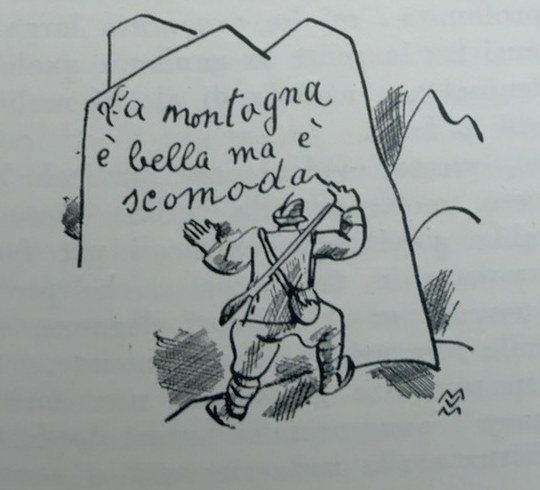
The Cauriol is not just any name. Between 24 and 27 August 1916 the «Feltre» battalion, with Manaresi as a lieutenant, captured it in one of the hardest battles in the Fassa Alps; for that action the author received his first bronze medal for valour. The phrase about a mountain that is «beautiful but uncomfortable» was written by a man who had felt that discomfort on his own skin, alongside the Alpini of Belluno.
Box 2 · The profaned mountain
Beautiful, but uncomfortable
Vellani Marchi’s drawing sums up the chapter better than any commentary: an Alpino seen from behind, rucksack and stick, writing the Cauriol maxim on the rock. In Manaresi’s text effort is not a punishment: it is the price of admission. Whoever is not prepared to pay it does not know the mountain – they consume it.
«The mountain is beautiful but uncomfortable: always try to master it from above».
The «old dog’s ten commandments», summit of the Cauriol (our translation)
On one side, mountaineering as lived experience, made of hobnailed boots and Sundays above two thousand metres; on the other, fashionable tourism, made of dance halls and strolls to be seen. The contrast is sharp, almost a caricature. But it still holds.
From the American cap to the selfie
Change just a few words. In place of the white shorts and American caps, put technical clothing bought for a photograph; in place of the dance halls, the queue for the same shot already seen a thousand times on a screen. The gesture is the same: the mountain as a backdrop, not as a place.
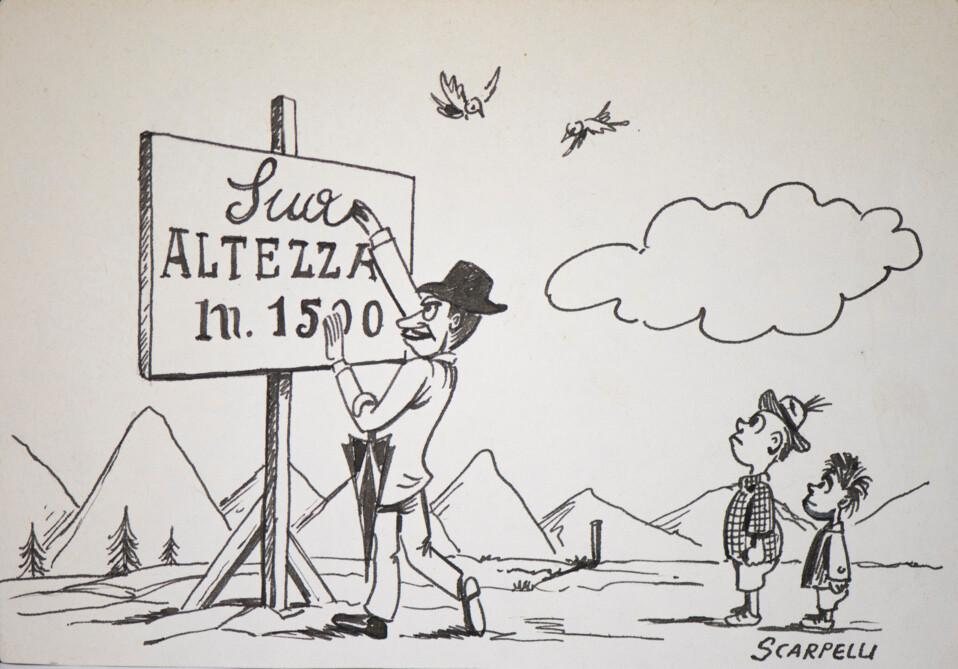
It was not Manaresi’s obsession alone. In the next issue of «L’Alpino», on 15 August 1929, the paper published the letters of support it had received, with two cartoons by the painter Ciotti; more letters followed in September. Satire of the holidaymaker who measures the mountain by the metres on a signpost, without ever climbing it, accompanied the press and the postcards of the twentieth century for a long time.
Comparing it with overtourism, without forcing it
Honesty is needed here. The tourism Manaresi describes was that of the few: wealthy families arriving by train, luxury hotels, months of summer holiday. Today’s overtourism is a mass phenomenon of cars, low-cost flights and social networks, concentrating thousands of people at the same spots, at the same times, for the same photograph.
On DolomitiBelluno.it, in the feature «Too Many Visitors: Overtourism in the Dolomites», we set out the figures: the visitor numbers around the Tre Cime, the rise in mountain rescue call-outs, villages emptying of residents while filling up with short-term lets. In 1929 none of these problems existed on this scale. The scale is different, and so is the impact on the environment and on communities.
And yet the underlying question is the same. What do we go looking for in the mountains? A place to cross with effort and respect, or a backdrop to show off? Manaresi answered with hobnailed boots. We can answer by choosing better where, when and how to go.
«The mountain and snobbery»
The article caused a stir. Two and a half months later, on 15 October 1929, Manaresi returned to the subject on the front page, and in the book this second piece follows straight after the first, on page 104:
«My most outspoken article on the “profaned mountain” has earned me a rich harvest of approval among capable people, and a few venomous, sour criticisms from some melancholy dandies on holiday».
Angelo Manaresi, «La montagna e lo snobismo», in «Quel mazzolin di fiori…», 1931, p. 104 (our translation)
A sign, he adds, that the article had hit the mark. Then he announces another subject to the paper’s «forty thousand readers». And here the tone changes.
1929, South Tyrol and the rhetoric of the time
The second target is no longer idle youth but the Italians who holiday in South Tyrol (Alto Adige) and dress in Tyrolean style: short trousers, little jackets, a green felt hat with a feather, wives and children in costume. To Manaresi this is a ridiculous fashion and, worse, an unpatriotic one. If Italian identity is to be brought back to those valleys, he writes, Italians must be proud of their own dress, and the Alpini must be its most uncompromising guardians.
It must be read for what it is: a text from 1929, written by an under-secretary of the Fascist regime. From 1923 the state had launched a policy of forced Italianisation in South Tyrol: place names translated by decree, German-language schools closed, Italian imposed in public offices. The German- and Ladin-speaking population experienced that policy as oppression, and the wounds it left lasted for decades. The «German costume» Manaresi mocked was the dress of people born in those valleys.
Republishing these pages today does not mean endorsing them. It means reading them in full, without cutting what jars: that too is memory. Today’s South Tyrol, with its autonomy and its three languages, is the answer history gave to that rhetoric.
Box 3 · Snobbery and the historical context
From fashion to politics
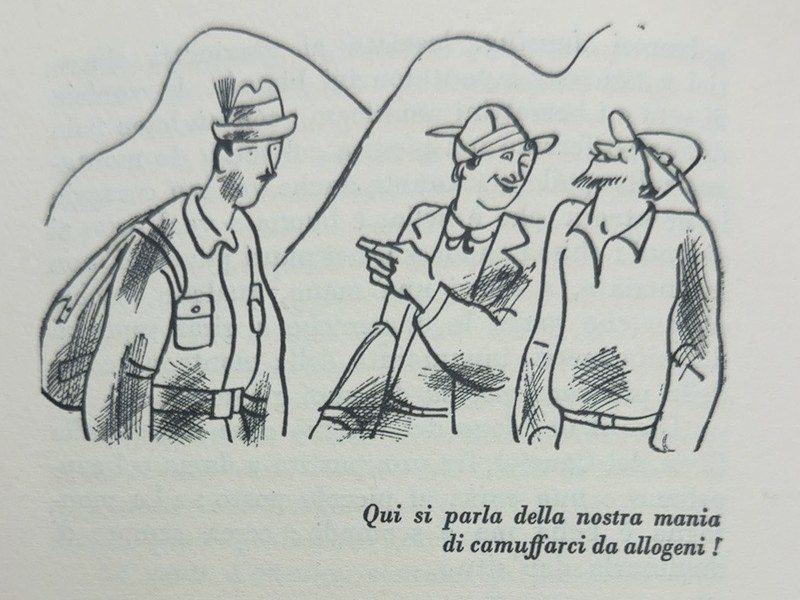
In the drawing that opens the chapter, a hiker with rucksack and feather looks at two companions dressed up in Tyrolean style. The caption speaks of «allogeni», the word the regime used for the German- and Slavic-speaking populations of the new borders.
The shift is clear: the first article criticised a custom, the second turns it into a national question. We are at the height of the Italianisation policy in South Tyrol, begun in 1923 with the translation of place names and the closure of German schools. Manaresi writes from within that policy and uses its language.
Today we can keep the part of his argument that withstands time – respect for the mountain and for effort – and recognise the rest as the document of an era. Respect also applies to the culture of the people who live in the valleys, including the clothes Manaresi mocked.
The mountain as heritage
If there is one idea the century has strengthened rather than refuted, it is that the mountain is not just scenery. It is a fragile environment, a history, a livelihood, a set of communities. The Dolomites have been a UNESCO World Heritage Site since 2009, but they are also someone’s pastures, paths marked out by someone else, war cemeteries, small chapels, huts built by the sections of the CAI and the ANA. Whoever arrives is entering someone else’s home.
On DolomitiBelluno.it we wrote it in «La montagna non è nostra» (in Italian): the mountain belongs to everyone precisely because it belongs to no one. Manaresi said it in other words, and in a tone we would not use today. But the meaning of his «take a bite out of the mountain» was this: really go there, not just be seen.
Box 4 · From 1929 to 2026
Three different things
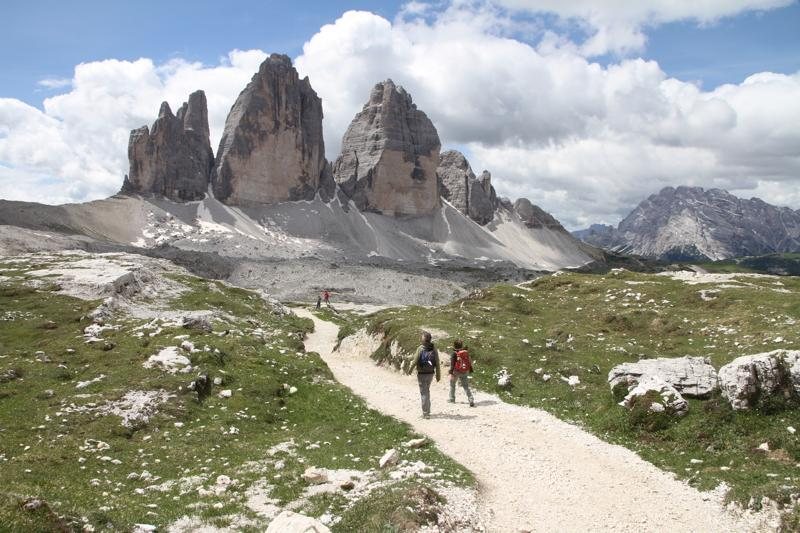
Fashionable tourism is what Manaresi made fun of: few people, wealthy, more interested in being seen than in climbing. Overtourism is something else: thousands of people at the same spots, at the same times, with measurable effects on paths, traffic, housing and rescue services. Responsible tourism is the possible answer: choosing less-trodden places, different seasons and times, staying longer, respecting those who live there.
On DolomitiBelluno.it you will find two practical suggestions: «Dolomites Without Overtourism: 10 Spectacular Places in Belluno» and «Cooler Dolomites, without new hotspots».
What remains for the young
Manaresi wrote to the young, and gave them a dressing-down. Today we might be gentler: many of them go to the mountains with more awareness than their holidaying grandparents, and they are often the first to call for limits, rules and respect. But his practical advice still holds. Suitable boots, a rucksack, the will to make an effort. And, if you are lucky, some old Alpino who lends you a hand on the steepest stretches.
That is what the Alpini still do: the Alpini groups who keep the paths clear, restore huts and places of memory, and accompany young people at the training camps. It is not nostalgia. It is a way of being in the mountains that you learn by walking together.
The Cauriol maxim
Almost a hundred years later, the phrase written on a rock of the Cauriol between a game of draughts and a turn on guard still works as a small rulebook for anyone who goes to the mountains. The mountain is beautiful. It is uncomfortable. And those who love it look at it from above only after climbing it, step by step, without asking it to become something else.
The rest – the American caps of then and the selfies of today – goes out of fashion. The mountain remains.
Sources and links
- Angelo Manaresi, Quel mazzolin di fiori…, illustrations by Mario Vellani Marchi, Rome, Edizioni de L’Alpino, 1931-IX, pp. 100–108. Copy with the author’s handwritten dedication, private collection. Quotations translated by the editors.
- «L’Alpino», year XI, no. 14, 1 August 1929: «La montagna profanata» (Italian).
- «L’Alpino», year XI, no. 15, 15 August 1929, and no. 16, September 1929: readers’ letters of support (Italian).
- «L’Alpino», year XI, no. 19, 15 October 1929: «La montagna e lo snobismo» (Italian).
- On Angelo Manaresi: Italian Chamber of Deputies, historical portal; ANA Bologna-Romagna section.
- Further reading on the subject today: Too Many Visitors · Dolomites Without Overtourism · La montagna non è nostra · Cooler Dolomites.
- More stories from our archive in the MEMORIA project and in Alpini history.
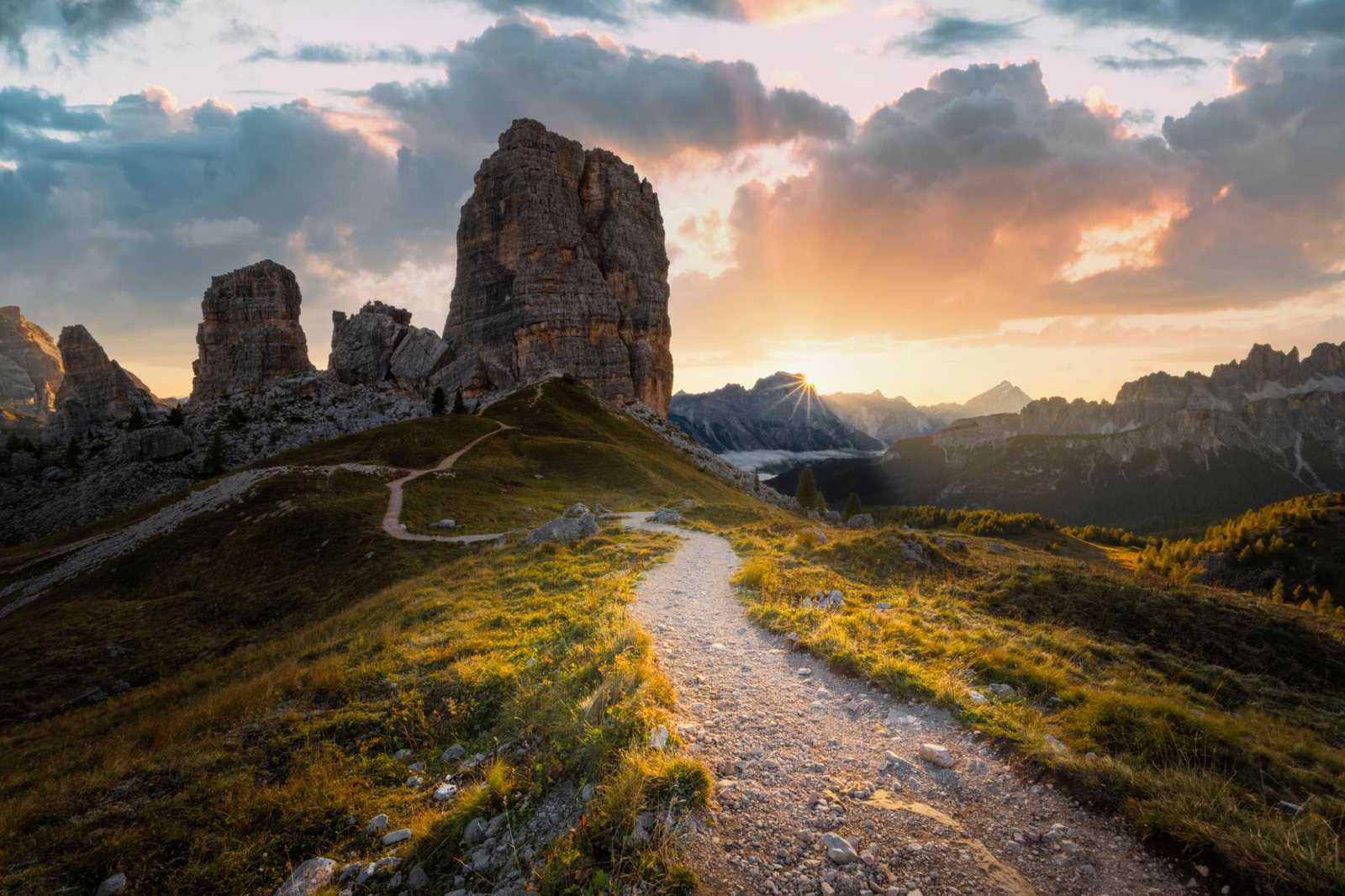
- Cover image: the Cinque Torri at sunset, photo by Mattew Gave (Pexels).