The Anglo-American secret agent who loved contemporary art and was the first to open the doors of the asylums.
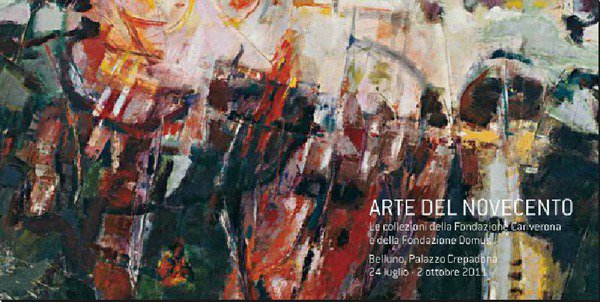
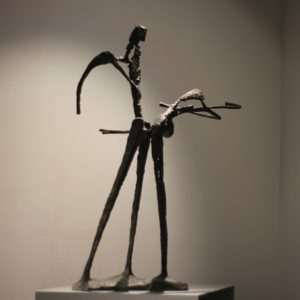
Sculptor, journalist and secret agent. By a lucky coincidence, Michael Noble’s works came to Belluno for the exhibition “Arte del Novecento” at Crepadona (23 July – 2 October 2011), at the same time as the exhibition at Sass Muss (Sospirolo), in the industrial archaeology complex launched by Dolomiti Contemporanee.
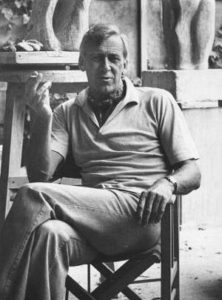
George Ernest Michael Sinclair Noble was born on 12 December 1919 at South Moor, County Durham, in north-east England.
A volunteer in 1939, he was in France until Dunkirk, then an officer in the Eighth Army in Libya. In 1944 in Italy he moved to the Political Intelligence Department of the Foreign Office.
Finally he was put in charge of the Psychological Warfare Branch, the Anglo-American military government’s psychological warfare division responsible for managing the media.
Noble arrived in Milan on 26 April 1945 with the Allied forces, with the rank of Major; in reality he was a secret agent tasked by the Allied military government with reorganising the information systems in Naples and Florence.
In Milan he founded the Giornale Lombardo (later Corriere Lombardo) with the journalists Gaetano Afeltra, Dino Buzzati and Benso Fini. But his main task was to get the Corriere della Sera back on the newsstands.
In April 1945 Noble was in Milan as chairman of the Allied Publications Commission for Northern Italy. And on 22 May 1945 the Corriere d’Informazione came off the presses in via Solferino (from May 1946, with the return of the Corriere della Sera, it came out as an afternoon edition); when Noble could not find a photograph, he published charcoal portraits of politicians that he drew himself.
In 1956 he married Ida Borletti, daughter of Senator Borletti (industrialist who founded La Rinascente in Milan in 1918), with whom he went to live at Villa Idania on Lake Garda.
This became a centre of cultural life frequented by Igor Markevitch, Nabokov, Pannella, Marina Cicogna, Giulia Maria Crespi (owner of the Corriere della Sera and later founder of FAI, the Italian National Trust), Igor Stravinsky, Stefan Zweig, Dacia Maraini, Trilussa, Salvatore Quasimodo and Indro Montanelli.
Between 1957 and 1963 Noble sought out the creativity of the mentally ill patients of the provincial psychiatric hospital in Verona, guided by the sculptor Pino Castagna and advised by the psychiatrist Vittorino Andreoli.
This experience brought to light the talent of Carlo Zinelli, who later became famous. Panels with men, women, soldiers, birds, monsters, lions, cats, trains, cannons, aeroplanes and tanks that fascinated Dino Buzzati, who wondered and wrote about “the mysterious light of art” that could be kindled in the equally mysterious folds of shadow of sick minds.
“Some of the patients were able to leave the hospital and went to live on the hill. Others – recalled Ida Borletti in an old interview with the Corriere della Sera – we sent a coach to fetch. We worked, went out in boats, to the trattoria, dancing. In short, a community had been born.”
Michael Noble thus anticipated by a few years what Franco Basaglia would later achieve: from 1962 Basaglia revolutionised psychiatric hospitals, leading to the liberation of patients with Law 180 of 1978.
Noble died aged 73 at his home on the Côte d’Azur on 7 February 1993.
Roberto De Nart, for Col Maòr no. 3, 2011