January 1916. No news from a supply party, a blizzard, and a colonel who sets out to find his men.
A story of trust and comradeship resurfaces from the pages of L’Alpino.
There are wartime stories in which the decisive moment comes when someone sets out to find the others.
One such story has resurfaced in the L’Alpino newspaper archive preserved on our website.
The issue of 25 February 1923 carries an account signed “Conte Verde”, set on Monte Nero in January 1916.
Reading it today, one certainty stands out: up there, among men exposed to cold, avalanches and enemy fire, knowing that someone would come looking for you could make all the difference.

In this article
The supply trail
The account takes us into the depths of the winter of 1915–1916. Alpini of the 3rd Regiment are stationed on Monte Nero. The battalion’s name is omitted from the text, so we cannot attribute the episode to a specific unit.
Rain alternates with snowfall heavy enough to cover trenches, barbed wire and shelters. Fog hides the route; the blizzard drains strength and destroys any sense of direction. Meanwhile, the war goes on.
Holding the positions requires food, ammunition and fuel to reach them. The corvée is the party responsible for carrying these supplies: laden men, walking in single file along a trail that may come under enemy fire or disappear beneath the snow.
The newspaper describes departures at dawn and waits that stretch into the evening, with commanders seeking news through communications that are repeatedly interrupted.
What was a corvée?
In this account, the corvée is the party tasked with carrying food, ammunition and fuel to the forward positions. An essential duty that, amid snow, avalanches and enemy fire, could become as dangerous as combat itself.
Behind the word “supplies” are backs, hands and legs. And men whom other men are waiting for.
A departure, then silence
That morning, a captain leaves Kozliak for the summit of Monte Nero with a detachment from his company. He wants to accompany the supply party himself, in preparation for the relief of the unit scheduled two days later.
The colonel approves his decision and watches the hours pass with growing unease. Replies from the positions above offer no reassurance: the detachment has not arrived and is not even in sight.
Then the telephone falls silent too.
The last reports, at around three in the afternoon, still bring no news. At five, the colonel decides to organise a rescue party. He asks for thirty strong volunteers. A hundred men step forward, along with all the officers.
A selection must be made: a rescue in these conditions calls for men able to withstand the ordeal. Yet the willingness to help is so great that some of those left out cannot accept staying under cover.

The colonel leads the way
At seven in the evening, the party sets off. The colonel leads it himself. They take stretchers, blankets and whatever might be needed to help anyone stranded on the mountain.
In places, the snow reaches shoulder height. Telephone poles help them find their direction; when the trail is lost, an electric lamp and a torch are lit to find it again. The light draws a burst of enemy fire. No one is wounded, but the lights must be put out immediately and the men continue in darkness.
The account makes no attempt to conceal the danger faced by the rescuers themselves. One soldier can go no further: his feet are freezing. He is helped to an intermediate post, where he receives care. Two others, showing signs of hypothermia, are carried into a shelter.
They are the very two Alpini who had initially been excluded because they were weak and already ill, but had secretly joined the party. The colonel reprimands them; then, recognising their wish to be useful, he embraces them and gives them two sweets.
Two sweets in the blizzard
Two Alpini, already ill and excluded from the party, secretly join the rescuers. When the cold overcomes them, the colonel reprimands them, embraces them and gives them two sweets. This gesture is recorded in the 1923 source: it preserves the human dimension of that night.
The long-awaited news
The march resumes. It is already midnight when the rescuers reach the main hut. To open the entrance, they have to dig through the snow for more than a quarter of an hour.
At last comes the news: the captain and all the men of the supply party are safe. They had reached the position and stayed there; the captain had telephoned, but his message had not reached the colonel.
After some five hours of climbing and danger, the anxiety lifts. The captain is woken and reports to his superior. In the account, their meeting begins with emotion, followed by explanations.
The trust that had sustained him was simple: he knew that the colonel would come looking for them.
What remains
This story finds a natural home in Col Maòr. Our newspaper has always preserved people, gestures and memories that deserve to be passed on to those who come after us.
The text does not give us the names of the captain and the colonel that night. But it does leave us a party setting out, comrades supporting those who can no longer walk, and a commander taking the lead.
Rereading these pages also means remembering the effort involved in holding a position and getting the necessities up to it. How fragile communications were. How much responsibility for other people’s lives mattered.
Amid the blizzard and the silence of the telephone, the most important words remained a promise honoured through action: someone would come looking for them.
Michele Sacchet
“Gen. P. Zaglio” Alpini Group – Salce (Belluno)
Sources and further reading
Article adapted from a reading of the original pages of L’Alpino, preserved in the digital newspaper archive of the Salce Alpini Group.
- Primary source: “Monte Nero (Gennaio 1916)” [Monte Nero (January 1916)], signed Conte Verde, L’Alpino, year V, no. 4, 25 February 1923, pp. 1–2. Browse the complete issue or download the original PDF.
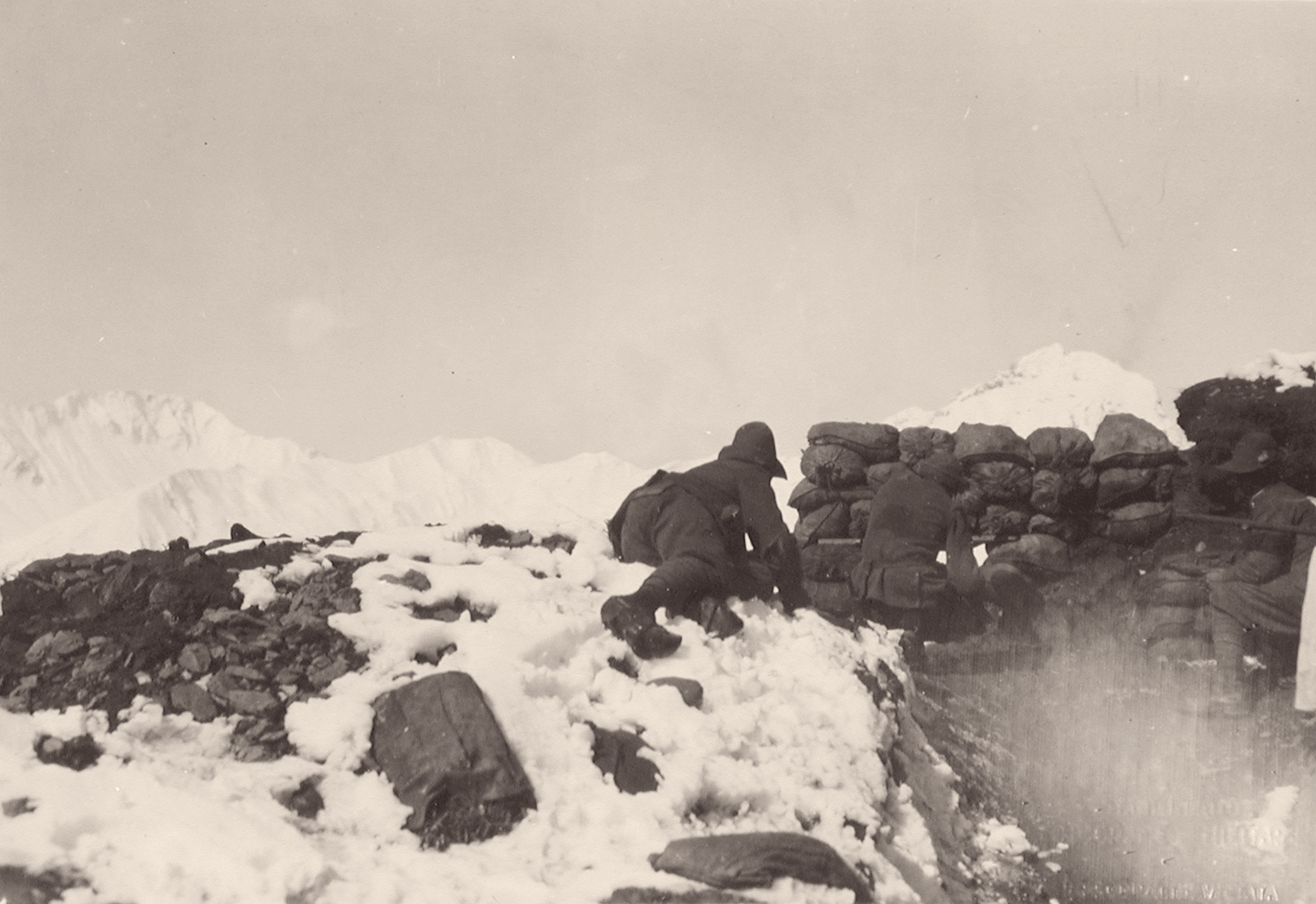
- Photographs: historical photographs of Monte Nero from the Italian Army’s galleries, available on Wikimedia Commons under the Creative Commons Attribution 2.5 licence. Credits and links appear beneath each image.
What we know, and what remains to be verified
The newspaper recounts an episode set in January 1916. The text identifies the 3rd Alpini Regiment, but omits the battalion and does not name the captain or the colonel. It does not specify the date of the rescue. This reconstruction respects those limits: it adds no undocumented names, decorations or details.
Dialogue has been rendered as indirect speech. The photographs illustrate the context and are not attributed to the night described. The date of 21 August 2016 on the photograph records refers to the digital upload, not to when the photographs were taken.
From May 1915 to November 1918, the Alpini fought on Europe’s highest front, and the Belluno area was on the front line rather than in the rear. You can read the other articles on the First World War.