A story of hidden files, buried truths and unpunished criminals
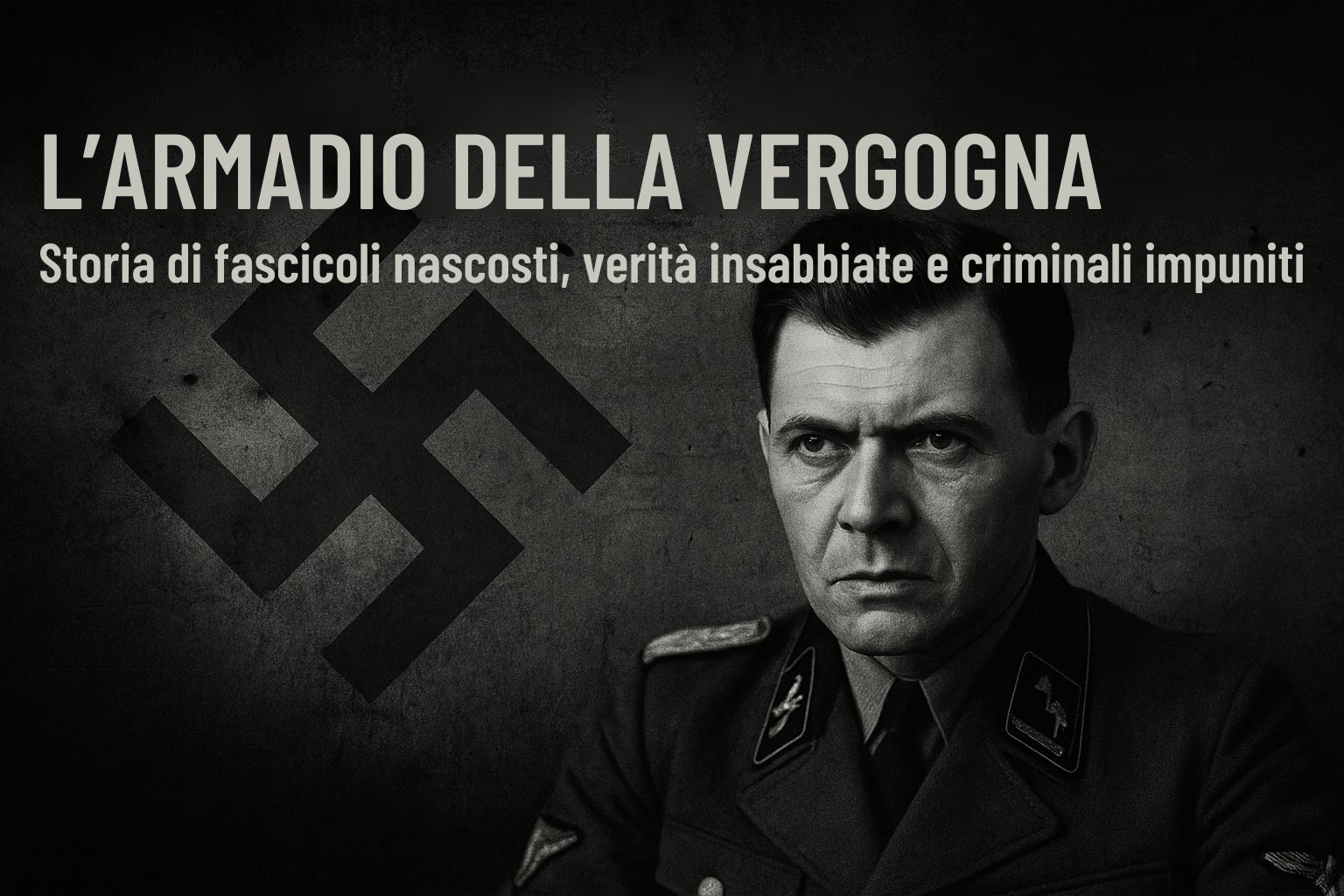
Hidden for over half a century in the basement of Palazzo Cesi in Rome, the “cabinet of shame” has become the symbol of one of the most serious cases of concealment of historical and judicial truth in the Italian Republic.
It contained 2,274 files concerning Nazi-Fascist war crimes committed in Italy during the Second World War, which were never forwarded to the competent prosecutors’ offices. An archive that should have set in motion hundreds of judicial proceedings against German officers and soldiers responsible for massacres and atrocities against the civilian population. Instead, it was locked away, ignored, buried for decades.
At the centre of this affair the figure of General Enrico Santacroce clearly emerges: Military Prosecutor General from 1958 and author of the notorious “provisional dismissal” order of 14 January 1960, which halted the judicial process for all the files. An act regarded as aberrant and contrary to law by many constitutional scholars and jurists, adopted without any legal basis and in conflict with the mandatory nature of criminal prosecution established by law.
The context was that of the Cold War: Italy was trying to maintain good relations with the new Federal Republic of Germany, a key member of NATO. Indeed, there was correspondence between senior political figures such as Gaetano Martino (Minister of Foreign Affairs) and Emilio Paolo Taviani (Minister of Defence), who in 1956 discussed the request for the extradition of a German serviceman for the events on Cephalonia. Both opposed it, citing legal constraints linked to the 1942 treaty on judicial assistance with Germany (renewed in 1953), which made the extradition of German citizens impossible.
In 1965, as the statute of limitations for Nazi crimes was approaching in Germany, the German government asked Italy for cooperation. The Military Prosecutor General’s Office responded by sending just 24 cases out of 2,274, chosen from those with the most documentation. A symbolic gesture, which could not fill a judicial void created by decades of inertia and cover-ups.
Among the most serious massacres left without justice: Boves, Sant’Anna di Stazzema, Marzabotto, the deportation of thousands of civilians, the killing of partisans, carabinieri, clergy and defenceless women. An endless list of horrors committed by the Nazis and left for far too long without a trial.
The Parliamentary Commission of Inquiry into the failure to forward the files reached a clear conclusion: Santacroce, together with his predecessors Borsari and Mirabella, is directly responsible for the concealment. But he was not alone: it was the entire legal and political system of the time that consciously chose not to deliver justice.
The “Santacroce case” is a perpetual warning. It reminds us how fragile justice is when bent to political interests, how dangerous silence is, and how much it is our duty to remember.
SOUTH TYROL, A PROTECTED REFUGE
It should not be forgotten that many of those responsible for Nazism, or who abetted it, found refuge in South Tyrol after the war, protected by an effective and organised network.
Among them:
- Karl Wolff – General of the Waffen-SS, Supreme SS and Police Leader in Italy – given shelter in Appiano.
- Karl Haas – Counter-intelligence officer, involved in the Fosse Ardeatine massacre – given shelter in Bolzano.
- Mario Carità – War criminal of the RSI – took refuge in Castelrotto.
- Pierre Laval and Jean Luchaire – Prime Minister and Minister of Propaganda of the Vichy government – took refuge in Merano.
- Margarete and Gudrun Himmler – Wife and daughter of SS chief Heinrich Himmler – given shelter in Selva di Val Gardena.
- The Bormann family – Wife and children of Martin Bormann – took refuge between Merano and Bolzano.
Even Adolf Eichmann and Josef Mengele, notorious war criminals, passed through South Tyrol, thanks to documents issued by the Municipality of Termeno. Mengele, known for his inhuman experiments on twins at Auschwitz, received in 1949 a document in the name of “Helmut Gregor”, born in Termeno, which allowed him to flee to South America.
Behind this network operated figures such as:
- Mgr Alois Pompanin – Vicar of the Diocese of Bressanone, awarded the “Ehrenzeichen des Landes Tirol” in 1958.
- Karl Nicolussi Leck – SS officer, decorated with the Knight’s Cross, co-founder of the Museion and of the Claudiana school.
As the historian Gerald Steinacher stresses in his book Nazis on the Run, this network had both international and local ramifications. A hidden, deep-rooted and complicit system, which ensured escape and impunity for criminals who should have faced justice.
The Alpini,
guardians of memory and protagonists of so many pages of resistance and solidarity,
cannot forget.
Because silence is never neutral.
RESPONSIBLE FOR THE CONCEALMENT
- Gen. Enrico Santacroce – Military Prosecutor General (1958-1974): ordered the provisional dismissal of the files in 1960.
- Dr Umberto Borsari – Military Prosecutor General (until 1954): kept the handling of the files inactive.
- Gen. Arrigo Mirabella – Military Prosecutor General (1954-1958): continued the policy of not forwarding the files to the prosecutors’ offices.
COLLABORATORS
- Col. Franco Puliti – Head of the registry, physically managed the files at Palazzo Cesi.
- Gen. Campanelli – Supervision and custody of the secret archive.
- Dr Giovanni Di Blasi – Assisted with the classification and storage of the files.
POLITICIANS INVOLVED (through acts or omissions)
- Gaetano Martino – Minister of Foreign Affairs, 1956: opposed the extradition of German criminals.
- Emilio Paolo Taviani – Minister of Defence, 1956: shared Martino’s opposition.
- Giulio Andreotti – Minister of Defence, 1960: denied any involvement, but was in office at the time of the dismissal.
NAZI AND FASCIST CRIMINALS ACCUSED IN THE CONCEALED FILES
(A selection of cases and names taken from the correspondence and official documentation)
- Gen. Hubert Lanz, Gen. Speidel – Responsible for the massacre on Cephalonia and Corfu.
- Gen. Lieb – Boves massacre and deportations in the Cuneo area.
- Joachim Peiper – Massacres in Piedmont, directly responsible at Boves.
- Titho Karl Friedrich, Hans Haage, Otto Rikoff – Killing of 71 internees on Capri.
- Lt Col. Ewert – Killing of 65 civilians in the province of Florence.
- Maj. Ludwig Wiegand – Responsible for several massacres in Tuscany.
- Col. von Bernardi, Capt. Leimberger, Strassmeyer – Torture of Italian prisoners in the Oflag 83 camp.
- Gen. Ritter von Oberkampf, Gen. August Schothuber, Lt Otto Ludendorff – Killing of 49 Italian prisoners in Split.
- Capt. Henning, Maj. Noll, Capt. Eghembar, Gen. Hoppe, Lt Hans-Dietrich Michelsen, Lt Wolf Dünnebier – Massacres in Emilia-Romagna, Tuscany, Trentino.
(The complete list is kept in the records of the Parliamentary Commission, WHICH WE ATTACH HERE, and in the archives of the Military Prosecutor General’s Office)
Memory is justice. Forgetting is complicity.
Michele Sacchet
For those who wish to find out more:
From “The Atlas of Nazi Massacres in Italy”
https://www.televignole.it/crimini-nazifascisti-occultati-5/
On a related subject, you may also be interested in: 1 May 1945: in Belluno, the last blood before freedom..