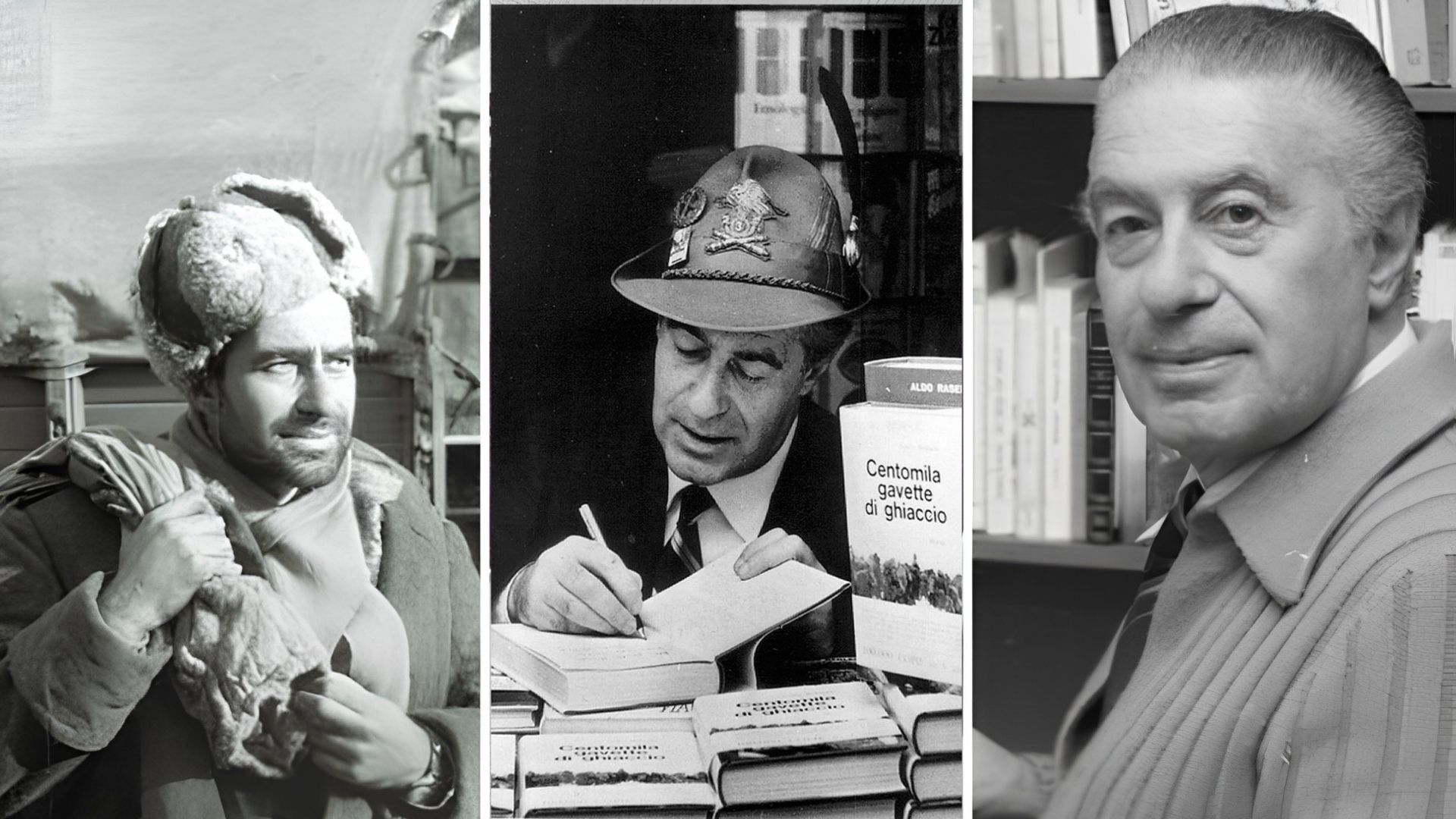
A hat, the memory of comrades, words entrusted to those who come after. Ahead of the conference in Milan on 31 October, we return to Giulio Bedeschi through the human bond that runs through his writing.
An Alpino’s hat kept at home – the felt hat with the black feather worn by the Alpini, the Italian Army’s mountain troops – carries a question with it: whose was it? Saying a name is enough to bring back a voice, a face, a story heard as children. Sometimes someone can still tell it. At other times all that remains is a photograph and a few lines, and we have to start again from there.
That is one more reason to go back to Giulio Bedeschi’s pages. Those who know him through Centomila gavette di ghiaccio (literally “A hundred thousand mess tins of ice”) remember his account of the war and of the retreat from Russia. Alongside that book there are other writings, stories and testimonies that help us understand how much, for him, memory travelled through the relationships between people.
The hat and the name of those who are missing
In Tra Piave e Montello, the newsletter of the ANA group of Crocetta del Montello (ANA stands for Associazione Nazionale Alpini, the national Alpini association), September 2001 issue, page 3, there is the closing part of E finalmente arriva il cappello (“And at last the hat arrives”), signed by Bedeschi and stated to be taken from Alpini – Storia e leggenda.
The piece dwells on the broken feather and on the meaning of the “penne mozze” – literally “cut-off feathers”, the name the Alpini give to their fallen. In this way the hat leads the reader towards the memory of the dead: behind a symbol everyone recognises, a life cut short reappears.
It is a page to be read for its narrative and symbolic value; the historical origin of the expression calls for separate verification. Its strength lies in the gesture of giving presence back to those who are missing. In our own archives, too, a photograph carries a different weight once we manage to add a name to it.
A pact passed on from person to person
A sentence by Bedeschi, quoted by the publisher in its presentation of Il segreto degli alpini (“The secret of the Alpini”), offers a key to reading him:
“Here is the simple, elementary secret of the Alpini: a sacred human pact.”
Our translation from the Italian.
For us, that pact can become a question about the present. What do we do with the memory we have received? How do we hand it on to those who never knew our veci – the “old ones”, as the veteran Alpini are affectionately called in the dialect of the Veneto?
In an Alpini group we see it in everyday gestures: looking for someone who has not been seen for a while, listening to a memory without hurrying, recognising people in an old picture, keeping the pages of a newsletter. These are different ways of caring for someone and for what they left behind.
War testimonies call for attention, respect and knowledge of the circumstances in which they were written. Our task is to make sure they go on being read, even when they become uncomfortable or raise questions.
Among Alpini, people are used to speaking plainly. The frankness and loyalty we ask of ourselves in the life of our Group also apply when we tell history, and above all when that history concerns someone we hold in esteem. That is why we take nothing away from the pages of Bedeschi that we love, and we hide nothing of what goes with them. The box that follows sets out facts and sources, with no posthumous trials and no automatic absolutions: it keeps what is documented separate from what is not, and leaves readers room to hold the two together.
In Milan, to read him again
On Saturday 31 October 2026 at 4 p.m., the conference hall of the Archivio Storico Diocesano (the Diocesan Historical Archive) in Milan, Via San Calimero 13, will host the conference Giulio Bedeschi, l’uomo, il soldato, l’autore (“Giulio Bedeschi: the man, the soldier, the author”), under the patronage of the Italian Senate.
The speakers will be Gastone Breccia, Lorenzo Cadeddu, Marco Cimmino and Lorenza Sala; Sergio Tazzer will chair. The ANA Giulio Bedeschi Choir of Conegliano Veneto will take part, presenting its new song L’attendente (“The orderly”). At 8.30 p.m. the choir will give a concert in the church of San Calimero.
For those who can attend, it will be a chance to listen and to learn. From Salce, too, we can take up the invitation, going back to a book or a page and placing it beside the testimonies kept by our families.
The human pact Bedeschi spoke of also takes shape in this way: giving time to a story, looking for a name still without a face, making room for those who can still tell. Memory goes on when someone takes on the task of listening to it and passing it on.
Sources and further reading
All sources are in Italian.
- L’Alpino, 23 October 2026: programme of the Milan conference.
- Giulio Bedeschi, E finalmente arriva il cappello, closing part, in Tra Piave e Montello, September 2001, year III, no. III, issue 12, p. 3, which gives Alpini – Storia e leggenda as its source.
- ANA: profile of Giulio Bedeschi, 9 July 2019.
- Ugo Mursia Editore: pages for Il segreto degli alpini and La mia erba è sul Don. The short quotation on the “human pact” is taken from the publisher’s presentation of the first book.
- Riccardo Rossotto, Corriere Torino, 16 July 2025.
- Benito Gramola, La 25a brigata nera “A. Capanni” e il suo comandante Giulio Bedeschi. Storia di una ricerca (“The 25th Black Brigade ‘A. Capanni’ and its commander Giulio Bedeschi. History of a research”), Cierre–Istrevi, 2005 (publisher’s page).
- Roberto Beretta, “Il lato oscuro di Bedeschi” (“The dark side of Bedeschi”), Avvenire, 23 April 2012.
- Atlante delle stragi naziste e fasciste, entry “Monte Rosso, Zugliano, 26–27 April 1945”, compiled by Pierluigi Dossi.