Seven hundred and thirty-five mule trips. It is not a symbolic figure, nor a village legend: it is a recorded number, set down in black and white together with the 1,440 hours of men’s labour and the 120 trips made with loads carried on their backs, when the animals were not enough or could not get through. It is the tally of the effort it took, at the beginning of the 1950s, to bring up to an altitude of 1,502 metres, beneath the south face of the Schiara, everything needed to build a stone house: lime, cement, sand, beams, metal sheeting, doors and windows, and food for the workmen camped up there.
Today the Rifugio 7° Alpini looks as if it had been born there, like a boulder broken away from the mountain. Anyone who reaches Pis Pilón after three hours on the path sees it appear at the far end of the meadow and takes it for granted, as one takes a bell tower for granted. But it was not there. Seventy-five years ago there was nothing up there but the old casera (mountain dairy hut) of Pis Pilón, the water of the Ardo and an idea that had been dragging on in Belluno for thirty years without ever turning into anything.
This is the story of how that idea became stone. And above all of who carried it up there.
Up there, beneath the Schiara
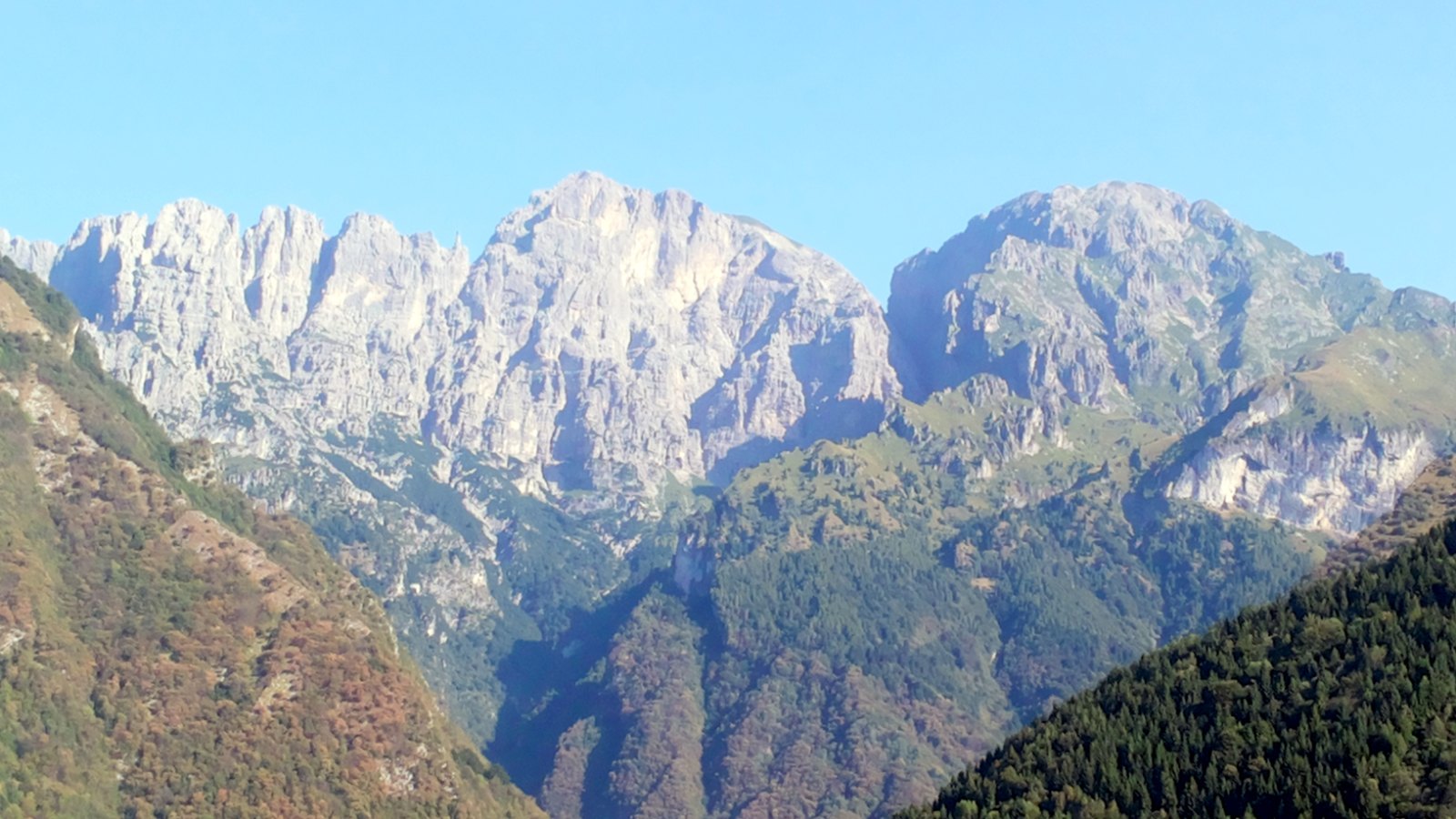
The Schiara group is the home mountain of the people of Belluno. It is not the most famous of the Dolomites; it does not have the picture-postcard look of the Marmolada or the Tre Cime: it is a stern rampart that rises immediately behind the city, and the people of Belluno find it before them every time they raise their eyes. The Gusela del Vescovà, that pierced finger of rock silhouetted on the crest, is one of the most recognisable profiles of the Belluno mountains.
The hut stands at Pis Pilón, at 1,502 metres, in the municipality of Belluno, at the head of the Ardo valley. It is owned by the Belluno Section of the Club Alpino Italiano and is the last hut on the Dolomites Alta Via No. 1: those who follow that long traverse southwards from Braies close the circle here before descending to the plain.
The choice of site was no accident. According to accounts handed down in Belluno’s mountaineering circles, it was the legendary “Chino” Viel who identified the right spot: close enough to the rock faces for the hut to be of real use to climbers, but sheltered from the avalanches that pour down those gullies in winter. Seventy-five years on, it is fair to say he judged it well.
Belluno and the idea of a hut
That a hut was needed beneath the Schiara had been said in Belluno for at least three decades. The Belluno Section of the CAI, founded in 1891, had come out of the Second World War eager to rebuild: it was precisely in the post-war period that the section filled its mountains with facilities — the huts on the Nevegàl, the Tissi on the Civetta, the Zacchi via ferrata and the bivouacs on the Schiara that would make the Alta Via No. 1 possible.
But huts are built with money, and the money did not come. For years the project remained a topic of discussion at the section’s headquarters: attractive, shared, inconclusive.
Then something happened which, told today, says a great deal about the Italy of 1950 and even more about Belluno. It was decided that the hut would bear neither the name of the mountain nor that of a benefactor, but the name of a regiment: the 7th Alpini Regiment, and more precisely the memory of its fallen. From that moment the funds began to arrive.
This is not a later reconstruction: it is the testimony of a journalist who was there. Dino Buzzati, writing in the Corriere della Sera, said that «people had been talking about it for at least thirty years; for Belluno the Schiara is the supreme crown», and recounted that a single piece of news — the dedication to the fallen of the 7th — had been enough for those thirty years of waiting to melt away.
A building site at 1,500 metres, with no road
It is worth pausing for a moment on what it meant, back then, to open a building site up there.
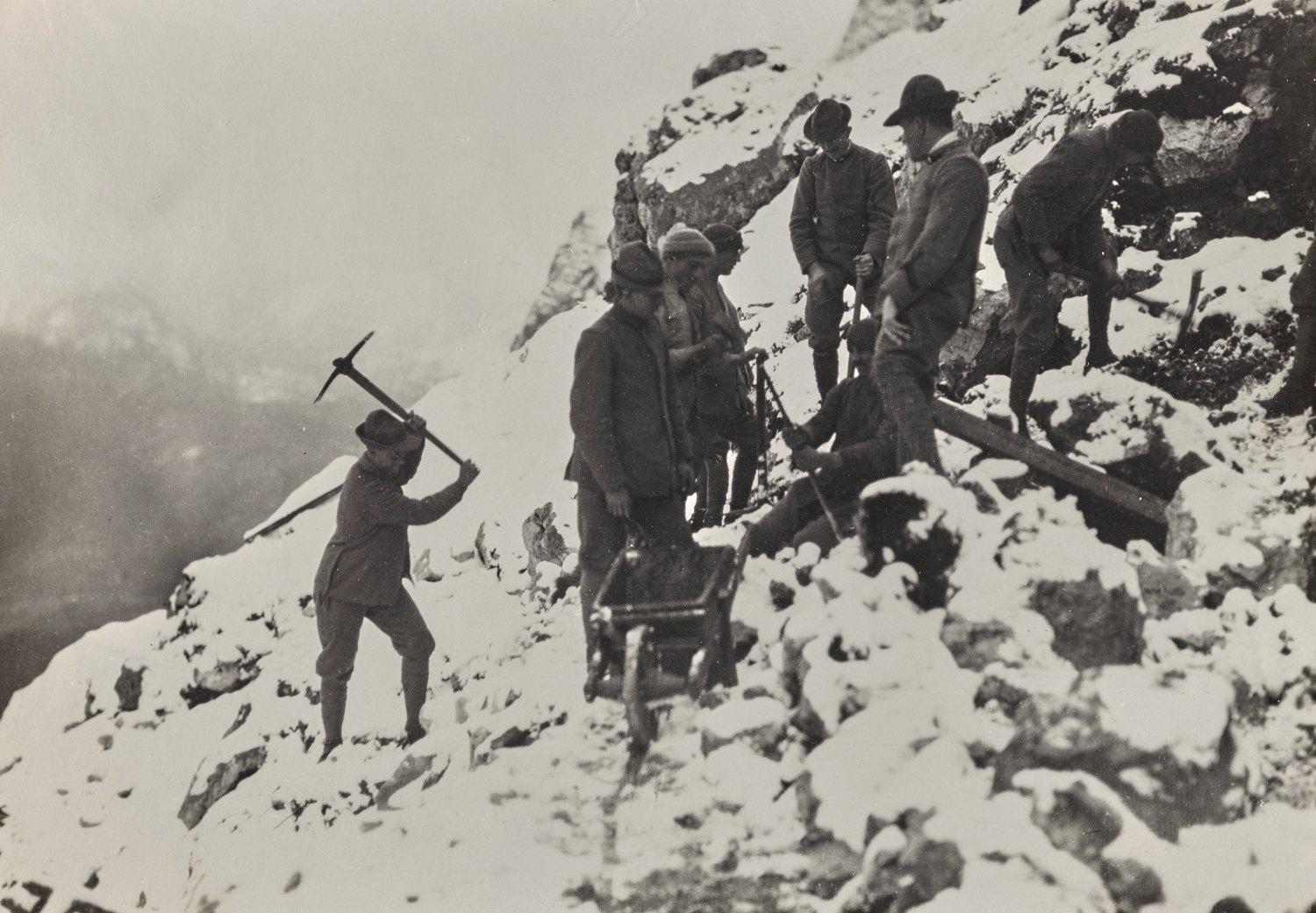
There were no forestry roads up to Pis Pilón. There were no helicopters: in Italy, transport to altitude by helicopter would become common practice only many years later. There were no permanent cableways, no concrete mixers to haul up. There was a mule track that climbs the Ardo valley, crosses and recrosses the torrent, and in its final stretch rears up in an ascent that walkers still call, without much imagination, il Calvario (Calvary).
The structural work was entrusted to the firm of the brothers Teobaldo and Giuseppe Bortoluzzi, for a sum of 3,800,000 lire — the building “in the rough”: walls, floors, roof. The workmen did not shuttle back and forth to the valley floor: they lived in a camp at Pis Pilón, for days and weeks on end, which means that it was not only the building materials that had to be carried up, but also food, water, tools — everything.
The site closed at the end of August 1950. Then it fell to the firm of senator Attilio Tissi — a name that needs no introduction in the mountaineering world, one of the strongest climbers of the “Belluno school” of the 1930s, later an administrator and member of parliament — to complete the work: interior finishes, doors and windows, sanitation, flooring. The hut was inaugurated in September 1951.
735 mule trips
And here we come to the heart of the story.
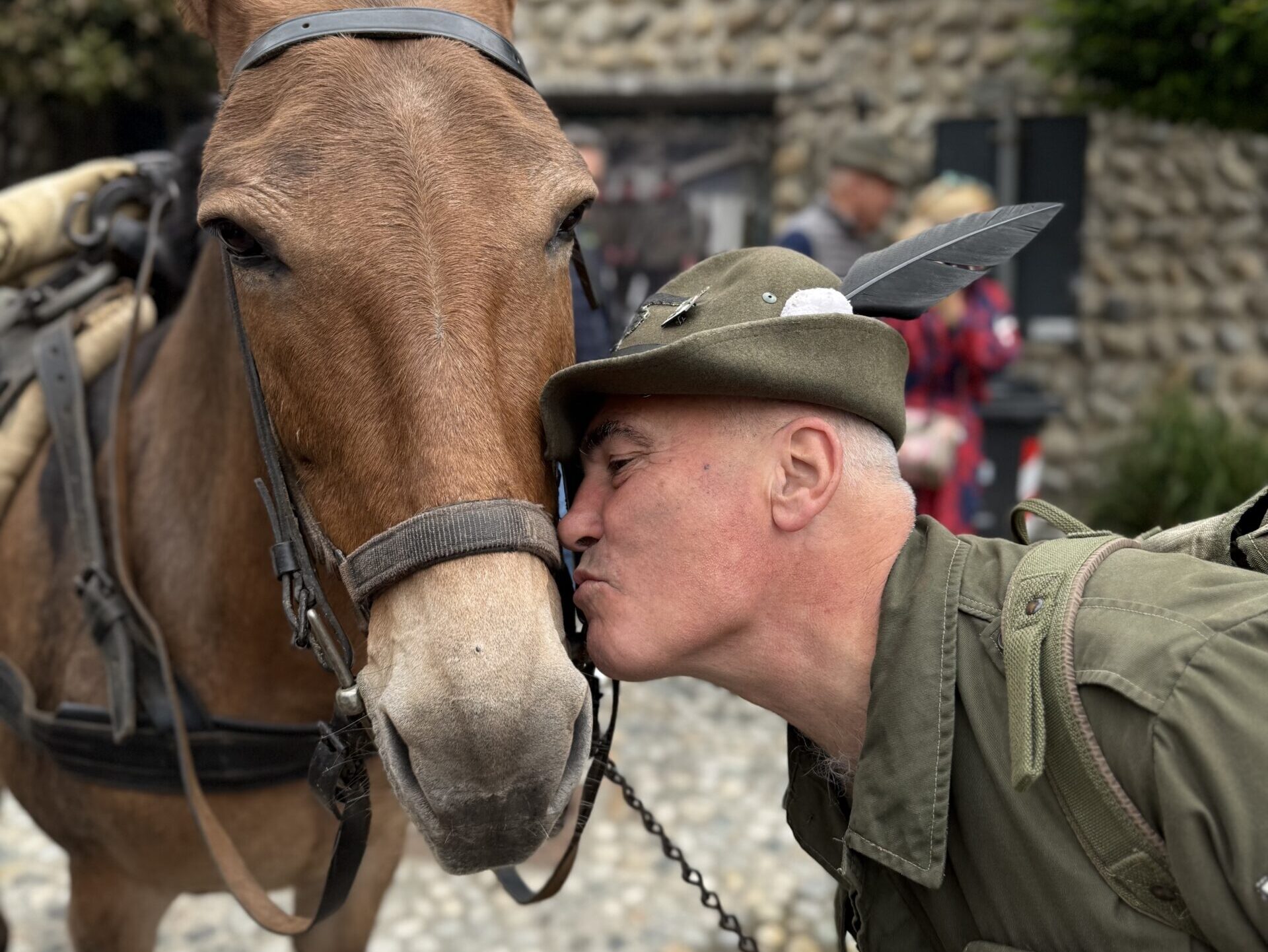
The transport of building materials and food for the workmen was not entrusted to a haulage firm, because a haulage firm, at 1,500 metres and with no road, would have been of no use at all. It was entrusted to the military. It was the Artillerymen of the 23rd Battery of the Belluno Group and the Alpini of the 8th Regiment from Tolmezzo who ensured that the loads made their way up the Ardo valley.
These were the years when the Italian Army still had pack-animal supply columns, and mules were an operational means of transport, not a folkloric memory. A pack mule carried a load of around a hundred and fifty kilos; a column set off before dawn and returned at nightfall. Making 735 trips means months of this, over and over, in the rain, in the mud of the path, through the fords of the Ardo, with animals to be tended, shod and fed.
The tally of the effort
Building the Rifugio 7° Alpini required 735 mule trips, 1,440 hours in total of work by the men engaged in transport, and 120 trips with loads carried on men’s backs, made where the mule could not go or was not enough.
Up went lime and cement, sand, beams, metal sheeting, doors and windows, ironmongery and tools. And up went the food for the workforce camped at Pis Pilón, who stayed there for the entire working season.
There were no roads and no helicopters: between the valley floor and the building site there was only a mule track, the hooves of the mules and the shoulders of the men. Every stone of that hut passed that way.
Anyone who knows mules knows that the relationship between the animal and the Alpino was not that between a man and a tool. The driver had his own mule, knew it by name and by temperament, knew when to urge it on and when to let it be. In the mountains, faced with an exposed passage, it was often the mule that was right. That familiarity, built up over decades of naja (military service) and war, is exactly the human capital that allowed an impossible building site to function.
If you want to understand how deep that bond runs, we have told elsewhere the story of the Alpine mule, from wartime companion to living symbol of the mountains.
The men behind the undertaking
It is right to name the names that the sources hand down to us, because a story without names soon turns into rhetoric.
- “Chino” Viel, a Belluno mountaineer, identified the right site: a detailed knowledge of the mountain — where the avalanche strikes, where the snow holds, how far off the rock face is — is know-how that is not found on maps.
- Teobaldo and Giuseppe Bortoluzzi, building contractors, raised the shell of the building for 3,800,000 lire.
- Attilio Tissi, mountaineer and senator, completed the finishes and installations with his own firm.
- The Artillerymen of the 23rd Battery of the Belluno Group and the Alpini of the 8th Regiment from Tolmezzo brought everything up: men in uniform, in peacetime, engaged in a civilian project.
- The Belluno Section of the CAI held the project together for thirty years and still owns the hut today.
- And then the nameless workmen camped at Pis Pilón, the mule drivers, the porters of the 120 back-carried loads. The records have not given us back their surnames. But they are the ones who built the hut.
Why “7° Alpini”
The hut’s name is not a generic tribute to the Alpini. It is a precise dedication: to the fallen of the 7th Alpini Regiment.
And there is a detail that makes that choice even more powerful, and that often goes unnoticed. In 1951 the 7th Alpini Regiment did not exist. It had been disbanded on 12 September 1943, in the chaotic days following the armistice, and would be re-established only on 1 July 1953, within the reborn “Cadore” Alpine Brigade.
This means that when the people of Belluno decided to give that name to their mountain, the 7th Alpini was, strictly speaking, only a memory: a unit that no longer had barracks or a flag in service, but which lived on in families, in the surnames on memorial plaques, in the stories of the veterans. Naming a hut after it meant saying, quite simply, that the regiment was not finished.
Why “7° Alpini”?
The 7th Alpini Regiment was founded in Conegliano on 1 August 1887, under the royal decree of 10 July of that year which brought the Alpini Corps to twenty-two battalions. Its first commander was Colonel Angelo Fonio.
It was formed with battalions bearing the names of these valleys: “Feltre”, “Pieve di Cadore” and “Gemona”, to which, over the course of its history, the “Belluno” and the “Cadore” would be added. Its motto is Ad excelsa tendo (“I strive towards the heights”).
For generations of Belluno families the 7th was simply “the regiment”: the one their sons, fathers and brothers went off to join. Giving its name to the hut beneath the Schiara meant placing a collective name on the home mountain.
Today the 7th Alpini Regiment is based in Belluno itself, at the “Salsa D’Angelo” barracks, and belongs to the “Julia” Alpine Brigade.
The 7th Regiment and Belluno
A full history of the regiment is not needed here — that would be another article, and a long one. What is needed are the few facts that explain why that number carries such weight in Belluno.
The 7th was deployed to Libya in 1911-1912. Then came the First World War, which was fought on home ground too: the front came down to the Piave and the Belluno area fell under occupation after Caporetto. The regiment’s losses in that first conflict were extremely heavy — in the order of 141 officers and over 3,600 soldiers killed — and earned its flag the Military Order of Italy. We have recounted a specific episode from that period in August 1917: the Battle of the Bainsizza and the 7th Alpini Regiment on the Isonzo.
There followed East Africa in 1936 and, between 1940 and 1941, the Greek-Albanian front, where on 8 December 1940 the regiment’s commander, Colonel Rodolfo Psaro, was killed, earning a posthumous Gold Medal of Military Valour. Then came 1943, the disbandment, and the deportation of most of the men.
The bond with the province, however, does not end with the wars. Indeed, the pages the people of Belluno remember best are two pages of peace. In October 1963, after the Vajont disaster, the 7th was among the units engaged in the relief effort: for that work its flag would receive the Gold Medal for Civil Valour. In November 1966 the regiment was once again in the front line, this time against the flood that devastated the Belluno area.
In 2005 the 7th returned to its historic home in Belluno, the “Salsa D’Angelo” barracks; in 2011 the City of Belluno granted it honorary citizenship. This was no mere formality: it was the recognition of a relationship that dates back to 1887.
The day of the inauguration
In September 1951 Belluno climbed up to Pis Pilón. We know it was a day of sunshine and crowds, with the authorities, the CAI, the Alpini, and an old general who took the floor. We know that the hut was handed over to those who would use it — mountaineers, walkers, and anyone who needed a roof up there.
A clarification, because local memory deserves rigour: the available sources agree on the year and the month — September 1951 — but do not consistently give the exact day of the inauguration. The date of 23 September 1951 circulates in various accounts and is consistent with Buzzati’s report published on the 25th, but we have not been able to document it with a primary source: anyone who holds a document, a dated photograph or a copy of a newspaper from the time is invited to write to us. This too is keeping memory alive.
Dino Buzzati tells the story of the Rifugio 7° Alpini
At Pis Pilón that day there was also the special correspondent of Italy’s most important daily newspaper. Which, for a provincial mountain hut, was by no means a given — except that the correspondent had been born a couple of kilometres away.
Dino Buzzati was from Belluno. Born in 1906 at San Pellegrino, on the edge of the city, he had learnt to gaze at the Schiara as a boy; he had climbed it, drawn it, written about it. The mountains of his books — including the imaginary ones that surround the Fortress Bastiani in Il deserto dei Tartari (The Tartar Steppe) — have the shape and the silence of these rock faces. Buzzati had joined the Corriere della Sera when very young and would remain with it all his life.
The article appeared on 25 September 1951 under a headline that has endured: «Non parlava inutilmente il vecchio generale degli alpini» (The old Alpini general did not speak in vain). It is from that piece that the most frequently cited testimony on the birth of the hut comes: the thirty years of fruitless discussion, and the sudden turning point when it was decided to dedicate it to the fallen of the 7th.
Buzzati was no rhetorician, and that is what makes his report so valuable. He knew military rhetoric very well and could recognise it; if in that headline he wrote that the old general had not spoken in vain, it was because he had seen that, on that occasion, words had produced a stone building at an altitude of 1,502 metres.
Dino Buzzati and that day in 1951
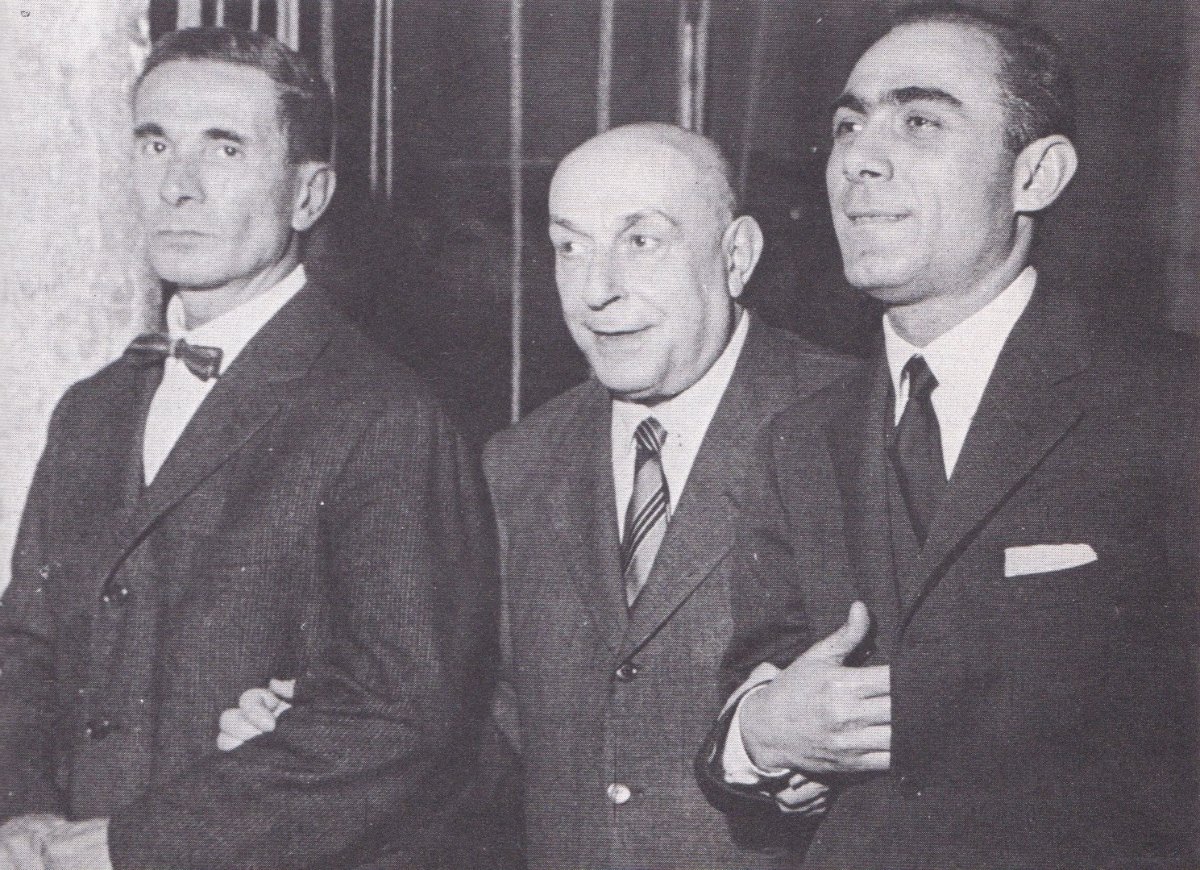
Dino Buzzati (left) beside Mario Missiroli, editor of the Corriere della Sera, and Gaetano Afeltra: this is around 1952, a few months after the report from the Schiara. Photo: unknown author, from G. Afeltra, «Missiroli e i suoi tempi», Bompiani 1985; Wikimedia Commons, public domain.
Who he was. Dino Buzzati (1906-1972), writer, painter and journalist, born in San Pellegrino di Belluno and a byline of the Corriere della Sera throughout his life. Author of Il deserto dei Tartari, Il segreto del Bosco Vecchio and hundreds of short stories.
His mountains. The Schiara and the Belluno Dolomites were his mountaineering apprenticeship and his literary obsession: he climbed them, painted them and transfigured them into imaginary landscapes that remain highly recognisable.
The article. On 25 September 1951, in the Corriere della Sera, his account of the inauguration appeared under his byline as special correspondent: «Non parlava inutilmente il vecchio generale degli alpini». It is the source from which we know that the hut, awaited for thirty years, was finally unblocked when it was decided to dedicate it to the fallen of the 7th Alpini.
Alpini and mules: an inseparable story
There is a reason why, in this story, the mules are not a colourful detail.
For a century the mule was the Alpini’s infrastructure. Where the carriage road ended, the pack train began: mountain artillery dismantled and loaded in pieces, ammunition, food, materials. In the First World War, in Greece, in Russia, and then in all the post-war exercises, Alpine logistics was to a very large extent four-legged logistics. Mules would officially leave the units only in 1993.
The Rifugio 7° Alpini is, in this sense, an unintentional monument: it is the material proof of what those men and those animals were capable of doing together. Not a feat of war — a civilian work, in peacetime, to leave something for those who would come after. Which is, when you think about it, the most exact definition of what it means to be an Alpino once the naja is over.
The hut today
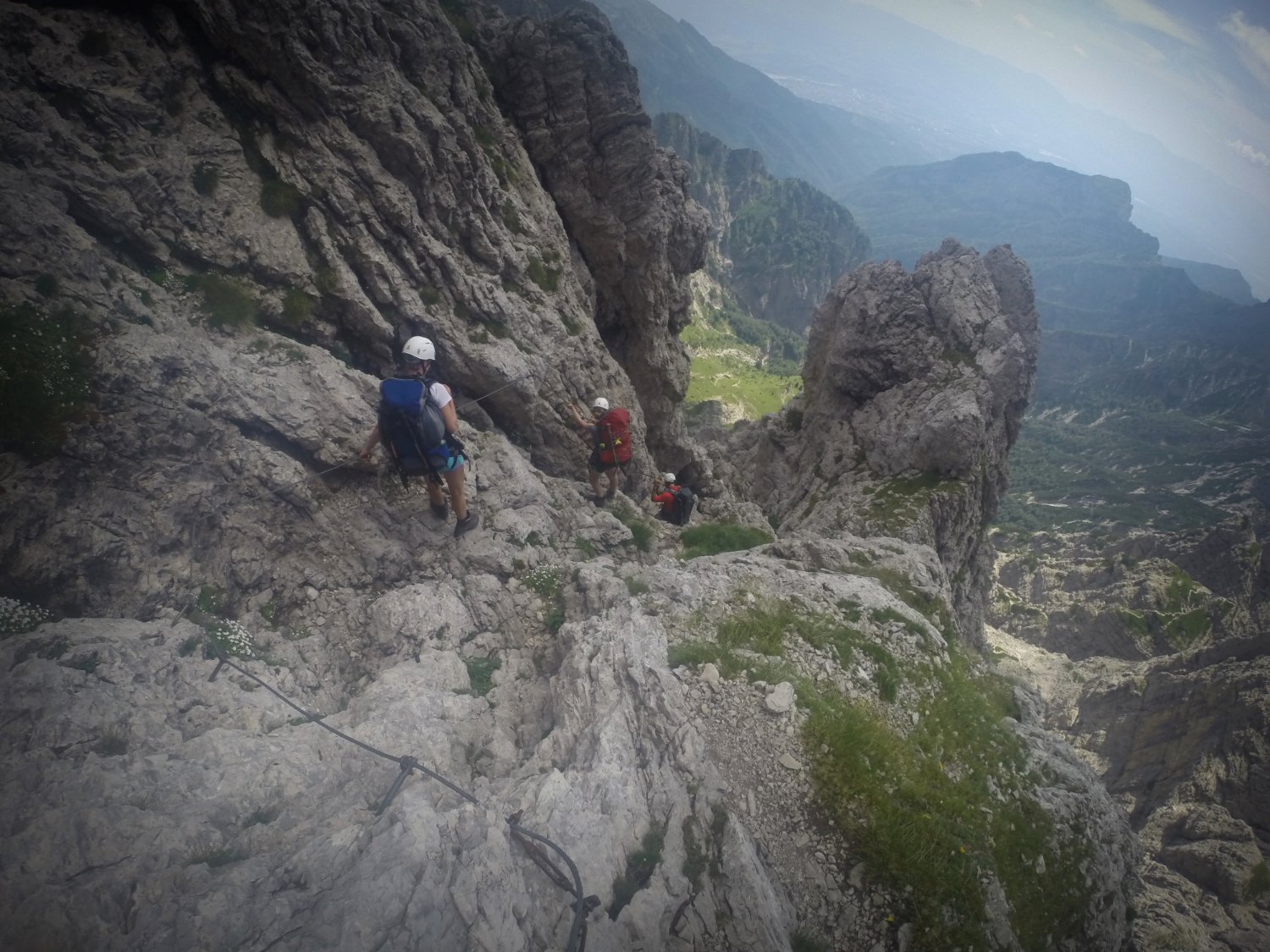
The Rifugio 7° Alpini is still there, still owned by the Belluno Section of the CAI, still open in the summer season with around fifty beds in dormitories. It is the base for the routes and vie ferrate of the Schiara — the Zacchi, the Marmol, the Piero Rossi, the Sperti — and the final stage of the Dolomites Alta Via No. 1; it lies within the Dolomiti Bellunesi National Park, in an area recognised as a UNESCO World Heritage Site.
The management has changed several times over the years, as happens with all huts. What has not changed is its purpose: a roof and a hot meal at 1,502 metres, for those who get there on their own two legs.
Since 2010 the path leading up there has also hosted a hill-climb race from Case Bortot to the hut — about 7 kilometres and 900 metres of ascent — which has much older roots: as early as the 1960s Belluno climbers would challenge one another on that climb, some with a loaded rucksack and some stripped to the waist, to test their fitness.
A story that still belongs to Belluno
There are monuments made specifically to be monuments: they stand in the square, they have a plaque, they are visited once a year. And then there are monuments people use without noticing — they sleep in them, eat in them, shelter in them from the storm.
The Rifugio 7° Alpini is of the second kind, and that is why it works. Every time someone pushes open that door, they are entering a building carried up there piece by piece on the backs of mules and men, and named after a regiment that in 1951 existed only in the memory of those who had served in it.
Seven hundred and thirty-five trips. That is the number worth remembering the next time that, from the far end of the Pis Pilón meadow, the hut looks as though it has always been there.
Would you like to reach the Rifugio 7° Alpini?
This is the story of why that hut exists. If, after reading it, you feel like actually going up there, the practical guide to the hike — starting from Case Bortot, CAI path 501 along the Ardo valley, walking times, height gain, difficulty, variants and tips for the visit — is published on the tourism portal DolomitiBelluno.it.
Frequently asked questions about the Rifugio 7° Alpini
Why is the Rifugio 7° Alpini so called?
Because it is dedicated to the fallen of the 7th Alpini Regiment, the regiment historically linked to the Belluno area. According to Dino Buzzati’s report in the Corriere della Sera, it was precisely the decision to dedicate it to the memory of the fallen of the 7th that unlocked the funding after some thirty years of plans that never left the drawing board.
When was the Rifugio 7° Alpini built?
The work took place between the end of the 1940s and 1951; the available sources do not state precisely when the building site opened. Construction of the shell of the building, entrusted to the firm of Teobaldo and Giuseppe Bortoluzzi for 3,800,000 lire, was completed at the end of August 1950; the interior finishes, doors and windows, installations and flooring were carried out subsequently by the firm of senator Attilio Tissi.
When was it inaugurated?
In September 1951. The available sources agree on the month and year; the exact day is not consistently documented, but the inauguration took place a few days before Dino Buzzati’s article appeared in the Corriere della Sera on 25 September 1951.
How many trips did the mules make to build it?
735 mule trips were made, with a total of 1,440 hours of work by the men engaged in transport and a further 120 trips with loads carried on men’s backs. The transport of materials and food was provided by the Artillerymen of the 23rd Battery of the Belluno Group and the Alpini of the 8th Regiment from Tolmezzo.
What is the relationship between the 7th Alpini Regiment and Belluno?
The 7th Alpini Regiment was founded in Conegliano on 1 August 1887 with battalions bearing the names of these places — “Feltre”, “Pieve di Cadore”, “Gemona”, later “Belluno” and “Cadore”. Disbanded in 1943 and re-established in 1953, it took part in the relief effort after the Vajont disaster of 1963 (Gold Medal for Civil Valour to its flag) and in the 1966 flood. Since 2005 it has been based in Belluno, at the “Salsa D’Angelo” barracks, and in 2011 it received the city’s honorary citizenship.
What did Dino Buzzati write about the Rifugio 7° Alpini?
Buzzati covered the inauguration as special correspondent of the Corriere della Sera and devoted to it the article «Non parlava inutilmente il vecchio generale degli alpini» (The old Alpini general did not speak in vain), published on 25 September 1951. In it he described the city’s thirty-year wait and how the dedication to the fallen of the 7th Alpini was what finally made the project possible.
Where is the Rifugio 7° Alpini?
At Pis Pilón, at an altitude of 1,502 metres, in the municipality of Belluno, at the head of the Ardo valley beneath the south face of the Schiara, within the Dolomiti Bellunesi National Park. It is owned by the Belluno Section of the Club Alpino Italiano and is the last hut on the Dolomites Alta Via No. 1.
Sources and further reading
- Historical reconstruction of the building site and the transport: Crono Rifugio Settimo Alpini – Our history (with the quotation from Dino Buzzati’s article).
- CAI Belluno Section – History of the Section and Rifugio VII Alpini information page.
- Official website of the Rifugio 7° Alpini.
- Dolomiti Bellunesi National Park – Rifugio 7° Alpini.
- History of the regiment: ANA (National Alpini Association) Conegliano Section – Historical summary of the 7th Alpini.
- Decoration of the flag: Presidency of the Republic – Gold Medal for Civil Valour to the 7th Alpini Regiment.
Opening image: the Schiara group seen from Col di Roanza — photo by Fistarol Ivan, Wikimedia Commons, CC BY-SA 4.0.