On 4 November 1966, flooding devastated the province of Belluno. Salce’s parish bulletin recorded the destruction and solidarity between communities in its December issue. This local testimony is examined alongside historical and scientific accounts of the disaster.
There are dates that, for those who lived through them, remain etched in the memory of an entire province.
4 November 1966 is one of them: within a few hours an unprecedented flood swept across a third of the Italian peninsula, and no area was hit as hard as the province of Belluno.
In its December issue that year, the parish bulletin of Salce gave its readers a dramatic account of the disaster, which today we can reread with the help of the historical and scientific sources available.

The cover of the December 1966 parish bulletin of Salce, which told its readers about the disaster of the previous weeks.
Source: bollettinisalce.com
4 November 1966: the day of the disaster
Between 2 and 4 November 1966, exceptional rainfall – in some places more than 200 millimetres in 24 hours, the equivalent of a month’s rain in a single day – struck much of northern and central Italy, after an October that had already been very wet.
Rivers and streams burst their banks almost everywhere at the same time: in Florence the Arno reached record levels, while in Venice the acqua alta peaked at 194 centimetres, a level never equalled since.
But it was among the mountains of the Veneto, Trentino and Friuli that the human toll was heaviest.
The province of Belluno under water
In the Veneto alone the flood claimed dozens of lives; in the province of Belluno, according to the most recent historical reconstructions, there were 26 dead, more than 4,300 buildings damaged or destroyed, and 528 bridges and 1,346 roads swept away by landslides and floodwaters. Entire villages were cut off from the rest of the world for days.
The Salce bulletin listed for its readers the names of the worst-hit villages, a roll of suffering worth reproducing in full:
- Falcade
- Rocca Pietore
- Alleghe
- Gosaldo
- Cencenighe Agordino
- Forno di Zoldo
- Zoppè di Cadore
- San Pietro di Cadore
- Santo Stefano di Cadore
- Sappada
Villages of the Agordino, the Val di Zoldo and the Comelico, overwhelmed by the floods of the Cordevole, the Maè and the Piave and their tributaries, and often reachable only with difficulty even in the days after the disaster.
The flood in the province of Belluno, in figures
26 victims · more than 4,300 buildings damaged or destroyed · 528 bridges collapsed · 1,346 roads cut off
Source: CNR IRPI – Polaris, «Le alluvioni del Novembre 1966»
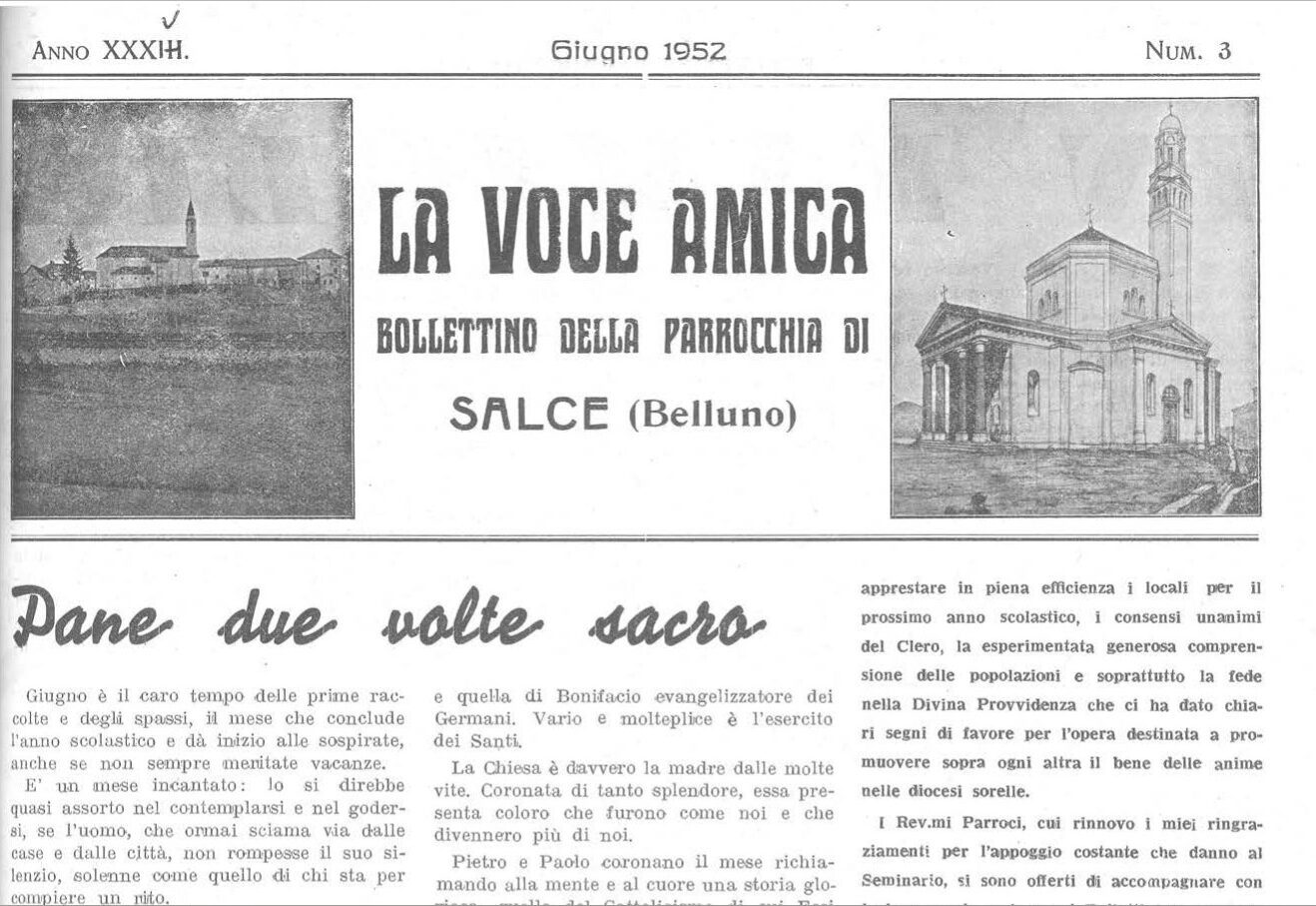
Pages of memory: another historic cover of «La Voce Amica», the parish bulletin of Salce.
What the Salce bulletin tells us
The account published in December 1966 was not just a cold list of places. It spoke of destroyed homes, of families left without food or light, «at the mercy of the fury of the water», of a desolation that the parish priest described as unprecedented «in living memory and in history».
Its direct, almost chronicle-like language conveys well how gravely the event was felt even by those who, like the readers in Salce, had not been struck to the same degree.
Solidarity between villages
In those very days, the closeness between the communities of the province proved essential: collections of food, clothing and aid were organised all over the Belluno area to support the isolated villages, at a time when relief resources were far more limited than today and much of the first emergency work fell to the spontaneous solidarity of neighbours in the valleys.

Solidarity in the mountains: when valley communities helped one another in times of emergency.
📷 In this historical photograph of the 1966 flood, Alpini help the population in the streets of Bolzano
The Alpini come to the rescue
On 4 November 1966 a devastating flood ravaged much of the province of Belluno, causing some thirty deaths and enormous damage.
Everyone, with the Penne Nere in the front line, threw themselves into relief work in the stricken places, through both collective and personal initiatives.
The chronicles of the Associazione Nazionale Alpini recount several episodes of this commitment in the valleys of Belluno.
Cencenighe
One of the worst-hit places, half buried under metres of debris. The head of the local group, Luigi Manfroi, worked tirelessly for days clearing debris and restoring communications.
Voltago and Frassenè
Here 4 bridges were swept away; the local Alpini group and other volunteers rebuilt them temporarily in timber.
Alpago
Many people were worn out by cold, fatigue, sleeplessness and fear. The alpino Giuseppe Bertolazzi, who ran a hotel, gave away all the clothing he had to those who had lost everything.
Val del Biois
The Alpini of Falcade and the local population, in just eight days, cleared the village of debris, restored communications and rebuilt a 12-metre bridge with a load capacity of up to 300 quintals (30 tonnes).
Source: chronicles of the Associazione Nazionale Alpini on the flood of November 1966. The number of victims in the province of Belluno given by the scientific sources (CNR IRPI – Polaris) is 26; the Alpini chronicles of the time speak of «some thirty» dead.
Salce and the flood: what reached us here
The pages of the bulletin do not suggest that Salce suffered damage comparable to that of the Agordino or the Comelico: the village, closer to the provincial capital, was one of the communities able to tell of – and perhaps also to help relieve – the suffering of those who were worse off.
It is a detail worth stressing: the memory of an event like this belongs not only to those who suffered it directly, but also to those who lived it from close by, through the news, through worry for relatives and friends in the stricken valleys, and through taking part in the relief effort.
A memory not to be lost
Almost sixty years on, the flood of 4 November 1966 remains one of the most serious events in the recent history of the province of Belluno, still remembered today in ceremonies and in studies on hydrogeological risk in the mountains.
Rereading how the small bulletin of a mountain village spoke of it, in the heat of the moment, is a way of not losing that memory, and of understanding better how our community has always been part of a larger story: that of the whole province.
Sources and further reading
- La Voce Amica, parish bulletin of Salce, December 1966 – see the original issue (in Italian)
- Digital archive: bollettinisalce.com
- CNR IRPI – Polaris, «Le alluvioni del Novembre 1966» (data on victims and damage in the province of Belluno; in Italian)
- Wikipedia, «Alluvione di Venezia del 4 novembre 1966» (in Italian)
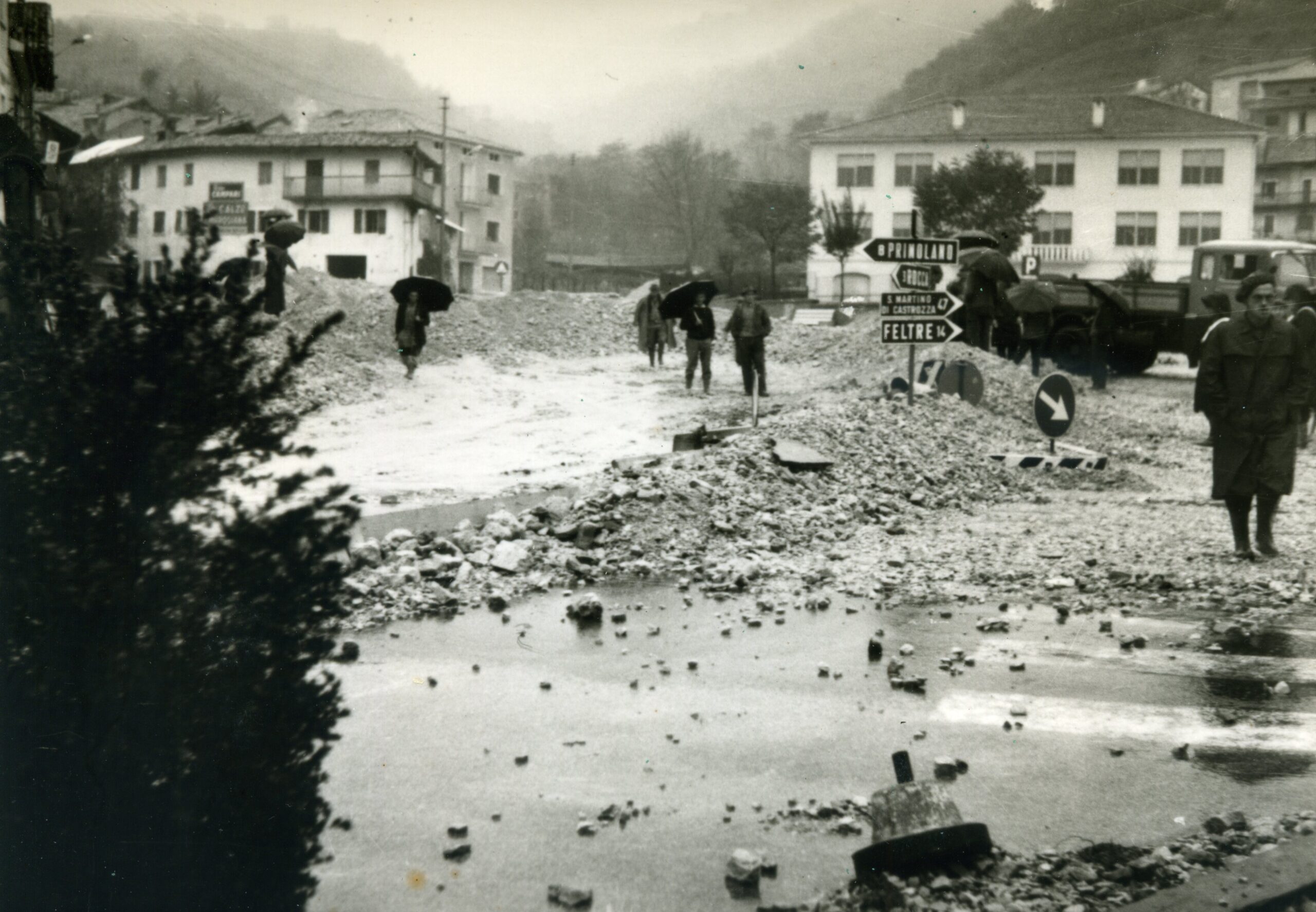
- Cover: the square of Arsiè in the aftermath of 4 November 1966.