A story almost 500 years long
The first structure for crossing the Piave at Belluno of which there is reliable record dates from 1388, in the small square of Borgo Piave near the apse of the old church.
Built of stone and timber, it was periodically destroyed by the river’s floods and rebuilt with wooden footbridges. The structure was duly rebuilt until 1872, the year the Zilli Bridge opened. And even afterwards it remained an emergency crossing, being the shortest point between the two banks of the Piave. It was in fact rebuilt in wood and used after its destruction by the retreating Austrians in 1866, because the stone bridge further downstream was not yet working. One arch of that bridge still survives today, and its reconstruction was finally abandoned after the collapse of 1882 — also because, after the flood, anchoring it to the left bank of the Piave had become technically difficult.
Another important record of the bridges over the Piave is owed to the Venetian architect Antonio Da Ponte (who also designed the Rialto Bridge in Venice). The Great Council approved the work at its session of 12 April 1568. The bridge was built quickly, with a single span, and by the end of 1568 it was already in use. But the flood of 1578 swept it away.

(From the Facebook group “Belluno e provincia: cultura arte e storia”)
For the next 250 years there are no documents recording the construction of other important bridges over the Piave at Belluno.
We must therefore assume that for two and a half centuries the link between the two banks was mostly provided by makeshift wooden footbridges. Work on the Austrian bridge, whose remains can still be seen at Borgo Piave, in fact began in 1837.
The bridge, designed by Antonio Zilli, was completed on 13 December 1841 after withstanding a violent flood in October of the same year. But on 2 November 1851 the raging waters of the Piave pushed harder, and this time they bent two piers on the Castion side, undermining the stability of three arches and forcing its closure. The bridge was restored 21 years later, in 1872. In the meantime the crossing was ensured by the wooden bridge of piazzetta San Nicolò, which was however swept away by water and a landslide in October 1882; its remains were later reused by the Italian military engineers to build a wooden footbridge.
And so we come to the last century.
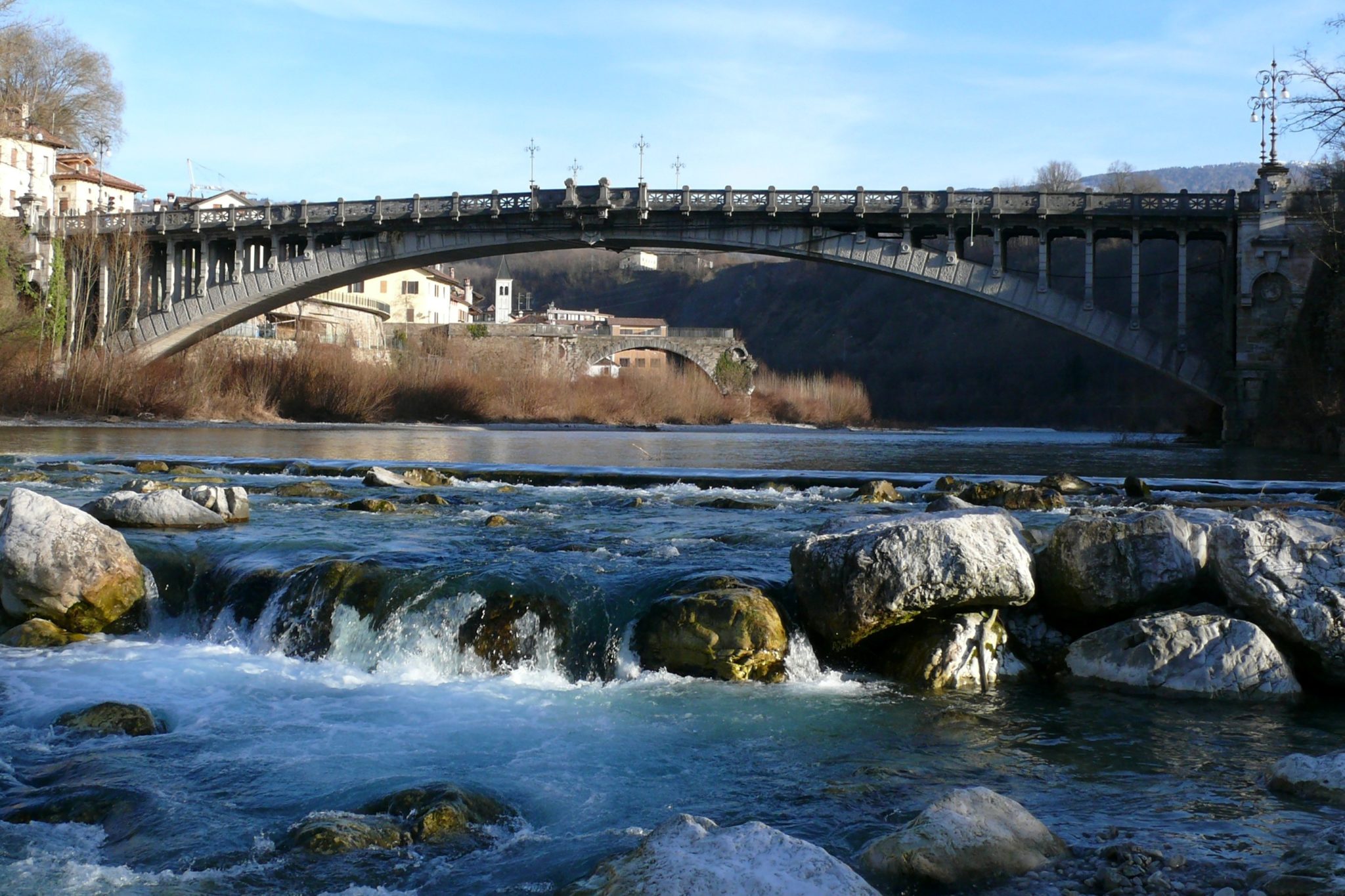
The frequent floods of the Piave, which carried timber downstream, had by now taught that bridge piers were periodically damaged and knocked down. For this reason engineer Eugenio Miozzi, working with architect Riccardo Alfari, revived the single-span solution already adopted by the Venetian architect Da Ponte. So on 11 June 1923 work began on the Ponte della Vittoria, finishing on 17 October 1925, when it opened to traffic.
The official inauguration took place on 23 May 1926 in the presence of King Victor Emmanuel III, and the newspapers of the time have left us a detailed account of the day. At 8.30 on Sunday 23 May 1926 the royal train arrived at Belluno railway station. With the King were Bonomi and Italo Balbo, General Cavallero representing the Ministry of War, Generals Tassoni, Sani, Cittadini and Graziani, Admiral Grotta and the members of parliament Tovini, Zugni Tauro and Chiarello.
They were welcomed by the Prefect of Belluno, Commendatore Camozzi Fassini, and Commissioner Del Niero with the other authorities. A luxurious Fiat 512 took the King to the Salsa barracks for the unveiling of the bronze monument made by the Alpini captain Silvio. Victor Emmanuel III and the motorcade then reached the Ponte della Vittoria for the symbolic laying of the last stone. Here the Commissioner, Commendatore Del Niero, praised the distinguished work that would stand for centuries as a testimony to the great historical event, before a crowd cheering the King from both banks of the Piave. The day continued with an imposing parade of the Alpini in piazza Campitello (now Piazza dei Martiri) at 11 o’clock. At noon the King left the city, saluted by the crowd.
And in the afternoon, in the rain, the visit ended with the unveiling of the flag of the Belluno Fascist Federation in piazza Duomo.
Roberto De Nart