The etymology and history of ranks (part 1)
The term for the category ranking immediately below officers comes from the French «Sous Officier».
Previously the category was called «Bas Officier», low officers, a term used until it came to be considered offensive.
In fact the simplest explanation of the term, while sharing the same root as «officer», opus facere, described the tasks assigned to non-commissioned officers, considered «low» not so much because they were humble, but because they were «low» in the chain of command.
It was therefore thought better to identify the category by its position in the hierarchy rather than by its tasks and duties.
SERGEANT
According to some, in the Middle Ages the sergeant was the coordinator of the group of pages and squires who followed a lord.
Hence the link with a leader, the lord of many people. Other research links it to the present participle of the Latin verb servire, serviente, the one who serves. In the age of chivalry, sergeants were the knights’ valets.
Yet another explanation splits the term into serra gente, «close the ranks»: the task of the men on the flanks of infantry formations, who had to stop the lines breaking up under the shock of the enemy or of its fire.
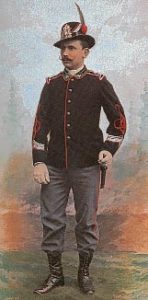
The sergeant was a junior officer of the Italian militias of the Risorgimento and, around 1200, in Italy the simple foot soldier was called a sergeant. Finally, in old Piedmont (16th century), there were sergeants who were junior officers, sergeant majors in command of a battalion, and battle sergeants, with the sergeant major general among the general officers.
So, while in 1294 Brunetto Latini defined the word sergeant as a «subordinate person», in 1540 Guicciardini labelled it simply as a «military rank».
But as we have seen, for at least two and a half centuries if not more, its place in the hierarchy fluctuated from the very top, with the sergeant major general of Emanuele Filiberto’s time, to settle, at least in Italy, in the 18th century, as a rank belonging to the category of non-commissioned officers.
Flanked from 1814 by the sergeant major, from the 19th century it remained linked to the organisational level of the squad leader. Its history is intertwined with the rank of quartermaster: the quartermaster sergeant, followed by the quartermaster major in 1841. The sergeant major would return in 1903 with the appearance of the rank of marshal, which partly absorbed the quartermasters and quartermaster majors.
MARSHAL
The term has been present in the Italian language and documents since 1427. It derives from the French «maréchal», a military rank and dignitary of the state created in 1185 by Philip Augustus of France, also given to the person in charge of the royal stables. It comes from the union of two old Germanic (Frankish) words, «marh» and «skalk», meaning horse and servant respectively.
Servant of the horse, then: a very important and at the same time humble task. The farrier (maniscalco in Italian, a word closely related to maresciallo) had the great responsibility of shoeing a lord’s horse or the horses of a squadron.
Hence the double meaning of the term marshal: either a rank or title at the very top of the hierarchy, or a non-commissioned rank in the cavalry «corresponding to the sergeant of the foot troops».
A «Marshal of Italy» was thus understood as «the King’s groom», or squire of the nation’s military fortunes, and therefore the highest rank attainable.
Second only to «Captain General», the rank reserved for the King, it remained in use in Italy on and off until the end of the Second World War.
In the same way, the marshal entered the category of non-commissioned or «low» officers as early as the 16th-century organisation of Emanuele Filiberto’s Piedmontese cavalry, as «Marechal de Logis», later translated as «Maresciallo d’Alloggio» (quartermaster marshal).
It was replaced by the «furiere», introduced into the Piedmontese army from the French «fourrier»: the one in charge of fodder, but also the «forerunner», who arrived first in a place and organised the logistics, that is, the unit’s lodgings.
Marshals returned to the Italian Army as a category of non-commissioned officers in 1903, replacing the quartermasters and organised on three levels – company, battalion and regiment – corresponding to Maresciallo Ordinario, Maresciallo Capo and Maresciallo Maggiore, with a strong logistical and administrative focus.
The rank, later reshaped and renamed, nevertheless settled above the sergeants.
In 1916 the category gained a new and unique rank, the «Aiutante di Battaglia» (battlefield adjutant), earned not through seniority but in combat, in regardless of one’s previous rank.
This «invention» was needed to fill the terrible gaps that had opened in the ranks of junior officers after the first months of trench warfare, and to bring in new platoon commanders with combat experience quickly.
The sequence of the three marshal ranks remained unchanged until the 1970s, when the title of Maresciallo Maggiore «Aiutante» was created; in 1995 it became the new top rank of the category.
With the most recent reforms, due to the professionalisation of the armed forces and the division of non-commissioned officers into several roles, the marshals’ role was reorganised into four ranks: Maresciallo, Maresciallo Ordinario, Maresciallo Capo and Aiutante.
In 2001 a new measure turned the Aiutante into 1° Maresciallo and created the title of 1° Maresciallo Luogotenente.
Michele Sacchet, from Col Maòr no. 4, 2006