Adunata Diary · Part 5 of 5
Lest we forget Guido Rossa
This page is part of the diary of the National Alpini Rally (Adunata) in Genoa 2026, but it lives a life of its own. If you were looking for information on Guido Rossa, here it is. If you have come here from the Adunata Diary, welcome to what is the most important page of all.
— Michele Sacchet, Alpino
There is a moment, at every Adunata, when the celebration has to stop. Not for an hour, not for a day: for the time it takes to look memory in the face. Civic memory above all. The kind that weighs, that burns, that calls us to account for what we are.
I was determined that, amid the Genoese crowds of Saturday 9 May, the Group should stop in front of the monument dedicated to Guido Rossa. It was not in our official programme. Nobody had asked for it. And yet it seemed impossible to me to cross Genoa without making this gesture — because Guido Rossa is one of us, because Guido Rossa died for refusing to look the other way, and because an Alpino from Belluno who passes through Genoa without saluting an Alpino from Belluno buried in Genoa is not worthy of the hat he wears.
A man from Belluno in Genoa
Guido Rossa was born in Cesiomaggiore on 1 December 1934. A Cesiomaggiore man, then. Like my father, Albino. One of ours, from these valleys, from this Belluno corner of the Veneto that has sent its children to every corner of the world in search of work, bread and dignity. The family emigrated to Turin when he was a child, then to Genoa, where Guido would remain for ever. A worker at the Italsider plant in Cornigliano — the great factory that was then the industrial heart of Italy, the symbol of the country’s workers’ struggles.

And then, above all: Alpino Paratrooper. A man of the mountains. An outstanding climber, one of those who scaled the walls of the Dolomites and the Western Alps with that stern ease found in men who grew up with their feet on rock. The mountains were in his blood, as they are in the blood of all of us born beneath the Pre-Alps. But his mountains, at a certain point, became too narrow for him.
“Going down among the people”
In 1970 Guido wrote a letter to his friend Ottavio Bastrenta that is one of the highest documents of civic conscience of the Italian twentieth century. A letter in which he announced — with sorrow — that he wished to give up competitive mountaineering to devote himself to social justice. “The indifference, the political apathy and the ambition that dominate the mountaineering world” had become unbearable to him. He, who had been one of the strongest climbers of his generation, was deciding to come down.
“We too must at last go down among the people to struggle alongside them, extending our solidarity among all people, so that it may lead to greater social justice, leaving a trace, a mark, among ordinary people.”
— Guido Rossa to Ottavio Bastrenta, 15 February 1970
These are words that today sound almost prophetic. A man who leaves the summits — the place where a mountaineer feels most himself — to come down and fight among ordinary people. So as not to shut himself away in the “solidary selfishness” of those who withdraw from the world. So as not to be part of that “paradise of clean, perfect and sparkling summits” while “two inhabitants out of three are undernourished”.
24 January 1979
At the factory Guido had become a delegate on the Factory Council, elected by his workmates. A Communist and member of the PCI, he was one of those trade unionists who saw the workers’ struggle as a service to the Republic — not against the State, but within the democratic State.
In 1978 what was bound to happen happened. Guido realised that one of his workmates, a certain Francesco Berardi, was circulating Red Brigades leaflets in the factory. Guido did not hesitate: he reported him. He reported him because he believed — simply, stubbornly, in an almost Alpine way — that one could not stay silent in the face of those who wanted to kill the Republic. Berardi was arrested. None of the other workers testified with him. Guido was left alone.

The Red Brigades decided that he had to pay. On the morning of 24 January 1979, at 6.35, at Via Ischia 4 in Genoa, Guido left home to go to work. He got into his Fiat 850. Behind him, in a Fiat 238 van, were three Red Brigades members: Riccardo Dura, Vincenzo Guagliardo and Lorenzo Carpi. The gunshots killed him on the spot. He was 44 years old.
It was the first time the Red Brigades had killed a worker, a trade unionist, a man from their own side of politics. It was, paradoxically, the beginning of their end. Among the Italsider workers, beneath the red flags of the funeral procession, appeared the most fitting placards that could have been written: “Neither with the State nor with the BR” — which was in fact to be read as “yes to the Republic, no to terrorism”. From that day on, the BR lost the factory. And without the factory, they lost everything.
Pertini and the dockers
After the funeral, the President of the Republic Sandro Pertini — partisan, socialist, a man of Liguria — wished to meet the dockers of the port of Genoa. He spoke words that ought to be carved over the entrance of every Italian school:
“Today I am not here as the President of the Republic, but as comrade Sandro Pertini. I have looked the Red Brigades in the face! The real ones! The ones who fought against the fascists, not the ones who have fought against the democrats!”
— Sandro Pertini, funeral of Guido Rossa, Genoa 1979
Guido was awarded the Gold Medal for Civil Valour, with a citation worth reading in full because it tells of an Italy that still knew how to recognise its heroes: “A trade unionist and member of the factory council of a major industrial plant, unwavering in his commitment to the defence of democratic institutions and of the highest ideals of freedom. Although aware of the dangers he faced, he did not hesitate to cooperate in the cause of justice in the fight against terrorism, and fell under gunfire in a cowardly and treacherous ambush. An admirable example of civic spirit and uncommon courage carried to the ultimate sacrifice.”
“Guido Rossa infame”
And yet. In 2019, in Genoa, exactly forty years after the murder, on the occasion of President Sergio Mattarella’s visit for the commemoration, shameful graffiti appeared in Salita Santa Brigida: “Guido Rossa infame” (“Guido Rossa, traitor”). The same words with which the Red Brigades had justified the assassination.
Forty years on, someone still had the nerve — or rather, the cowardice — to insult a man who died for the Republic. Mattarella, on that same day, recalled that Guido Rossa “paid, together with his family, the supreme price of those who chose to keep faith with the value of the Republic, which in Genoa and in its factories found the Resistance”. Noble words, but the graffiti remained. For days. In full view of everyone.
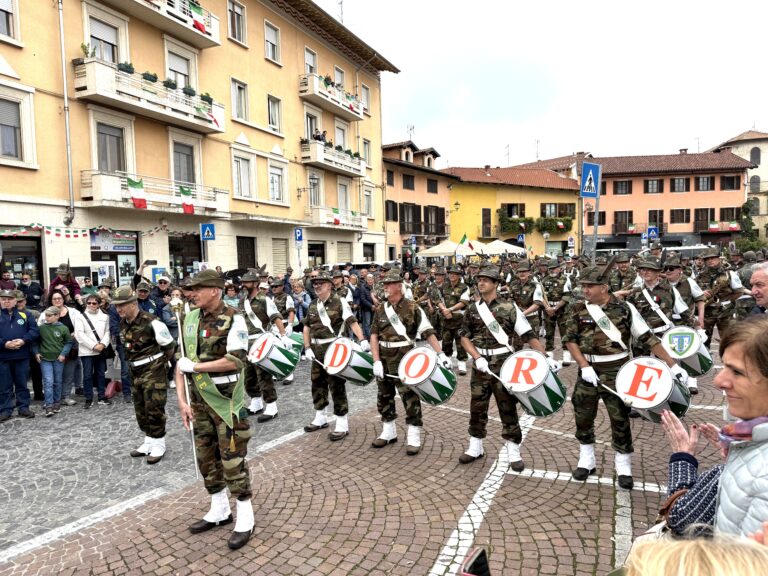
This, in the end, is what made me want the pilgrimage to the monument. Because memory is extremely fragile. Because it takes very little to make people forget. Because amid the festive crowds of the Adunata, the songs, the applause, the photos with foreigners who asked us about our hats, it seemed right to me that at least one of the many Alpini Groups in Genoa should stop in front of that marble. Even just for five minutes. Even just to take off our hats.

Sabina, in Rome
I would have liked Sabina Rossa, his daughter, to be there with us too — a woman who carries on her shoulders a surname that is also a responsibility. I had written to her in the weeks before the Adunata, hoping she might be able to come. Sabina answered me with the firm courtesy of someone who learned early to weigh her words: on 9 May she would be in Rome, for the Day of Remembrance of the Victims of Massacres and Terrorism.
It could not have been otherwise. That national day of remembrance — established in 2007 on the anniversary of the killing of Aldo Moro — is one of the days on which Sabina represents not only her father, but all the fallen of Italian terrorism. We made each other a promise: we will come back. Perhaps together. I sent her a photograph of our Group beneath the monument, with our Alpini hats in view. She replied with just two words: “Thank you, lads.”
What I would like to say to my friends
When we took the souvenir photos in front of the monument, I realised something that made me think: many of my friends — not to say all of them — did not even know who Guido Rossa was. I do not say this to accuse anyone. I say it because it is the symptom of a greater ill: Italy’s civic memory, the memory that ought to hold a Nation together, is in poor shape.
We remember footballers, actresses, singers. We forget the righteous. We know by heart the line-ups of the 1982 national team, but we do not know that in Cesiomaggiore — an hour from our homes — a man was born who paid with his life for his choice to stand on the side of the Republic.
And we Alpini, in particular, have a duty. Because Guido Rossa was one of us. From Belluno, a paratrooper, a man of the mountains. He wore the hat with the feather as we wear it. He climbed the walls of the Dolomites as we climb them. And when he had to choose between silence and justice, he chose justice — exactly as we would expect of an Alpino worthy of the name.
Lest we forget
This fifth part was not in the original plan of our diary. It was meant to end with the fourth, with Sunday’s parade. But it seemed impossible to me to leave it like that. Because an Adunata is not just a celebration. An Adunata is also, above all, an exercise in collective memory. And in this collective memory Guido Rossa has the right to a permanent place.

I say this to those who have read this far: if you did not know him, do as my friends did in front of the monument. Look him up. Read his 1970 letter. Listen to Pertini’s words. If you pass through Genoa, go to the monument in Piazzale Bligny. Take off your hat. Five minutes. Nothing more. But five minutes that, you can be sure, will change something inside you.
Guido Rossa must not be forgotten.
It is a duty — above all ours, we Alpini,
who carry memory on our hats like a feather.
And to all my friends, Alpini and not, who accompanied me on this Genoese weekend, Stefano, Claudio, Maurizio, Alberto, Loris, Luciano, Cesare, Mosè, Ivano, Mauro, Alfredo, Mara, Lorella, Lorenza, Domenica, Marilisa, Carlotta, Gianni, Roberto, and to everyone we met along the way, I say: SEE YOU IN BRESCIA 2027!
THANK YOU FOR BEING THERE!
— from the travel notebook of the Gruppo Alpini di Salce
Michele Sacchet
The full portrait of Guido Rossa published on our website:
“Guido Rossa, a righteous man who must not be forgotten”Guido Rossa · Cesiomaggiore, 1 December 1934 — Genoa, 24 January 1979
Factory worker, trade unionist, Alpino Paratrooper, man of the mountains.
Gold Medal for Civil Valour.
Adunata Diary · 5 parts
|
← Previous part
|
↻ Start from the beginning Day 1 · From Salce to Chiavari
|
On a related subject, you may also be interested in: Remembering Guido Rossa.