
Santo Stefano di Cadore — the story of a barracks and of the Alpini who lived there
A barracks is not just a building. For thousands of Alpini it was a place of training, friendship, sacrifice and memories that stay alive long after discharge. With “Our Alpine Barracks” we begin a journey through the places where generations of Alpine troops spent an important part of their lives.
A barracks born in the war years
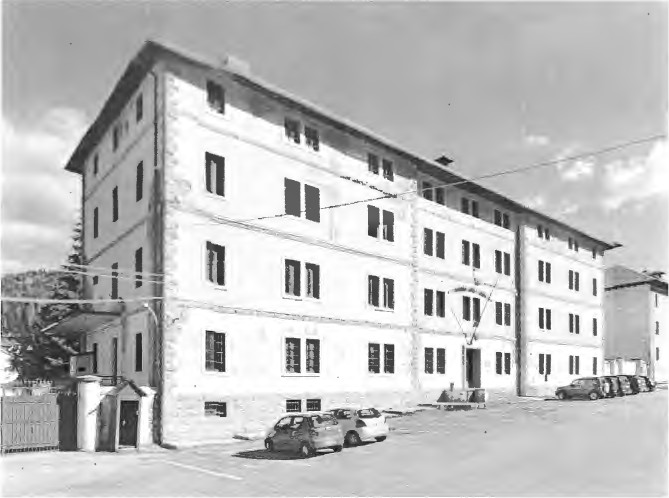
The barracks was built in 1940–1941 as part of the border defence programme known as the “Vallo alpino del Littorio” (the Alpine Wall). Until the mid-1970s it was exclusively the “home” of the truppe d’arresto, the static border-defence troops.
It stands where the Padola stream meets the Piave river, in Via Medole, at the southern entrance to Santo Stefano di Cadore: coming from the south along the SS 52 “Carnica” road, it is on the left just after the bridge over the Piave.
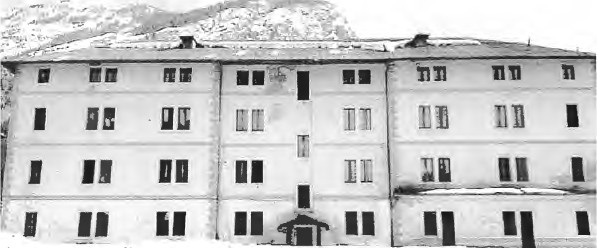
The complex consists of five buildings. Four date from the original construction: the main building, with four floors plus a basement; the so-called “officers’ building”, facing Via Venezia; and two smaller buildings for the mess and kitchen and for the motor pool. The fifth is a two-storey building with an attic, built in the 1970s. The parade ground lies north of the main building; to the west, lower down and connected by a ramp, is the entrance yard with the vehicle gate.

From border troops to the Alpini
The Guardia alla Frontiera
The Guardia alla Frontiera (Frontier Guard) was officially established in 1937. Its training and uniform were very similar to those of the Alpine troops, but its hat had no feather: this is why in Piedmont the corps was nicknamed “la vidoa”, the widow. The Alpine Wall was divided into western, northern and eastern sections, and then into army corps, sectors and sub-sectors.
In those years the Santo Stefano barracks housed the command of Sub-sector XVI/A “Cadore”, part of Sector XVI “Cadore-Carnia” of the XIV Army Corps, headquartered in Treviso. The sub-sector included the barrier positions of Passo Monte Croce Comelico, Cima Canale, Santo Stefano di Cadore, Val Frison, Cima Gogna, Passo Cimabanche and Passo Tre Croci. At the end of the Second World War the Guardia alla Frontiera was disbanded.
The post-war years and the fortress units
The peace treaty required the fortifications along the Italian-Yugoslav border to be destroyed or removed, but as early as the 1950s fear of an invasion from the East led to a new permanent fortified system on the eastern border, completed around the mid-1960s.
In 1948 the first fortress battalions (battaglioni da posizione) were formed to man the fixed defences on the north-eastern border. From 1 September 1952 frontier groupings were set up, and a group of the XII Frontier Grouping, headquartered in Paluzza, moved into Santo Stefano. When the XII Grouping was disbanded in 1954, the group joined the “Cadore” Alpine Brigade as the “Cadore” Barrier Group. From 1957 groupings and groups took the names of Alpine fortress groupings and battalions, with local or at most regional recruitment.
The XIX Battalion and the “Val Cismon”
From 1957 the barracks, by then named after Lieutenant Colonel Carlo Luigi Calbo, housed Alpine units: it was the base of the XIX Alpine Fortress Battalion, formerly the “Cadore” battalion, with its splendid motto “Chi osa, s’infrange” (“Whoever dares, shatters”). In 1962–63 groupings and battalions became “d’arresto” (holding units), and from 1 July 1963 they took the names of the “Val” battalions that had distinguished themselves on the Greek-Albanian front and in Russia: the XIX became the “Val Cismon” Alpine Holding Battalion (Battaglione alpini d’arresto “Val Cismon”), with the 264th, 265th, 277th and 347th companies. The battalion took part in public order operations against terrorism in South Tyrol.
From the Val Cismon to the Pieve di Cadore
With the 1975 Army reorganisation the battalion was disbanded. Only one autonomous company remained, first with the “Cadore” Alpine Brigade and then under the “Tridentina”; in 1979 it moved to the “Druso” barracks in San Candido as the 264th “Val Cismon” Alpine Holding Company of the “Val Brenta” Battalion, with which it was disbanded on 23 August 1986.
From the mid-1970s the “Calbo” housed the 75th Company of the “Pieve di Cadore” Alpine Battalion, “la camorz”, and, after the 264th moved out, the 67th as well, “la saetta”.
«A Santo Stefano… a casa per telefono.»
The last Alpini at the Calbo
In 1995 the battalion was reduced to cadre strength and on 31 January 1997 it was disbanded: the last Alpini left the “Calbo”. Decommissioning went on until the early 2000s, when the barracks was still used as a logistics base.

Credit is due to the Alpine groups of the ANA sections and to the conscript year-groups who, during reunions and events held at the barracks, cleaned up and tidied its outdoor areas.
🎖 The man behind the name
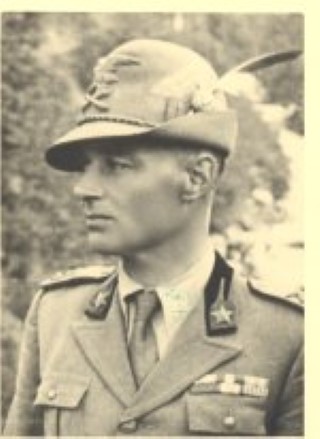
Carlo Luigi Calbo
Belluno, 24 December 1898 – Russia, January 1943
Carlo Luigi Calbo was born in Belluno on 24 December 1898. Not yet eighteen, he volunteered and fought in the First World War, first as an officer cadet in the 2nd Mountain Artillery Regiment, then in the 3rd, where he was commissioned second lieutenant.
In 1919 he left for Anatolia with the Eastern Mediterranean Expeditionary Corps; back in Italy, he was discharged in June 1920 as a lieutenant. He returned to regular service in 1921 with the 3rd Mountain Artillery and moved back to the 2nd on promotion to captain in 1932. He fought in the Spanish Civil War; promoted major from 1 January 1940, in June that year he served on the western Alpine front with the “Vicenza” Alpine Artillery Group, and from November 1940 to April 1941 on the Greek-Albanian front.
Promoted lieutenant colonel from 1 January 1942, eight months later he left for Russia with the 2nd Alpine Artillery Regiment of the “Tridentina” Division. He was killed in action at the end of January 1943, during the retreat.
After his death, his gunners laid his body on a sledge and carried it out of the encirclement, so that he could be given a proper burial.
Decorations: Gold Medal of Military Valour (Middle Don, 17–26 January 1943); War Cross of Military Valour (Middle Piave, October–November 1918); promotion to major for war merit (Greek-Albanian front, 1940).
A street in Belluno, in the Nogarè district, is named after him, as are a memorial plaque with other Gold Medal gunners on the Strada degli Artiglieri at Costa Volpina, south of Rovereto, and a mountain running trophy.
Read the Gold Medal citation
Original Italian text:
«Comandante l’artiglieria di una colonna in ripiegamento in lungo periodo di contingenze eccezionalmente avverse, sempre si imponeva all’ammirazione di capi e gregari, per il suo incomparabile valore. Dopo aver solidamente contribuito, col magistrale impegno delle sue batterie, all’esito vittorioso di ben undici battaglie combattute nel gelo torturante della steppa, di fronte a situazione ormai tragica, conscio dell’alta responsabilità di un comandante che non ha limiti alla sua missione, quando le batterie divennero inerti per forza di eventi, egli fece di artiglieri, alpini, e li portò all’assalto con la fede e la ferma volontà di vincere che mai in lui erano venute meno. Mortalmente colpito da pallottola nemica sulle posizioni ormai conquistate, serenamente come era vissuto, donava alla Patria la sua vita luminosa di eroe.»
Medio Don (Russia), 17–26 January 1943
In English: commanding the artillery of a retreating column through a long period of exceptionally adverse circumstances, he won the admiration of officers and men alike for his incomparable courage. After his batteries had contributed decisively to the victorious outcome of eleven battles fought in the tormenting cold of the steppe, when the guns could no longer fire, he turned his gunners into Alpine infantry and led them in the assault with unwavering faith and will to win. Mortally wounded by an enemy bullet on the positions just taken, he gave his life to his country as serenely as he had lived.
A memory built by those who served there
The first version of this story was written by our group councillor Oscar Colle for the Col Maòr, the Group’s newsletter, together with members who did their military service at the “Calbo”:
- Giuseppe Bortot — reserve sergeant, “Val Cismon” Alpine Holding Battalion
- Renato Bortot — reserve sergeant, “Val Cismon” Alpine Holding Battalion
- Cesare Colbertaldo — reserve second lieutenant, 75th Company, “Pieve di Cadore” Alpine Battalion
- Ennio Dell’Eva — reserve second lieutenant, 264th “Val Cismon” Alpine Holding Company (autonomous)
- Gianpaolo Garna — corporal major, 67th Company, “Pieve di Cadore” Alpine Battalion
Because telling the story of our barracks also means telling the story of the Alpini who lived in them.


