A Yugoslav partisan remembers the Italian front in Herzegovina
From the memoirs of Mirko Savo Sirovina, witness to the guerrilla war of 1941
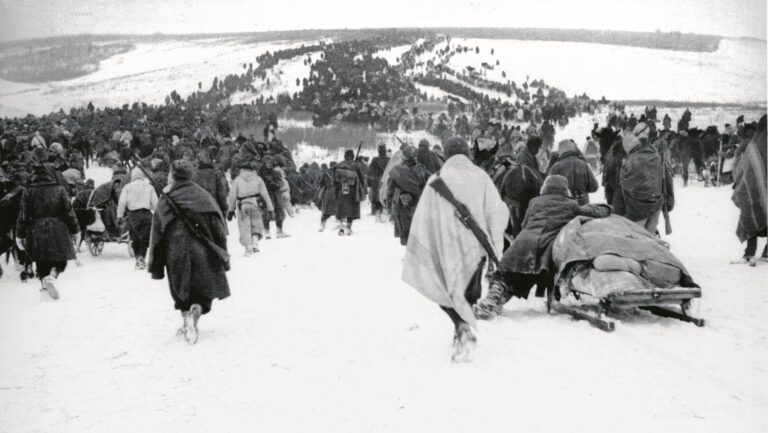
In October 1941, in a village in Herzegovina a few kilometres from Dubrovnik, a sixteen-year-old boy was watching from a distance a war that was about to become his own. His name was Mirko Savo Sirovina, born in 1925 in the small hamlet of Gorodashi, the son of poor peasants in a poor land — mountains, goats, potatoes carried on their backs to the town. His mother was illiterate. His father had come home after the defeat of April 1941 with a rifle on his shoulder, walking for weeks along mountain paths to avoid being taken prisoner by the Italians.
Almost seventy years later, in 2010, Mirko Sirovina — by then an old man living in Chișinău, Moldova, after a lifetime in the Soviet army — told all this in a long interview with the Russian website iremember.ru, an archive of the memories of Second World War veterans. His testimony is one of the few first-person accounts, from the Yugoslav side, of the early stages of the partisan guerrilla war in Herzegovina: the same guerrilla war that the Italian soldiers of the Royal Army found themselves facing in 1941 without having really foreseen it, without understanding it, and often without knowing how to handle it.
The context: Italy in Herzegovina and Montenegro
After the rapid capitulation of the Kingdom of Yugoslavia in April 1941 — eleven days of fighting, then surrender — the territory was divided among the Axis powers. The Italians controlled Slovenia, Dalmatia, the rest of Croatia, Herzegovina with the Marche and Messina divisions, and Montenegro with the Emilia, Ferrara, Venezia and Taurinense divisions.
On paper it was an occupation. In reality it was almost immediately a war. In Montenegro the popular uprising broke out on 13 July 1941 — barely three months after the surrender — and the Italian Supreme Command was forced to transfer six divisions in haste under General Alessandro Pirzio Biroli. In Herzegovina, where Sirovina was, the situation was similar: a proud mountain population, armed with what was left of the scattered Yugoslav army, beginning to organise itself into partisan detachments.
The partisan Sirovina remembers precisely how he looked at the Italians as a boy: “When they first came to our village, in great force, we went up into the mountains, and almost all the men who stayed behind were arrested at once and taken to Lovrenac — the famous fortress of Dubrovnik turned into a prison. From our village there were twelve to fifteen men.” His father and uncle were released only thanks to the personal intervention of a Croatian official from Dalmatia who had friends in the village. Five fellow villagers did not come back.
October 1941: the ambush on the railway
Sirovina’s account becomes more precise when he describes the first episodes of organised guerrilla warfare in the autumn of 1941, when he was just sixteen and not yet a fighter.
“In October the Italians took about fifty prominent people from our area hostage. In response our people, led by Božo Slavić, gathered into a detachment of eighty men and, on the stretch of railway between the villages of Zavala and Marev-Lut, ambushed a military convoy. One hundred and twenty Italian soldiers were captured.”
What followed is extraordinarily revealing of the way this war was fought in its early stages: five days of negotiations, an exchange of ultimatums, talks that in the end concluded with an exchange of prisoners. The captured weapons stayed with the partisans.
Ten days later an Italian column set out from Zavala to punish the guerrillas. For five days there was fighting on the heights. In the end the Italians withdrew. Young Mirko, whose cousin Yovo — one of the leaders of the detachment — had categorically forbidden him to fight, carried food and ammunition to the partisans, covering five kilometres of mountain in the dead of night.
November 1941: the Lastva ambush
The second episode Sirovina recounts is even more significant, because it involves two men who would become legendary figures of the Yugoslav resistance.
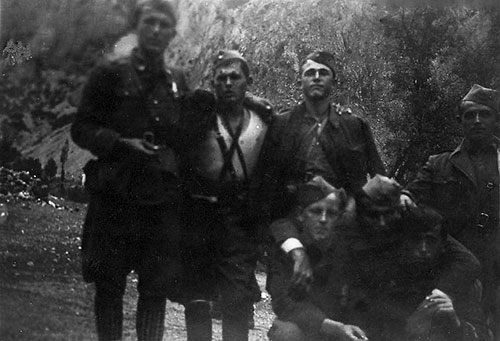
“In November 1941 a detachment of forty-five partisans led by Sava Kovačević and Vlado Šegrt ambushed Italian motorised units on the mountain road near the village of Lastva, on the border between Montenegro and Herzegovina. This tiny detachment, using mainly grenades, managed to capture twenty-nine light armoured vehicles and twenty-four prisoners.”
The episode is confirmed by historical sources: on 26 November 1941 Sava Kovačević led an ambush against an Italian motorised column on the road between Bileća and Vilusi, capturing three Italian tanks with which he formed the first armoured unit of the Yugoslav liberation forces. After the war, 26 November would become the commemorative day of the tank corps of the Yugoslav People’s Army.
Vlado Šegrt, active since September 1941, had already won several important victories against the Italians and the Ustaše in the Trebinje area. Both commanders were destined to become central figures of the Yugoslav resistance: Sava Kovačević would fall in 1943 during the battle of the Sutjeska, protecting the wounded of his division as the Germans tightened the encirclement — and Sirovina, who was fighting in the same division, was a direct witness to that sacrifice.
How the Italians saw this war
Sirovina’s testimony also offers a valuable insight into how Italians and Yugoslav partisans perceived each other in this early phase.
“You want to know what we thought of the Italians as soldiers? Even if there were only fifty of us, with heavy weapons we could face five thousand Italians without fear, because they were not fighters. Excellent thieves, yes — when they entered the villages they looted almost everything — but as soldiers they were another matter altogether compared with the Germans.”
It is a harsh judgement, but not without nuance. Sirovina acknowledges that with the Italians, unlike with the Germans, it was possible to negotiate: “With the Italians you could hold negotiations. With the Germans it was unthinkable.” And he recalls that the operation that saved his life after a serious wound was performed by a captured Italian army doctor, whose good faith he never doubted.
This matches what historical sources describe as a feature of the Italian occupation: less systematically brutal towards civilians than the German one, but militarily unable to deal with a guerrilla war that was developing at an unforeseen speed. In their documents the Italian authorities gave credit to the supposedly decisive role of the communists in the Montenegrin uprising, but in reality the most important part was played by the peasants who joined the rebellion en masse and by former officers of the Yugoslav army.
A destiny between two worlds
Mirko Sirovina formally enlisted in September 1942, at seventeen, in the 10th Brigade of the 3rd Division. He rose quickly through the ranks to company commander. He fought at the battle of the Neretva, survived the Sutjeska, and witnessed the liberation of Belgrade with the Red Army in 1944 — where he lost his cousin Gojko.
Then, in 1948, when Tito broke with Stalin, he chose to stay in the Soviet Union. He trained at the Frunze Academy in Moscow, served as a Soviet officer until 1974, and retired to Chișinău as a lieutenant colonel. When he was interviewed he was eighty-five. He spoke Russian without an accent.
“You want to know what helped me survive? Not God — I did not believe. I knew how to adapt in the most difficult circumstances. I remember lying in a trench under the snow, with a cap of snow on my head, and not moving. My comrades looked at me in amazement. If you moved, the sniper got you.”
A memory worth preserving
For anyone interested in the Alpine and military history of the twentieth century, Sirovina’s testimony is a rare document: the voice of someone who stood on the other side, told without hatred but with great lucidity.
The Italians who appear in his memory are frightened soldiers, corruptible officials, honest doctors, officers who negotiate — and executioners too. As in every war.
The Italian divisions that operated in Herzegovina and Montenegro — Marche, Messina, Venezia, Taurinense — brought with them thousands of young Italians, many from the North, many from the Alpine regions, torn from their families and thrown into a mountain guerrilla war they did not understand.
They too, in their own way, are victims of that history. A history that the testimony of Mirko Savo Sirovina helps us to see with new eyes.
Michele Sacchet
Main source: interview with Mirko Savo Sirovina, iremember.ru archive, 2010. Interviewer: N. Čobanu. Quotations translated from the Italian version of this article.