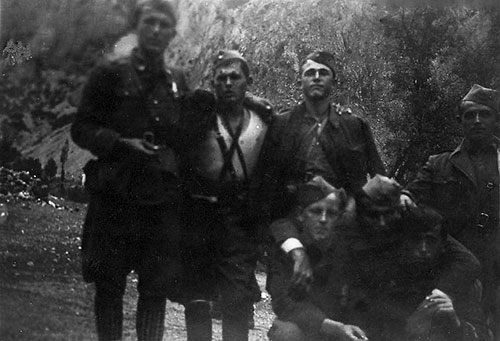
On 26 January 1943, before the village of Nikolajewka, the retreating column of the Alpine Army Corps fought open the last road to the west. It was not a victory and it was not a feat: it was the unavoidable passage of tens of thousands of men who had a defended village in front of them and no alternative behind.
How it came to the retreat
In the summer of 1942 the Italian Army in Russia (ARMIR) was deployed along the Don. The Alpine Army Corps, with the Tridentina, Julia and Cuneense divisions, held the northern sector, on a plain that had nothing in common with the terrain those units had been trained for.
Between December 1942 and January 1943 two successive Soviet offensives overwhelmed the flanking sectors. By the time the order to withdraw reached the Alpini, the ways out had already been cut: the retreat therefore began inside an encirclement that was already closed.
The march
The column moved west for days, in temperatures far below zero, fighting at almost every village it had to cross. The formed troops were gradually joined by a mass of Italian, German and Hungarian soldiers separated from their units: the sbandati, the stragglers, often unarmed and frostbitten.
26 January 1943
Before Nikolajewka the column found the railway embankment and, beyond it, the village held by Soviet forces. At the head was the Tridentina, the only division still able to manoeuvre as an organised unit.
The fighting took up the whole day. The gap opened in the late afternoon: the push of the units still in formation was joined by that of the mass of stragglers pressing from behind. It is the image that has remained in Alpini memory, and it should be told for what it is: not a successful manoeuvre, but a human wave.
History, memory and testimony
Three levels coexist around Nikolajewka, and it is worth keeping them distinct. History is what the documents allow us to establish. Testimony is the account of those who were there, precious and partial by definition. Memory is the way the ANA and the Alpini communities have chosen to remember. Confusing them produces rhetoric; separating them does justice to all three.
What changed, and what did not
The gap at Nikolajewka allowed part of the column to go on, but it did not end the retreat: the march continued for days before the survivors reached the rear lines. The Julia and the Cuneense, which were following different routes, were very largely lost.
The overall toll of the Russian Campaign for the Italian troops runs to tens of thousands of dead, missing and prisoners. Many of the missing never had a grave, and for their families the waiting lasted years.
Why Nikolajewka is still central
In Alpini memory, 26 January is not the celebration of a battle won. It is the date on which it is remembered that some came back and a great many did not, and that is why it is observed every year in the ANA sections and groups.
Many veterans did not speak for decades. The story of the retreat arrived late, often through literature and through the testimonies collected by the groups: on this site too Russia appears several times in the words of those who were there, from Seen by the enemy to Miracle at the Perati Bridge. The general picture of the conflict is in the section Alpini in the Second World War.
Sources
- Historical archive of the Associazione Nazionale Alpini
- Italian Army, documentation on the Alpine Army Corps
- Archivio Centrale dello Stato (Italian Central State Archive)
- Treccani, entries on the Russian Campaign and the ARMIR