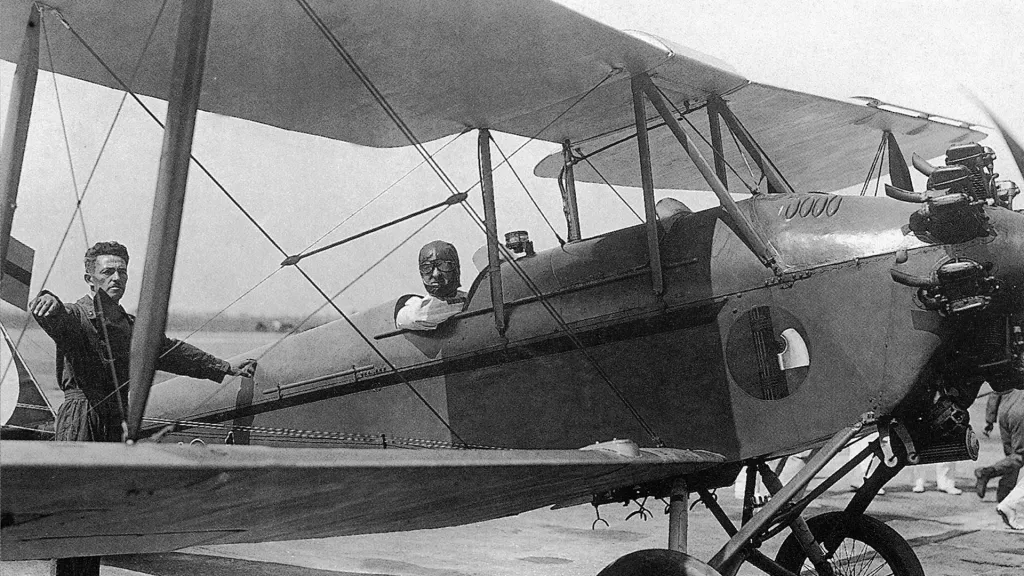
On the morning of 1 September 1917 an aerial duel between an Italian aircraft and an Austrian one took place in the sky over Belluno.
The Austrians had not yet broken through at Caporetto, and so our province had not yet been invaded by the enemy. The Italian pilot’s name was Arturo Dell’Oro and he had been born in 1896 in a small town in the Chilean interior to parents of Piedmontese origin.
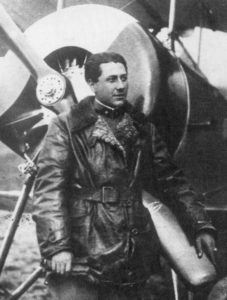
In Chile the Dell’Oro family owned a vineyard and produced wine and grappa. In May 1915, when Italy entered the war, an office was opened in the Chilean port city of Valparaíso to recruit our emigrants who wished to enlist as volunteers.
Arturo, too, went to enlist, and that same day, without even the chance to say goodbye to his parents, he was put aboard a steamer bound for Genoa. His application to be assigned to the Air Service was accepted. In the homeland he attended and brilliantly passed the flying course, earning his pilot’s licence and the rank of sergeant.
He was then posted to a reconnaissance squadron, and as early as November 1915 he earned a Silver Medal of Military Valour for a risky mission in the sky over La Muda (between Belluno and Agordo). In 1916 the Royal Air Service set up an airfield at Belluno and stationed there a squadron of fighter aircraft tasked with guarding the Dolomite front.
Arturo was assigned to that squadron. The skies over the Belluno area were not very busy, and on the rare occasions when Arturo had the chance to engage the enemy he had to give up the fight because of engine failure or a malfunctioning machine gun.
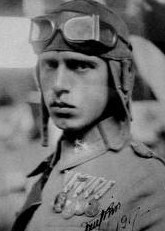
Let us return to the morning of 1 September. The alarm began to sound and the anti-aircraft batteries went into action. An Austrian aeroplane had appeared in the sky over Belluno. Arturo took off in his fighter, determined to face the enemy.
The enemy aircraft was a two-seater: besides the pilot, who could fire straight ahead, there was a machine gunner who fired to the rear and to the sides of the aircraft. This firepower made it a formidable opponent. On the other hand, the Italian aircraft was faster. In a short time the opponent was caught up. The two adversaries exchanged a few bursts of machine-gun fire, then the enemy aircraft began to move away towards the north.
Probably the machine gunner had run out of ammunition or his weapon had jammed. The Austrian pilot knew that in a dogfight he would have had no way out: the faster Italian aircraft would have got on his tail, machine-gunned him and shot him down.
So he tried to flee towards his own lines, hoping for the magnanimity of the Italian pilot. Arturo’s state of mind was quite different. He had never shot down an enemy; this was his great chance. Instead, once again luck turned its back on him: the machine gun jammed.
Who knows what went through the mind of that young man, who was not yet 21. Anger got the better of reason. Arturo hurled himself at the enemy. The two aircraft collided and a burst of flame rose into the sky: vanquished and victor fell, crashing not far from where the Rifugio 7° Alpinistands today, at the foot of the southern slopes of Monte Schiara.
At the site a plaque marks the point of the crash. Extensive photographic records show the enormous popular participation in the funeral of the three airmen. With these words the homeland dedicated to his memory the Gold Medal of Military Valour: “A most daring fighter pilot, tirelessly flying over the peaks of Cadore, bold among the bold, rather than give up victory he hurled himself against an enemy aircraft, brought it down by ramming it, and fell together with the vanquished. A supreme example of courage and admirable self-sacrifice – Sky over Belluno, 1 September 1917”.
The important military airport of Pisa, Belluno airport and the prestigious Italian School of Valparaíso (Chile) are named after Arturo Dell’Oro. Arturo is buried in the Military Ossuary of Mussoi.
Let us now speak of Ermenegildo (Gildo) Dal Pan. This name may sound familiar to some of you. The lower secondary school in Via San Lorenzo in Belluno was in fact named after Gildo Dal Pan.
Gildo was born in our city. He was a sergeant major in the Air Force and, as a volunteer, fought in the Spanish Civil War alongside Franco’s Nationalists. In 1937, at the age of 23, he fell in combat.
He was awarded the Gold Medal with the following citation: “A volunteer in a war mission fought for
a supreme ideal, he faced the hardest trials, always displaying the exemplary virtues of an expert and valiant combatant.
Driven by unconditional, enthusiastic devotion to the cause to which he had dedicated his young and spirited life, in the heroic attempt to complete a risky action he had been entrusted with, he met a glorious death. Sky over Spain, 19 March 1937”.
In the 1970s it was decided to name the school after Ippolito Nievo instead, because Gildo did not represent the ideals on which the Constitution of our Republic is founded. Let us return to the Great War and pay tribute to an adversary.
Josef Kiss was born in 1896 in Pozsony, today’s Bratislava. Today Bratislava is the capital of the Slovak Republic; at the time it was one of the main cities of the Austro-Hungarian monarchy and lay within the Hungarian borders. His paternal great-grandfather was one of the instigators of the Hungarian uprising of 1848 against the Austrians and for this reason, once the revolt had been crushed, he was shot and his property was confiscated.
In spite of this, when war broke out Josef broke off his studies and volunteered for the army. He applied for admission to officer school, but the lack of an upper secondary school diploma ruled out this possibility. He was therefore assigned to an infantry regiment and sent to fight the Russians in the Carpathian Mountains. There he was seriously wounded.
During his convalescence he applied to be assigned to the air service. His application was accepted and, after the training period, he was posted to a squadron based at Cirè di Pergine Valsugana. The Valsugana belonged to the Austro-Hungarian monarchy and bordered the Asiago plateau to the south and the Feltre area to the east. This helps us understand why the Austrians defended their positions on the Asiago plateau so fiercely: had those ridges fallen into Italian hands, the villages of the Valsugana would have been an easy target for our artillery.
Josef (Yosha to his friends) immediately showed his skill as a fighter pilot. From June 1916 to the end of 1917 he scored 19 victories, establishing himself as one of the most feared “aces” of the Austro-Hungarian air force.
Josef performed his feats mainly against our pilots, clashing with them between the Pasubio and the Grappa and in the skies over the Feltre area. For his victories he received 16 medals for valour, medals he proudly wore pinned to his tunic even during his flights.
On both sides of his aircraft’s fuselage Josef had a large white “K” (Kiss) painted over the image of a medal for valour.
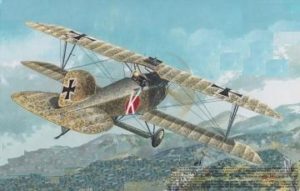 This is how his aircraft must have looked in flight in the skies over the Valsugana: Josef’s great ambition was to become an officer: he fought with great enterprise because his only chance of becoming one was through merit in war.
In January 1918, in combat with an Italian airman, Josef’s aircraft was riddled with bullets. Seriously wounded in the abdomen, he managed to get back to the base at Cirè and was admitted to hospital in Trento. A few hours later his squadron comrades went to visit him.
They found him abandoned on a stretcher, half bled to death. Furious, they went looking for the doctors. They found them eating, drinking and joking. A brawl broke out, and punches and insults flew.
“With that wound he has no chance. Operating on him is a waste of time. And besides, he isn’t even an officer!” said the doctors.
Josef survived miraculously. The doctors declared him unfit for operational service, but he rejected the medical verdict and asked to return to flying.
Although he was still in very poor physical shape, on 24 May he insisted on climbing back into his aircraft for a mission together with two other aircraft of his squadron. The three were intercepted by nine British and Italian aircraft. Josef was recognised and skilfully isolated by the enemy pilots.
In the end he found himself fighting alone against six opponents. His aircraft was hit by a burst of fire that killed him. He was 22. The aircraft crashed on Monte Coppolo, in the municipality of Lamon. His remains were recovered by Italian soldiers and handed over to the Austro-Hungarians. On 27 May a great funeral ceremony was held at Pergine.
It is said that during the ceremony a formation of Italian, British and French aircraft dropped a wreath of flowers with a ribbon that read: “Our last salute to a courageous adversary”. The day after his death Josef was promoted to second lieutenant (officer) for merit in war. Josef Kiss was the Hungarian pilot with the highest number of victories in the First World War, and in his homeland he is still remembered and celebrated today.
He is buried in the ossuary at Rovereto. For years his native city has been asking for the return of his remains. Would it not be a fine gesture to let him go home?
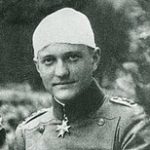
When one thinks of a flying ace, one’s thoughts can only turn to the “Red Baron”. Manfred von Richthofen (born 1892) – for that was his name – was the pilot with the highest number of victories in the First World War: no fewer than eighty. His brother Lothar (1894) was also an excellent “hunter”, with forty victories.
To be entitled to the title of “ace” one had to have scored 5 victories for the Italians and their allies, and as many as eight for the Germans and the Austro-Hungarians. The two brothers flew in the same squadron and really were barons. They came from a noble Prussian family with a long military tradition. Both attended the Military Academy and became cavalry officers.
When war broke out (1914) Manfred was immediately sent to the front, but trench warfare limited the use of cavalry; so, after several months of inactivity and eager to play an active role in the fighting, he wrote to the General Command asking to be transferred to the air service. His wish was granted.
After the training courses and the usual apprenticeship, he was given a fighter aircraft and Manfred immediately proved his worth. In just four months he shot down sixteen enemy aircraft, becoming a “double ace”, and he was awarded the blue cross “Pour le Mérite”, the highest German decoration.
When the German Command issued the order to paint aircraft in camouflage colours to make them less visible to the enemy, Manfred replied that his opponents had to know whom they were dealing with, and so he had his aircraft painted red, the colour of his cavalry regiment.
The unbeatable red aircraft soon became legendary. It was first nicknamed “le petit rouge” (the little red one) by the French and “the red devil” by the British. A rumour also spread that it was flown by a girl, a kind of Joan of Arc, or that the red was a special paint able to withstand bullets. Only when the Anglo-French discovered Manfred’s identity did they name him “the Red Baron”.
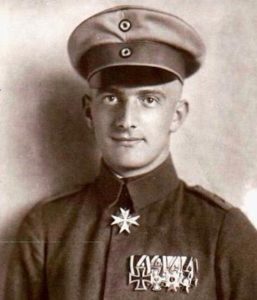
The Allies set up a squadron with the specific task of shooting down “the Baron”. To make him less easy for the enemy to identify, all the aircraft of Manfred’s squadron were painted red, and so that they could recognise one another the German pilots painted their tails in different colours. Lothar (photo above) painted his tail yellow. The fighting did not always go well for Manfred: the photo alongside shows him convalescing after “catching” a bullet in the head.
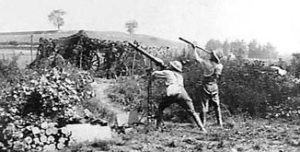
On 21 April 1918, flying low over the enemy lines, Manfred was chasing a British aircraft when the aircraft of the Canadian pilot Brown fell in behind the two. Suddenly the red triplane banked to the right and crashed to the ground. Officially the downing of the “Red Baron” was credited to Brown, but it has been proven that what killed Manfred instantly was a machine-gun bullet fired by Australian anti-aircraft gunners (photo below), which struck him from below and tore through a lung.
His body was recovered by Australian soldiers, who gave him a funeral with full military honours. On the headstone they wrote: “Here lies a brave man, a noble adversary and a true man of honour. May he rest in peace”.
The photos published here show us boys barely out of adolescence. Their “boyish faces” contrast with their determination and ruthlessness on the battlefield. The innocence and light-heartedness of these twenty-year-olds were swept away by the brutality of war and gave way to the instinct for survival, which leaves no room for pity.
(Article by Daniele Luciani for Col Maòr no. 9, December 2012)
Further reading – a related article: Angelo Schiocchet: the Wolf of the Tofane.