From Luigi Barzini’s book “Al Fronte”: the accounts of our war in its first four months, from the last days of May 1915 to the last days of September, written by newspaper correspondents in the zones of operations.
…in the upper Isonzo valley…
The hill of Santa Lucia is oblong, regular and wooded; but here and there the wood stops at the straight edge of large sloping meadows, shaded in places by a clump of trees and streaked by a dense spread of hedges; the summit too is grassy and bare. Now the meadows are torn up here and there by cannon shots, flayed, the colour of ploughed fields, and the summit, pitted with shell craters one beside the other, has that strange look of lunar landscapes, full of round hollows and circular rims.
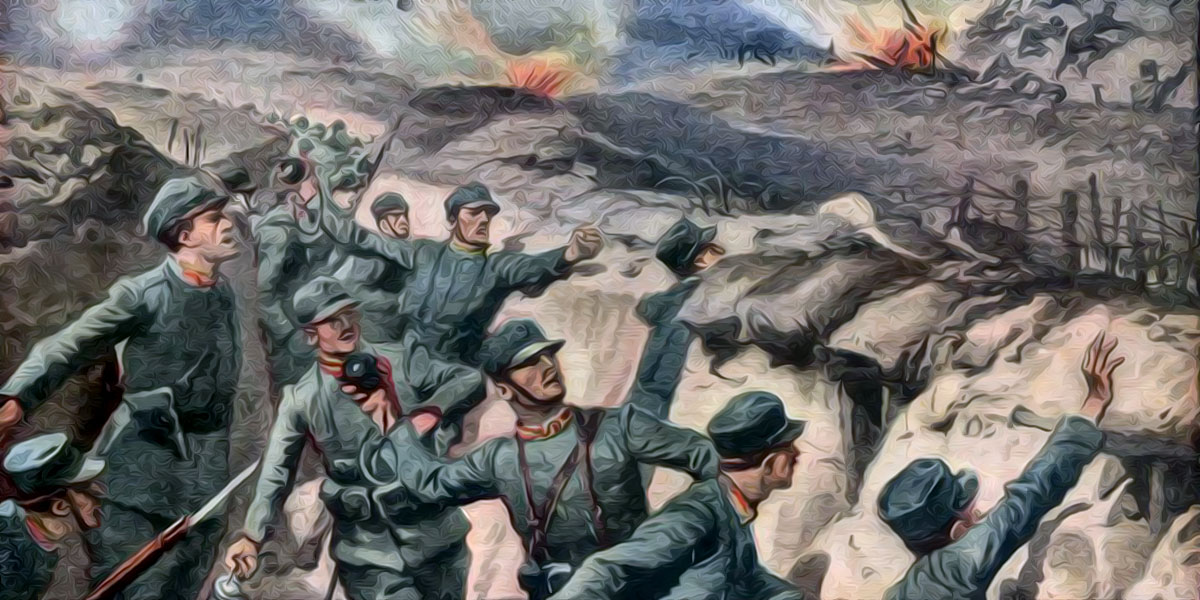
Our artillery poured a deluge of shells on Santa Lucia and Santa Maria to prepare the attack. Covered by that fire, our infantry broke through the wire and charged with the bayonet. A line of Austrian entrenchments was taken. Then another. The assault climbed the slope from the west. The shouting of the fighting men could be heard, loud and terrible, from the artillery positions on the nearby heights. In the captured trenches whole companies of Austrians surrendered.
During the day of 16 August 17 officers and 517 men were taken prisoner. Machine guns, rifles and ammunition made up a considerable haul of booty. One unit finally managed to storm the last trenches, those on the summit of Santa Lucia, which run round two knolls like the two broad humps of a gigantic camel.
Then the storm of the Austrian artillery began. No fewer than forty guns concentrated a terrifying fire on the top of the hill. There was no time to build shelters; we had to pull back from the most exposed ridge. But we held firm on the flanks of the heights, where the deep furrows of our entrenchments can now be seen winding, reached by strange approach paths. The Austrians reoccupied the summits. Their trenches are about a hundred metres from ours.
The enemy’s real strength in resistance lies in his guns. His infantry holds only at the points his artillery can cover. The Austrians have always had to abandon the slopes to hold on to the crests. Where their shells do not reach, their defence vanishes.
The battle continued on the 17th. A few new trenches were taken. Another two hundred prisoners were captured. But the fight was one of consolidation, of organisation and preparation more than of attack. Violent enemy advances came down at night. They were driven back. Men fought and worked in the glare of flares. For many days the action went on in episodes, under the fire of the enemy artillery, which searched the reverse slopes of the hills to prevent the building of defences.
On 9 September, at night, the fighting flared up again furiously. With a sudden assault one of our units on the little hill of Santa Maria seized another line of trenches and drew near the summit, on which stands a small church, now in ruins. But in front of the attackers there suddenly flashed blue, fantastic flames of flammable liquids, Germany’s latest scientific atrocity.
Thrown in long jets, the unlit liquid, which did not reach our men, ran down the slope in long, invisible, silent rivulets, then on contact with an incendiary capsule it blazed up all at once. And there were incredible writhings of pale, flickering light, a tortuous, diaphanous flaring along the slope, a darting of spectral flames, soon extinguished because the earth absorbed the liquid and the flames quickly sank.
They died in a crackling flutter, leaving all around a tiny sparkling of embers, a burning glitter of kindled blades of grass. Meanwhile violent explosions of hand grenades released the acrid smell of suffocating gas, a mist that lingered in the stillness of the night.
Our men stopped, shouting insults and challenges: «Cowards! Come on!»
(From the book “Al Fronte” by Luigi Barzini – 1915)