
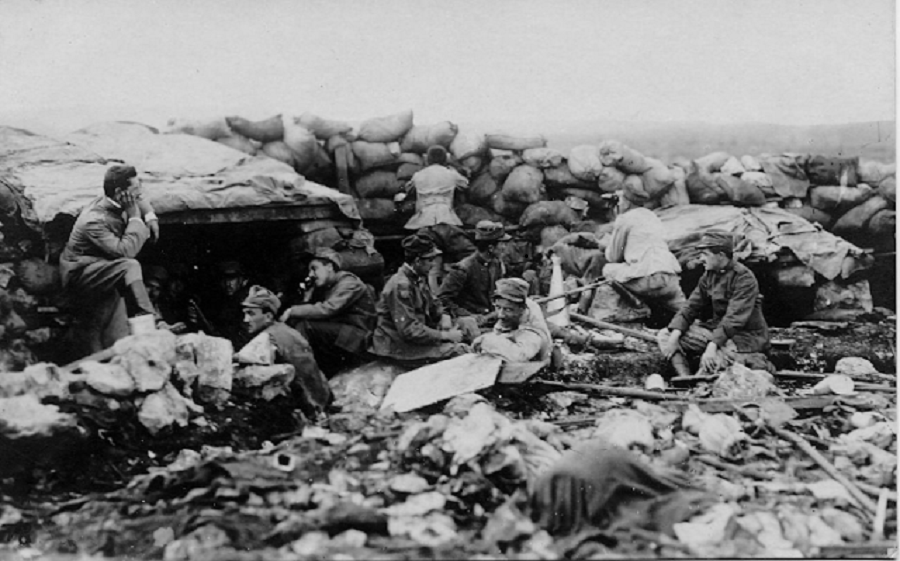
One hundred and nine years ago, in these very days of August, thousands of Italian soldiers were crossing the Isonzo under enemy fire. Among them were the Alpini of Belluno and the Cadore.
Anyone crossing the Bainsizza plateau today, among woods, scree, dolines and small villages east of the Isonzo, finds it hard to imagine that in August 1917 this landscape was the scene of one of the greatest Italian offensives of the First World War.
It was the Eleventh Battle of the Isonzo. The Italian Army tried to break the Austro-Hungarian front with an effort never seen before in that sector. Hundreds of thousands of men were engaged between the Isonzo, the Bainsizza, Monte Santo, the San Gabriele and the Karst.
And among them were four battalions of the 7th Alpini Regiment deeply tied to the province of Belluno: Belluno, Pieve di Cadore, Monte Antelao and Monte Pelmo.
They were not mere spectators of the offensive. They crossed the Isonzo, advanced onto the heights and fought at Monte Raune, in the Sirocaniva gully, towards Hill 545 and Mesnjak. Some units literally opened the way for the others, building footbridges over the river and capturing positions defended by the Austro-Hungarians.
This is the story of the Bainsizza in August 1917. But it is also a story of Belluno.
In this article
- The Eleventh Battle of the Isonzo
- Cadorna’s plan and the Bainsizza
- The night of the Isonzo crossing
- Monte Santo and Arturo Toscanini
- The 7th Alpini Regiment on the Bainsizza
- Monte Pelmo: Doblari, Monte Raune and the footbridge
- The Belluno Battalion: eight days of fighting
- Monte Antelao and the struggle for Mesnjak
- The Pieve di Cadore
- Thirst, supplies and living conditions
- The end of the offensive
- The price of the Bainsizza
- From the Bainsizza to Caporetto
- Why remember it today
The Eleventh Battle of the Isonzo: August–September 1917
When in the summer of 1917 Luigi Cadorna prepared a new offensive against Austria-Hungary, fighting on the Isonzo front had been going on for more than two years.
Ten battles had followed one another since 1915. The Italian Army had taken Gorizia in August 1916 and made other local gains, but the Austro-Hungarian front had not collapsed.
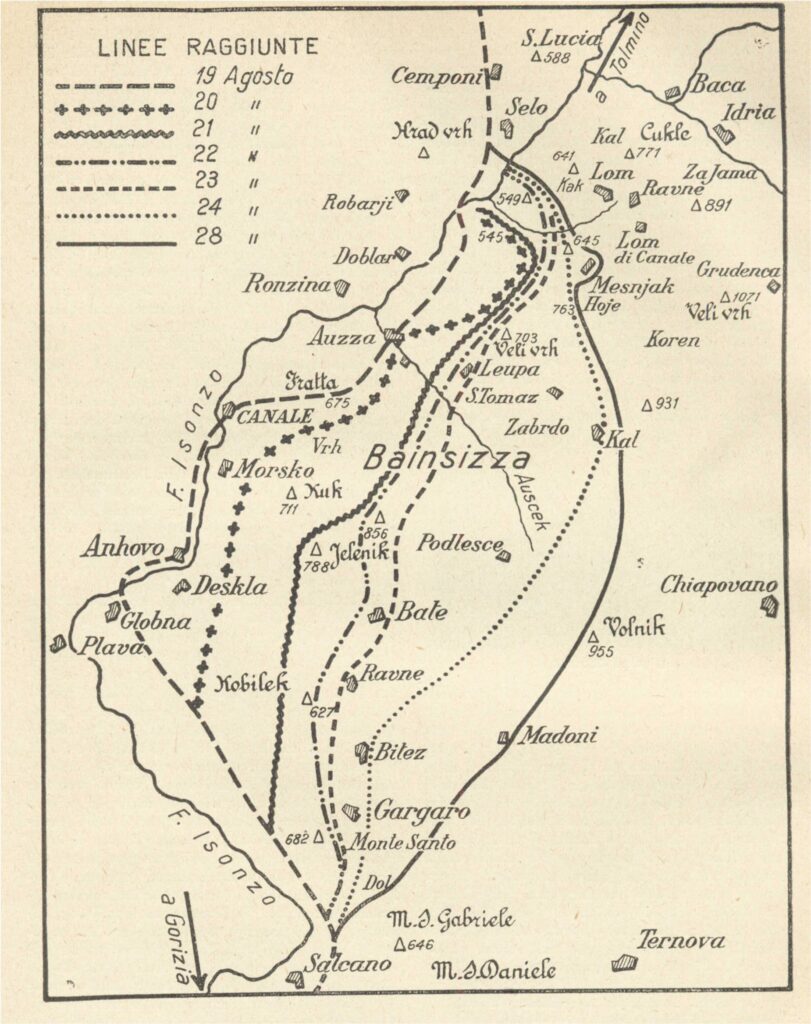
The Eleventh Battle of the Isonzo, which began on 18 August 1917, was meant to change this situation.
The main objective was to cross the Isonzo north of Gorizia, take the Bainsizza plateau and throw the entire Austro-Hungarian defensive system into crisis. Further south, the 3rd Army would at the same time put pressure on the Karst and towards the Hermada.
A note on the dates
The main phase of the offensive on the Bainsizza took place in the second half of August, and the great Italian offensive drive gradually ran out of steam at the end of the month. The Eleventh Battle of the Isonzo as a whole, however, is generally dated between 18 August and 12 September 1917, because fighting continued in other sectors, above all around Monte San Gabriele.
Cadorna’s plan: cross the Isonzo and take the Bainsizza
The offensive mainly involved the 2nd Army of General Luigi Capello, tasked with forcing the Isonzo and advancing onto the Bainsizza plateau, while further south the 3rd Army under the Duke of Aosta was in action.
On 18 August an extremely violent artillery preparation began. Thousands of guns and trench mortars opened fire on the Austro-Hungarian positions.
But to turn the bombardment into an advance, an enormous problem had to be solved: getting men, weapons, ammunition, food and artillery to the other side of the Isonzo.
The river was not only a natural obstacle. Its banks were watched and swept by enemy positions. The footbridges and bridges built by the Engineers could be hit by artillery.
The night of 18–19 August: crossing the Isonzo under fire
During the night of 18–19 August Italian units began crossing the river at several points.
It was one of the decisive moments of the whole operation. The engineers worked to build footbridges and links while the infantry poured onto the eastern bank.
Once across the Isonzo, however, the hardest part began: climbing towards a rugged plateau, short of water and cut by gullies and heights turned into defensive positions.
To understand the Bainsizza
You should not imagine a single assault along a continuous line. The advance went through bridges, gullies, hilltops, small villages and strongpoints that had to be taken one after another. Names like Doblari, Monte Raune, Sirocaniva, Hill 545 and Mesnjak thus entered the history of the Belluno Alpini battalions.
24 August: the capture of Monte Santo
One of the most important objectives, symbolically and militarily, of the first days was Monte Santo, today Sveta Gora, north of Gorizia.
The mountain dominated a strategic sector of the front and had been bitterly contested during the earlier battles of the Isonzo.
On 24 August 1917, after the Austro-Hungarians withdrew, Italian troops took possession of the summit.
The capture of Monte Santo became one of the symbols of the offensive. But a few days later something quite different from a war fought with rifles and artillery happened up there.

On 26 August 1917 Arturo Toscanini, who was at the front and had also come to the area to see his son Walter, brought a military band up the newly captured mountain.
The Maestro conducted marches and anthems in a scene that remains one of the most unusual images of the Great War: music on a mountain still exposed to enemy fire.
We have told this story separately in the article «The Maestro on Monte Santo: Arturo Toscanini at the front in 1917».
The Belluno Alpini leave the Dolomites: the 7th Regiment reaches the Isonzo
For our local memory this is the most important passage.
In 1917 the 7th Alpini Regiment had its units spread over a vast front. Many came straight from the mountains of Belluno and the Cadore, where they had fought in the first two years of the war.
In August 1917 four battalions were transferred to the Isonzo:
- Belluno Battalion;
- Pieve di Cadore Battalion;
- Monte Antelao Battalion;
- Monte Pelmo Battalion.
The participation of these four battalions in the battle of the Bainsizza is also confirmed by historical accounts of the 7th Regiment.
For men used to fighting on the Tofane, in Val Travenanzes, on the Falzarego, on Col dei Bos and in the mountains of the Cadore, it meant a completely different operational environment.
From high-mountain warfare they moved to the gullies and karst plateaus of the Isonzo.
The Monte Pelmo Battalion: the Doblari footbridge and the assault on Monte Raune
Of the four Belluno units, the historical record makes it possible to follow the Monte Pelmo Battalion with particular precision.
The unit reached the Doblari sector on the Isonzo and took a direct part in preparing the crossing.
The records of the 7th Alpini in fact recall the building of a difficult and indispensable footbridge over the Isonzo.

It was not just a technical job. Once across the river, the men of the Monte Pelmo had to face the fortifications protecting Monte Raune.
There followed extremely hard fighting, including hand-to-hand combat. The action enabled the Alpini to reach the top of the mountain and, according to the regimental account, led to the capture of about four hundred prisoners, as well as weapons and ammunition.
A key detail
The history of the 7th Alpini reports that along the line opened by the Monte Pelmo the Belluno, Monte Antelao and Pieve di Cadore battalions also advanced, together with the Albergian Battalion. This now makes it possible to place the presence of the Belluno units in the offensive more precisely.
On the night of 20 August the Austro-Hungarians counter-attacked and temporarily managed to break into the Italian line. The 146th Company of the Monte Pelmo played an important part in restoring the situation.
A further attack coming from the area of the houses of Sirocaniva was stopped.
The advance then continued towards Mesnjak, one of the names that recurs most often in the records of the 7th Alpini battalions engaged on the Bainsizza.
The Belluno Battalion: eight days on the Bainsizza
Even stronger is the territorial bond represented by the Belluno Battalion.
An account kept in the historical archive of the Municipality of Belluno makes it possible to pin down the period of its deployment on the Bainsizza with remarkable precision: eight days, from 19 to 27 August 1917.
They were eight days of fighting but also of extreme exhaustion, made worse by thirst and supply difficulties.
The same source credits the battalion with capturing Hill 545, Sireka Mjva and Mesniak.
The history of the 7th Alpini also recalls the Belluno Battalion in the fighting on Hill 545 and in the attack on Kukli Vrh.
The price paid by the Belluno
According to the Belluno historical account, at the end of those days the unit was reduced to about 70–80 men per company.
The actions on the Bainsizza also brought many individual decorations: the history of the 7th Alpini records for the Belluno Battalion nine Silver Medals and eight Bronze Medals.
Behind those figures there are men, families and villages.
And this is one of the aspects that deserves further research: identifying the names, birthplaces, companies and individual actions of the Alpini decorated or killed on the Bainsizza.
An important clarification: the Belluno Brigade that appears in the sources was an infantry brigade (274th, 275th and 276th Regiments), so it should not be confused with the Belluno Alpini Battalion.
Both units, however, fought in the same sector of the Bainsizza. The Belluno Alpini Battalion crossed the Isonzo near Doblar on the night of 19 August, fought on Hill 545–550 and advanced towards Mesnjak and Testen; on 27 August it was withdrawn to Peternel to reorganise.
Monte Antelao: Sirocaniva and the struggle for Mesnjak
The Monte Antelao Battalion was also heavily involved in the advance.
Austro-Hungarian resistance along the line towards Mesnjak was particularly fierce. The records of the 7th describe close-quarters fighting in which, at times, the clash came to hand-to-hand combat.
The battalion commander, Major Umberto Dedini, was wounded in the gully of Sirocaniva. From 20 August command passed to Captain Luigi Reverberi, previously commander of the 150th Company.
On 25 August 1917, with the help of other Alpini units, the 150th Company of the Monte Antelao also managed to reach Mesnjak.
It is a detail that helps show how the capture of the plateau was not a single linear advance but a succession of fights for gullies, villages and hilltops.
The Pieve di Cadore Battalion on the road opened by the Pelmo
The fourth unit of the 7th Alpini from our land was the Pieve di Cadore Battalion.
The available documentation confirms its part in the battle of the Bainsizza and its advance along the line opened after the Isonzo crossing and the action of the Monte Pelmo.
For the Pieve di Cadore we currently have fewer specific details about individual days on the Bainsizza than have emerged for the Belluno, Monte Pelmo and Monte Antelao.
That does not mean its story cannot be recovered.
The collections of the Historical Office of the Army General Staff hold war diaries and records of the 7th Alpini units that could allow an even more detailed reconstruction of movements, orders received and losses.
Research still open
The Bainsizza story of the Belluno battalions is therefore not a closed chapter. Military war diaries could make it possible to reconstruct, day by day, orders, positions, losses and the names of the men. It is one of the lines of research we intend to pursue.
Mesnjak: the name that keeps returning in the stories of the Belluno battalions
Among the many places mentioned in the records, one name keeps coming up: Mesnjak.
The stories of the Belluno, the Monte Antelao and the Monte Pelmo all converge there.

The sources describe particularly stubborn Austro-Hungarian resistance and very close fighting during the approach to the place.
This is why Mesnjak can be considered one of the symbolic places of the Belluno Alpini’s part in the battle of the Bainsizza.
Today those names are almost unknown to most people in Belluno. In 1917, however, they appeared in operational orders, military reports and the letters that told of what was happening at the front.
The Bainsizza’s real enemies: thirst, fatigue and supplies too
The battle was not fought only against Austro-Hungarian machine guns and artillery.
The Bainsizza posed enormous logistical problems. The ground of the plateau was short of water and the advance had quickly lengthened the supply lines.

In many cases the men advanced faster than food, ammunition and above all water could follow them.
The account concerning the Belluno Battalion speaks explicitly of hardship from thirst and lack of supplies.
This too helps explain why a unit could be deeply worn out after just a few days of fighting.
23–25 August: the advance reaches its furthest point
In the days around the capture of Monte Santo the Italian offensive kept gaining ground.
The Austro-Hungarian defence was forced to fall back from the Bainsizza, and the Italians achieved one of the most significant territorial advances made on the Isonzo front since the start of the war.
But the further the Italian Army advanced, the greater the difficulties became.
Roads and tracks were inadequate, the artillery struggled to keep up with the infantry, supplies became difficult and Austro-Hungarian resistance was regrouping.
Around 25 August, while the Alpini of the Monte Antelao were reaching Mesnjak, the offensive gradually began to lose its initial momentum.
The Bainsizza taken, but the Austro-Hungarian front does not collapse
Militarily the offensive achieved an important result: much of the Bainsizza plateau fell into Italian hands and the Austro-Hungarians had to fall back.
But what the Italian Supreme Command hoped for did not happen.
The front did not collapse.
The Austro-Hungarians managed to establish a new defensive line and keep key positions. Fighting continued above all around Monte San Gabriele, which was to become one of the bloodiest places of the entire Eleventh Battle of the Isonzo.
By the end of August the great drive of the offensive on the Bainsizza was spent, although the battle as a whole continued into September.
The price of victory
The price paid by the two armies was enormous.
Overall estimates vary depending on the sources and criteria used, but they speak of many tens of thousands of dead, wounded, missing and prisoners on both sides.
Italy had taken a large stretch of territory, but it had used up men, materiel and reserves.
Austria-Hungary, for its part, had lost ground and suffered losses so heavy that it was ever harder to imagine being able to withstand another Italian offensive of the same scale indefinitely.
Seen from the other side
Austro-Hungarian sources help us understand an often overlooked aspect: the loss of the Bainsizza was a serious crisis for the imperial defensive system. After eleven battles on the Isonzo, Vienna found it ever harder to bear the human cost of an endless defensive war.
From the Bainsizza to Caporetto: barely two months
It is impossible to tell the story of the Bainsizza without looking at what happened shortly afterwards.
The Italian offensive had shown that the Austro-Hungarian front could be pushed back. But it had also left the Italian Army tired and spread over an advanced front that was hard to hold.
On the other side, the Austro-Hungarian commanders were increasingly aware of the risk of not being able to withstand a twelfth major Italian offensive.
This was one of the reasons behind the decision to seek German help in order to switch from defence to attack.
On 24 October 1917, barely two months after the fighting described in this article, the Austro-German offensive of Caporetto began.
And the names of the Belluno battalions appeared in the records once again.
The Belluno Battalion, which had fought on the Bainsizza a few weeks earlier, was caught up in the dramatic retreat across Monte Rosso and Monte Stol and towards the Belluno mountains.
The unit’s fate was to become even more tragic in the following weeks, up to the events of the Cansiglio and its disbandment in December 1917.
A consequence of the Bainsizza
Simply calling the Bainsizza the “preface to Caporetto” risks being reductive. More precisely, the outcome of the Eleventh Battle of the Isonzo helped convince the Austro-Hungarian leadership that a new major Italian offensive might become unbearable. Their answer was to seek German support and prepare a pre-emptive offensive.
Four battalions, four stories still to be told
The research carried out for this article therefore makes it possible to go beyond the generic statement that the Belluno Alpini “fought on the Bainsizza”.
We can begin to reconstruct places and days.
| Battalion | Documented elements | Possible further research |
|---|---|---|
| Monte Pelmo | Doblari, footbridge over the Isonzo, Monte Raune, Sirocaniva, advance towards Mesnjak | Full history of the battalion and the fighting of 19–21 August |
| Belluno | 19–27 August, Hill 545, Sireka Mjva, Mesniak, Kukli Vrh | Decorated men, the fallen and the later retreat after Caporetto |
| Monte Antelao | Sirocaniva, Dedini wounded, Reverberi in command, Mesnjak on 25 August | History of the battalion born in Mel and of its commanders |
| Pieve di Cadore | Part in the offensive and advance along the line opened by the Monte Pelmo | Reconstruction through the military war diaries |
Why remember the Bainsizza 109 years on
Today the Bainsizza is far less known than Caporetto, the Piave, Monte Grappa or the Ortigara.
Yet in August 1917 it was the scene of one of the largest military operations fought by the Italian Army during the First World War.
And for Belluno it is not a distant story.
The battalions that crossed the Isonzo bore names that still belong to our geography today: Belluno, Pieve di Cadore, Antelao, Pelmo.
Many of the men who fought there came from our valleys. Others had spent months in our mountains and belonged to units that would go on linking their history to that of the province of Belluno.
Remembering does not mean celebrating war.
It means searching for names, places and documents to give back an identity to the men who crossed that river in August 1917. It means turning a date in a history book into a story made of real people. And it means understanding why names like Belluno, Pelmo, Antelao and Pieve di Cadore appeared, one hundred and nine years ago, in war reports written on the banks of the Isonzo.
Today we know much more than we thought about the presence of the Belluno Alpini on the Bainsizza. But much still remains to be reconstructed.
And perhaps this is exactly the task of memory: not just to repeat what we already know, but to keep searching.
Michele Sacchet
“Gen. P. Zaglio” Alpini Group – Salce (Belluno)
Sources and further reading
This reconstruction was made by comparing Italian historical and regimental sources with records and accounts of the Austro-Hungarian front. Among the main sources consulted:
- Historical Office of the Army General Staff – records of the Museum-Shrine of the 7th Alpini Regiment and collections of First World War war diaries;
- Istituto del Nastro Azzurro – history and campaigns of the 7th Alpini Regiment;
- National Alpini Association, Conegliano Section – historical account of the 7th Alpini originally published in Fiamme Verdi;
- Historical archive of the Municipality of Belluno – records on the history of the Belluno Battalion;
- Treccani – account of the battle of the Bainsizza;
- Austrian State Archives (Österreichisches Staatsarchiv) – records and reconstruction of operations on the Isonzo front in 1917;
- historical sources and records on the battalions of the 7th Alpini Regiment.
Place-name spellings may differ between Italian sources of the time, today’s Slovenian names and the transcriptions found in military records. For this reason, in some cases the forms used in the historical documents consulted have been kept.
To continue this journey through the historical memory of the Alpini and of our land: www.gruppoalpinisalce.it/en
For further reading, a related article: The sons of Belluno at war.


