Second World War · Western Front, June 1940
In Scurelle a requiem Mass was said for an Alpino who was still alive. The man who had really fallen was Pietro Lazzarotto, from Valstagna, and his family learned of the mix-up only a few years ago.
The cross was leaning against a wall, not planted over a grave. It bore the name of Giuseppe Girardelli, an Alpino from Scurelle in the Valsugana, and the person who found it in the cemetery of Argentera, in the upper Stura valley, was his wife, who had travelled all that way to mourn her husband.
That cross, it soon emerged, was wrong twice over: Girardelli was not dead, and the man buried at Argentera had another name, another mother and another village, which would know nothing of the error for decades.
At a glance
When: June 1940, the Italian attack on France in the Western Alps.
Where: the area of the Colle di Puriac, above Argentera, in the upper Stura valley (province of Cuneo).
Who: Giuseppe Girardelli of Scurelle (Trento), reported dead but in fact alive; Pietro Lazzarotto of Valstagna (Vicenza), killed on 23 June 1940.
Main source: the article by Dino Lazzarotto published by L’Alpino and the research of Massimo Robotti and Matteo Grosso.
June 1940, a fifteen-day war
On 10 June 1940 Mussolini declared war on France and Great Britain. France had already been brought to its knees by the German offensive, and the decision was taken with an army that was not ready to fight in the Alps: along hundreds of kilometres of border, units found themselves deployed without adequate means, with equipment that soon showed all its limits at high altitude.
In the Stura valley sector stood the Pusteria Alpine Division, which from 21 June advanced into French territory together with other units. It included the 11th Alpini Regiment, with the Bolzano, Trento and Bassano battalions. Names that tell where most of its men came from: it is no surprise, then, to find in the same story a man from the Valsugana in Trentino and a man from the Canale di Brenta near Vicenza, even though the source does not say which battalion either of them belonged to.
According to the account published by L’Alpino, a poorly equipped group of Alpini from the 11th was near the Colle di Puriac. The French called on them several times to surrender; the order was to hold out. In one of the first clashes an Alpino was killed. His body was recovered and buried in the cemetery of Argentera.
Our sources state that the man killed at the Colle di Puriac was “probably the first” Italian to die on that front, but men were already dying there earlier: the first fallen of the Armée des Alpes, the chasseur Jean Rigot, was killed on 14 June at the Mont Capelet Supérieur in a clash with Alpini of the Ceva battalion.
A message to the Carabinieri of Scurelle
From that moment the story moves to the other side of the Alpine arc, to the Valsugana. The command informed the Carabinieri of Scurelle of the death of Alpino Giuseppe Girardelli, who lived in the village. The news was brought to his mother and to his wife, who had married him in 1938.
Scurelle held a Mass for the repose of his soul. The church, the article recounts, was filled mostly with women, because the men were at the front. It is a detail worth more than many pages on 1940: a mountain village mourning one of its own while its other sons are still under arms, not knowing who will be next.
The journey to Bersezio
Girardelli’s wife did not stop at grief. With two sisters she took the train to Cuneo, and from there reached Bersezio, a hamlet of Argentera, aboard an ambulance. She wanted to see her husband’s grave.
In the cemetery she found the cross with his name, but leaning against a wall, not over a grave. It was at the command that they told her the truth: Giuseppe was alive. He had been taken prisoner by the French and then released. The name on the cross was his; the body beneath the earth was not.
Until the cellar ran dry
Husband and wife were reunited and went back to Scurelle together. In the village the celebration lasted, writes L’Alpino, as long as there was wine in the cellar. After a funeral Mass, a homecoming: for once the war had given back what it seemed to have taken.
Girardelli’s war, however, did not end there. He was sent to the Greek-Albanian front, where the Alpini paid a very heavy price in the winter of 1940-41. For health reasons, on the other hand, he was spared the Russian campaign, from which many of his comrades never returned. He had three children: Chiara, Mentore and Mercedes.
Pietro Lazzarotto, the missing name
There remained the question that no one, in the relief at Scurelle, seems to have asked: who was the Alpino buried at Argentera?
His name was Pietro Lazzarotto. He was born in Valstagna, in the Canale di Brenta, on 6 April 1915, the son of Bortolo and Seconda Giovanna Ferrazzi. He died on 23 June 1940, aged twenty-five.
The armistice with France was signed at Villa Incisa, near Rome, on the evening of the following day, 24 June, and the guns fell silent in the early hours of the 25th. Lazzarotto fell two days before the end of that campaign.
The municipal archive of Valstagna holds his death certificate, but does not say when or how his remains were brought home. A younger family member recalls that Pietro’s brother Remo, for many years a councillor and deputy mayor of the village, carried the small coffin wrapped in the tricolour from the church to the cemetery of Valstagna.
Today Valstagna is no longer a municipality in its own right: since 2019 it has been part of Valbrenta, formed by its merger with Campolongo sul Brenta, Cismon del Grappa and San Nazario.
Two families, one cross
For eighty years the two stories remained apart: on one side a family that told of the funeral Mass and the wine that ran out in the cellar, on the other a family that had buried its fallen without knowing that his name, for a few days, had been confused with someone else’s.
They were stitched back together by Massimo Robotti and Matteo Grosso, researchers from the Cuneo area who have spent years reconstructing what happened along that border. It was they who put Lazzarotto’s relatives in touch with Mentore Girardelli, Giuseppe’s son, and the two families have met. A woman of the family found the most exact words for what binds the two stories together: that false death, she observed, “was tragically real for many others”.
The research, according to the article, is not finished. Local institutions and the Alpini have been informed, with the aim of reconstructing the facts more fully and turning them into an occasion of remembrance for young people. Perhaps this is the simplest meaning of the whole affair: behind every engraved name, even on a wrong cross, there is a person whom someone has a duty to find.
What we know and what we don’t
The “first fallen”. The source describes the Alpino killed at the Colle di Puriac as probably the first Italian soldier to fall on the Western Front. Lazzarotto’s date of death, 23 June, however falls in the middle of the offensive that began on the 21st, and men had been fighting and dying on the border before then: the first French soldier of the Armée des Alpes to fall was killed on 14 June, in a clash with Alpini of the Ceva battalion. The claim therefore remains a hypothesis of the source, and we do not present it here as established.
The burial. According to the article it was the French who recovered the body and buried it at Argentera, on Italian territory. The circumstances of this are not explained.
The units. The source speaks of Alpini of the 11th Regiment, but does not name the battalion of either Girardelli or Lazzarotto.
The altitude. The article places the group of Alpini above 1,600 metres, without specifying their exact position relative to the pass.
Other Second World War stories told by our Group are collected in the section Alpini in the Second World War (in Italian).
Sources
Dino Lazzarotto, “L’alpino che visse due volte” (in Italian), L’Alpino / ana.it, 7 January 2021. Main source for all facts concerning Girardelli and Lazzarotto; the research findings are credited to Massimo Robotti and Matteo Grosso and to the archive of the Municipality of Valstagna.
For context: organisation of the Pusteria Alpine Division and the 11th Alpini Regiment in 1940 and start of the advance on 21 June 1940 (historical profiles of the Pusteria Division and the 11th Alpini); armistice of Villa Incisa of 24 June 1940; first French fallen of the Armée des Alpes on 14 June 1940 (Dario Gariglio, quoted by Cuneodice); establishment of the Municipality of Valbrenta on 30 January 2019 (Veneto Regional Law no. 3/2019).
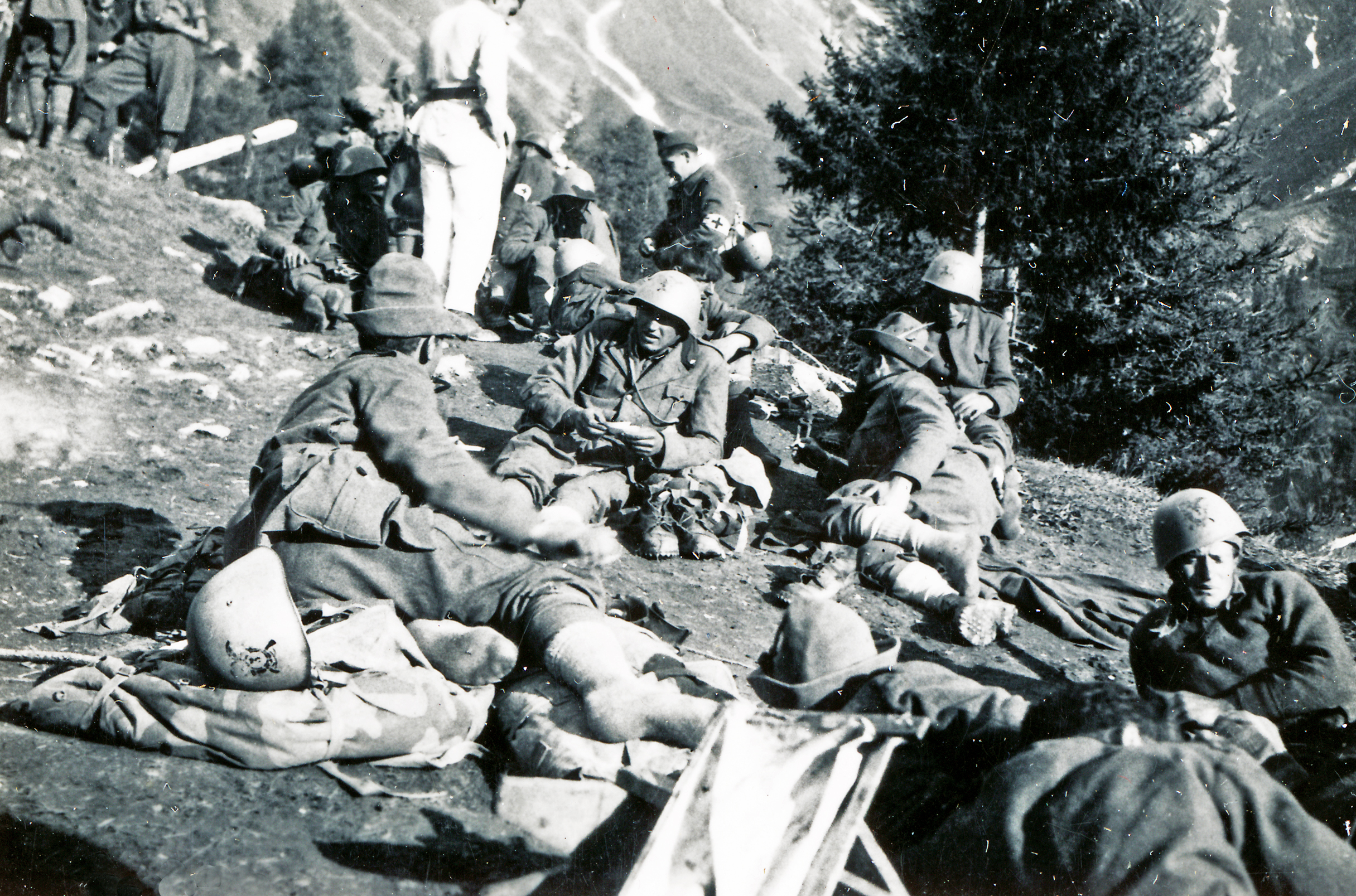
Cover photo: Alpini of the Ceva battalion on the French border (from the website https://www.labatailledesalpes.fr)