
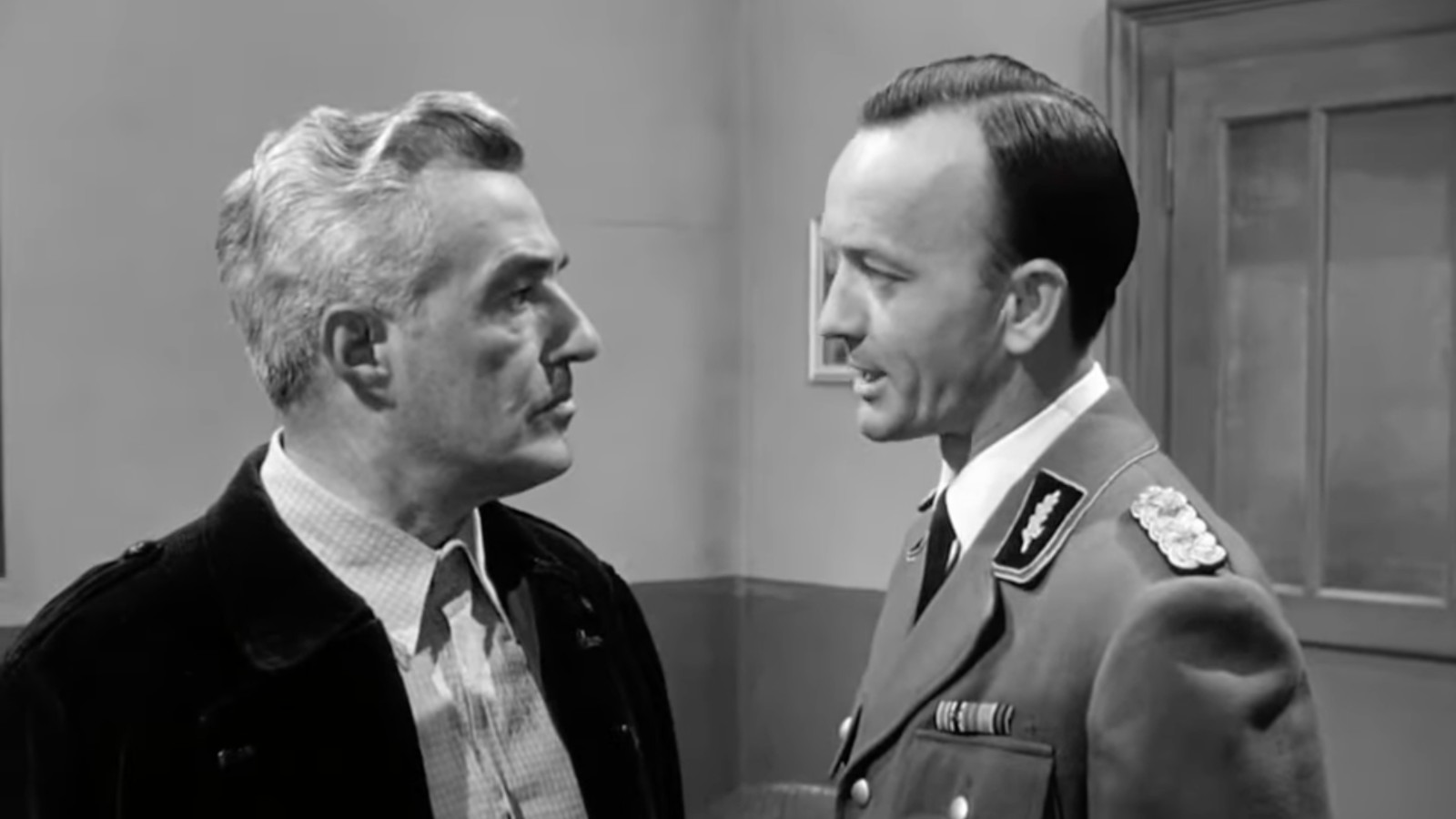
From the drama of «Il generale Della Rovere» to the famous raspberry of «I due marescialli», and on to Colonel Di Maggio in «I due colonnelli»: three very different films and one and the same question. What is left of a man when the moment comes to choose?
There are moments in history when everything that holds a life together — the uniform, the rank, the order received, the oath sworn — suddenly stops working. 8 September 1943 was exactly one of those moments. At 19.42 the voice of Pietro Badoglio announced on the radio the armistice signed in secret five days earlier at Cassibile; a few hours later the King and the government left Rome for Brindisi, while the divisions scattered across France, the Balkans, Greece and the Aegean received no clear order on what to do about the Germans, who until the day before had been allies.
In that command vacuum, hundreds of thousands of Italian servicemen found themselves having to decide on their own. There was no manual, no chain of command to lean on, not even time to think it over. There was only a man, often a very young one, and a question: and now what do I do?
Italian cinema has told the story of that moment in surprisingly different ways. It did so with the spare drama of Roberto Rossellini, but also — and this is no paradox at all — with the comedy of Sergio Corbucci and Steno. Three films, three directors, two great actors in Vittorio De Sica and Totò, and a single knot that always comes back the same: the moment when obedience and conscience part ways, and one has to choose which of the two to follow.
An impostor who becomes the General
Il generale Della Rovere(General Della Rovere), directed by Roberto Rossellini and released in 1959, grew out of a story by Indro Montanelli, who in February 1944 had been locked up in the political wing of Milan’s San Vittore prison and there, for a few days, had crossed paths with a man who presented himself as a general. From that memory Montanelli drew first the short story and then, with Sergio Amidei and Diego Fabbri, the screenplay of the film.
The protagonist, Emanuele Bardone (in Montanelli’s story he is called Giovanni Bertone), is played by Vittorio De Sica and is anything but a hero: a gambler, a braggart, a professional swindler who wheedles money out of the families of political prisoners by promising interventions he cannot deliver. He is no anti-Fascist: he is an opportunist who lives off other people’s desperation.
When the Germans arrest him, Colonel Müller — played by the German actor Hannes Messemer — offers him a deal: his life in exchange for a service. Bardone is to enter San Vittore posing as General Della Rovere, an officer loyal to Badoglio who had been killed by mistake when he landed, and identify among the prisoners the Resistance leader known as «Fabrizio».
What happens next is the moral heart of the film. In the political wing the other prisoners look at him the way one looks at a general: they ask him for comfort, entrust him with messages for their families, stand to attention when he passes. Bardone plays the part, at first out of self-interest. Then something jams. Acting out dignity, day after day, in front of men who are about to die, ends up costing him more than the truth. And when he finally learns who «Fabrizio» is, the swindler does not give him up: he chooses to stay silent and to go to his death in place of the man he had only pretended to be.
Rossellini does not turn this story into a comforting fable. Bardone does not become good: he becomes responsible, which is a harder thing. And Colonel Müller is no comic-strip caricature of a Nazi, but an intelligent, cold man who watches that metamorphosis almost with respect, without ever ceasing to be what he is. It is precisely this refusal of short cuts that makes the film still uncomfortable and relevant today. In 1959 Il generale Della Rovere won the Golden Lion at the Venice International Film Festival, jointly with La grande guerra (The Great War) by Mario Monicelli: two films which, from opposite sides, said the same thing about Italy at war.
It is worth adding a historical note that the film does not tell. The real man with whom it all began was called Giovanni Bertoni: he really was a con man, he really was used by the Germans as an informer, and he was found out and shot at the Fossoli camp in 1944. The character’s moral leap belongs to literature and cinema, not to the historical record. But it is precisely that leap that explains why the film concerns us: because it tells of a possibility, not a statistic.
Vittorio De Sica: when an impostor learns honour
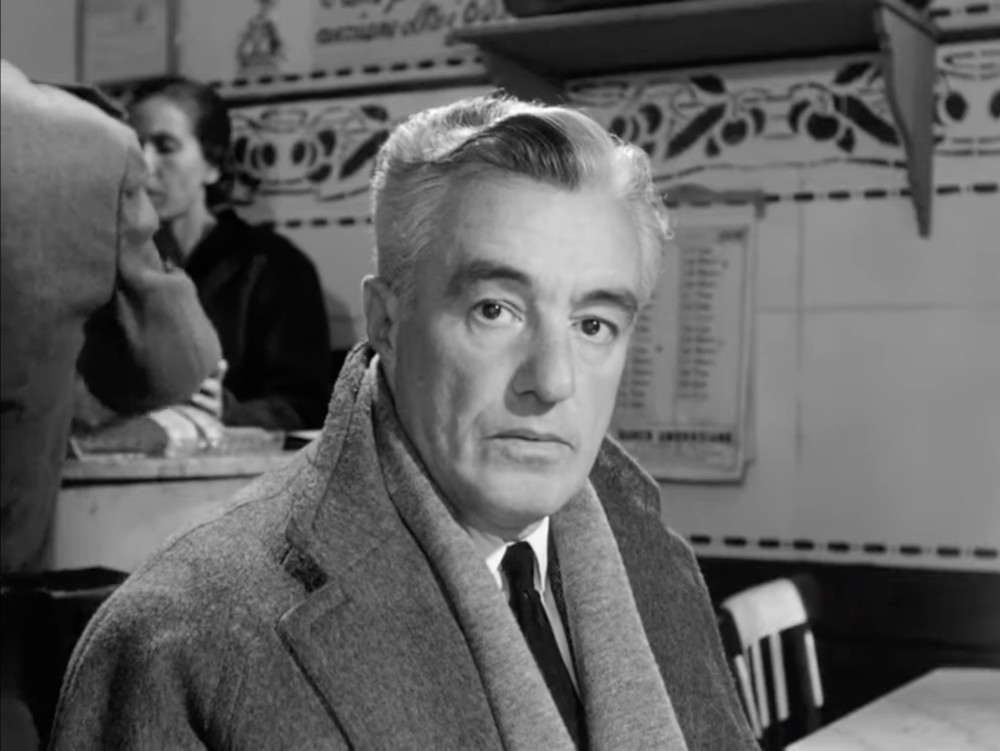
Vittorio De Sica in a scene from Il generale Della Rovere (Roberto Rossellini, 1959). Film still – Wikimedia Commons, public domain.
Born in Sora in 1901 and died in Paris in 1974, Vittorio De Sica was one of the greatest figures of Italian cinema: director of Sciuscià(Shoeshine), Ladri di biciclette(Bicycle Thieves), Umberto D. and Il giardino dei Finzi Contini(The Garden of the Finzi-Continis), and three times winner of the Oscar for Best Foreign Language Film. But throughout his life he was also an actor who accepted almost any part: an inveterate gambler, always short of money, often obliged to act in minor films to fund his own.
That is exactly why Rossellini chose him. No one was better placed to play a man who lives on appearances and who at a certain point discovers that the part he has been playing has stuck to him. When Bardone stops pretending, it is not because he has understood politics: it is because he has understood the way others look at him. It is an honour learned late, almost by contagion. And perhaps that is why, on screen, it is more believable than so much professional heroism.
Then came Totò. And a raspberry was enough
Two years later, in 1961, Sergio Corbucci brought to the screen I due marescialli(The Two Marshals), and the same Italy of 8 September is told in an entirely different register. We are in Scalitto, an imaginary village in central Italy. During a bombing raid a professional thief, Antonio Capurro (Totò), and the carabinieri marshal Vittorio Cotone (Vittorio De Sica once again) end up each in the other’s clothes: Capurro finds himself dressed as a marshal, Cotone as a priest.
The whole comedy springs from that exchange of clothes. The false marshal has to deal with the German command occupying the village; the false priest, who is the real carabiniere, protects evacuees and fugitives and persuades the thief to play a double game. It is a paradoxical tale, and yet it tells a precise historical truth: after the armistice, in hundreds of Italian towns and villages, legitimate authority dissolved, and those who stayed on to hold the line almost always did so without a mandate, improvising, with forged papers and uniforms that were not their own.
And then there is the scene everyone remembers. Facing the German officer, Totò — in a marshal’s uniform, that is, disguised as authority when he is no authority at all — blows a pernacchia (a raspberry). He does not shoot, he does not harangue, he makes no patriotic speeches: he puffs out his cheeks and blows. In that tiny gesture lies a whole Italian popular tradition: power that takes itself seriously is disarmed by ridicule. Five years earlier, in L’oro di Napoli (The Gold of Naples, 1954), directed by De Sica himself, the episode «Il professore» with Eduardo De Filippo had even made the raspberry a technique to be taught, the weapon of those who have no other against the arrogance of the powerful.
It would be wrong to read genuine resistance into it: a raspberry liberates no village and saves no life. But it is the first gesture of someone who refuses to be wholly afraid, and that is why Italians loved it so much. In a season when obedience had become a habit, laughing at those in command meant remembering that you did not belong to them.
Totò: when laughter becomes a form of resistance
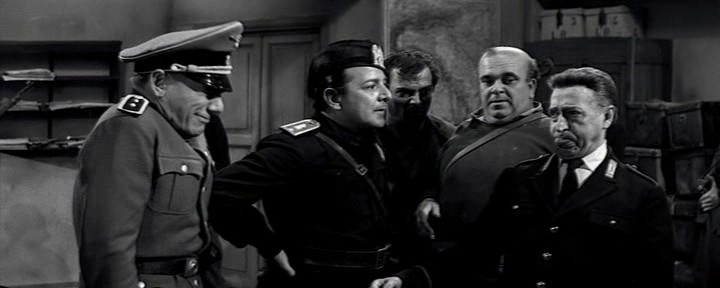
Totò in the famous raspberry scene from I due marescialli (Sergio Corbucci, 1961). Film still – Wikimedia Commons, public domain.
Antonio de Curtis, known to everyone as Totò, was never a political actor. And yet his films of the 1960s are crossed by a recurring figure: the small, frightened, powerless Italian who, faced with authority, finds his only weapon in his body, his face, his voice. Not rhetoric: ridicule.
It is a minimal form of freedom, but not a negligible one. Whoever laughs at an authority is saying, without saying it, that this authority does not own him. In an occupied country, where fear was the rule and silence was prudence, this was enough to draw a line. It was not medal-winning courage: it was the spark from which, for many, real courage later began.
Totò becomes a colonel
In 1962 Steno directed I due colonnelli(The Two Colonels), and Totò wears the rank of a colonel in the Italian Army: he is Antonio Di Maggio, commander of the garrison of Montegreco, an imaginary village on the border between Greece and Albania. Facing him is the British colonel Timothy Henderson, played by the American actor Walter Pidgeon; at his side is Sergeant Major Quaglia, played by Nino Taranto.
For much of the film we laugh: the village passes from one army to the other with the ease of a revolving door, the two colonels vie for the same positions and the same female attention, and the war looks like a performance among slightly ridiculous gentlemen. Then, all of a sudden, the comedy changes temperature.
The German order arrives to destroy the village. Di Maggio is a career officer, a man who has spent his life carrying out orders and having them carried out; and it is he who stops. He refuses. Not out of political calculation, not because he has chosen a side: because that order, quite simply, cannot be reconciled with who he is. He is arrested and sentenced to death, and is saved only because history — 8 September, the arrival of the British — reaches him just in time.
It is a short scene, set within a comic film, and perhaps that is precisely why it strikes so deep. It tells us that conscience is not the preserve of professional heroes: it can light up in an ordinary man, perhaps clumsy, perhaps vain, at the very moment he is asked to do something he cannot do. And that is exactly the situation in which, after the armistice, thousands of real Italian officers and soldiers found themselves, with no script and no guaranteed happy ending.
8 September 1943: when there were no easy answers any more
The armistice had been signed at Cassibile on 3 September 1943 and was made public on 8 September at 19.42. Badoglio’s proclamation ordered an end to hostilities against the Anglo-Americans and a response «to any attacks from any other quarter»: a formula that never named the Germans and left it to local commands to interpret it. The King and the government left Rome; the chain of command broke.
Germany responded with Operation «Achse», planned well in advance: to disarm and capture the Italian forces in Italy and in all the occupied territories. About a million Italian servicemen were captured; more than 800,000 were deported to the Reich. On 20 September 1943 Hitler ordered that they were not to be considered prisoners of war but «military internees» (IMI), thereby removing them from the protection of the Geneva Convention.
Each of them was repeatedly offered a way out: join the Italian Social Republic and Germany, and go home in uniform. About 600,000 said no, and remained in the camps until the end of the war. Between 37,000 and 50,000 of them never came home. It was, in effect, the largest mass act of refusal in Italian history: silent, unarmed and without proclamations.
Three films, the same question
Emanuele Bardone, Antonio Capurro, Antonio Di Maggio. A swindler, a thief, a career officer. Three characters who have nothing in common, and who are nonetheless very much alike.
All three start from a mask: a uniform not their own, a usurped rank, a role being played. All three arrive, by different routes, at the same point: a limit they are not prepared to cross. Bardone finds it in the silence that saves another man. Capurro finds it in a vulgar gesture that restores to him the dignity of having no masters. Di Maggio finds it in an order he refuses to carry out.
None of the three was born a hero, and none of them chooses because he has understood history: they choose because at a certain point they understand themselves. It is an important difference, and the three films portray it honestly. There is no good Italy set against a bad Germany. There is a clear-headed, civilised German colonel manipulating a corrupt Italian; there are Italians who grow rich on the occupation and Italians who denounce their neighbours; there are Germans who carry out criminal orders and others who, in historical reality, refused to do so. War, as we have already recounted on these pages when writing about a Japanese interpreter buried in a cemetery in the Veneto, does not choose a homeland: it chooses individual destinies.
If these three films still speak to us, it is because they do not ask us to take sides after the fact, when the right answer is already printed in the history books. They ask something harder of us: to imagine not yet knowing it.
The Alpini and the meaning of the choice
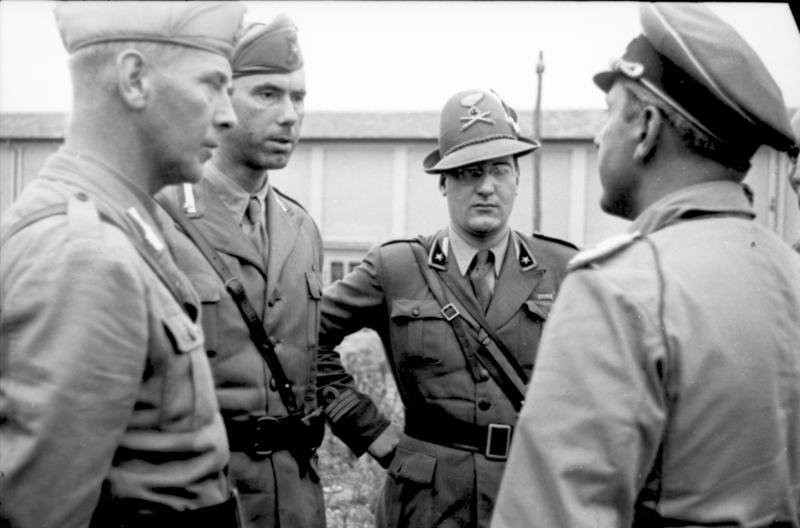
Italian officers captured by German paratroopers in the days immediately following 8 September 1943. German propaganda photograph. Source: Bundesarchiv, Bild 101I-304-0604A-31 / Otto / CC-BY-SA 3.0 (Wikimedia Commons).
Now let us close our eyes and take the screen away.
Let us imagine a twenty-year-old lad. Not a character: a real lad, from Salce, from Cavarzano, from the Val Belluna. He went off to the Alpini because that was what one did, he learned to carry the load, to march, to trust his corporal. On the evening of 8 September 1943 he is two thousand kilometres from home — in Montenegro, in Greece, in Albania, in the western Alps — and from a crackling radio he hears that the war is over. But nobody tells him whom he is no longer to fight, and nobody tells him what he is to do tomorrow morning.
Around him the officers talk in low voices. Some say to hand over their weapons and wait, that the Germans are still comrades. Some say to disappear into the woods. Some say to fight. The lad is twenty, he is hungry, he is afraid, he has a mother he has not seen for two years. And he has to decide within a few hours.
It is not a choice between good and evil: it is a choice between different risks, all of them enormous, made without information and without guarantees. Those who handed over their weapons were not cowards: many ended up in a cattle truck all the same. Those who ran were not automatically brave: some got home, others were shot by the roadside. Those who stayed to fight often did so not for a flag, but because they could not do otherwise.
The Alpini lived through that night everywhere. The Belluno battalions of the 7th Alpini Regiment knew the French front, the Greek-Albanian front, the guerrilla war in Montenegro and then, for a great many, deportation to Germany. In Montenegro the units of the 1st Alpine Division «Taurinense» and of the «Venezia» Infantry Division, instead of surrendering, stayed under arms alongside the Yugoslav partisans, and on 2 December 1943, in the countryside around Pljevlja, formed the Italian Partisan Division «Garibaldi»: about 16,000 men at the outset, almost a third of whom were killed or went missing. The survivors returned to Italy only on 8 March 1945.
Then there is the silent choice of those who had no unit to follow and had to fend for themselves. This is the story of Duilio Pitto, a founding member of our Group, who after 8 September escaped from Fiume with forged leave passes: he too, like Bardone, saved his life thanks to a false document. With one not insignificant difference: his was not a deception in the service of the Germans, but against them. And there is the generation of very young officers fresh from the cadet courses, such as the «Ragazzi di Aosta ’41» (the Lads of Aosta ’41), who at barely twenty found themselves deciding not only for themselves but for their men.
That is why, for us Alpini, those three films are not just cinema. Bardone, Capurro and Di Maggio are invented characters; but the question that runs through them is the same one that, on the night between 8 and 9 September 1943, ran through thousands of penne nere (the Alpini’s black feathers, and so the Alpini themselves) of flesh and blood. And the answer they gave did not come from a manual or from a superior’s order: it came from who they were.
Remembering them does not mean consigning them to a monument. It means recognising that dignity, when it really matters, is never comfortable: it comes at a cost, and the bill always reaches the wrong person, at the wrong moment, without warning.
«What should they have done?»
«In their place,
what would I have done?»
The second question is the only one that really matters. And it has no comfortable answer.


